


The short answer
On an American Standard furnace, a pressure switch code means the furnace couldn’t prove its vent was clear, so it won’t light. In Northern Virginia the switch itself is rarely what failed. It’s usually a PVC vent blocked by snow, leaves or a nest, a condensate trap or drain that backed up, a split hose, or an inducer motor that’s slowing down. On the door display you’ll see E3.2 (the switch didn’t close), E3.1 (it was closed when it should have been open) or E09 (the drain side). Older boards blink 3.

The pressure switch codes
From the manufacturer’s S-series furnace manual, which covers American Standard’s Silver S9X1 and Gold S9X2.
Swipe to see all columns →
Swipe to see all columns →
| Code | What it means |
|---|---|
| E3.2 | First stage pressure switch didn’t close: vent, drain or inducer |
| E3.1 | First stage pressure switch closed when it should be open |
| E3.3 / E3.4 | The same two faults on the second stage switch (S9X2 only) |
| E09 | Inducer limit or condensate pressure switch open, usually a backed up drain |
| 3 blinks | Older boards: pressure switch, so vent, drain or inducer |
The $67 Heating Check
We check your furnace, heat pump or boiler before winter. Through December 31. See the offer
What E3.2 looks like in your basement
The thermostat calls for heat. The inducer, the small motor near the top of the furnace, starts and hums. Normally the igniter glows and the burners light shortly after. With E3.2 they never do: the board waits for the pressure switch, it doesn’t close, and after a few tries the furnace stops and flashes the code.
Work through it in this order
- The pipes outside. Two white PVC pipes on the side of the house or the roof. Clear snow, leaves or a nest by hand. A screen that iced over counts too.
- The drain. Look at the trap and the drain hose beside the furnace. Standing water or sludge is a clog. If there’s a condensate pump, check its tank: full and humming means the pump is dead. E09 points straight here.
- One power cycle. Set the thermostat to off. Turn off the breaker or the switch for the equipment, wait about five minutes, turn it back on and set the thermostat back. Do it once.
- If the code comes back, stop and call. Don’t tap the switch, pull the hoses or jumper anything. The switch is what keeps exhaust out of the house.
Why it trips
The vent
High-efficiency American Standard furnaces vent through PVC, often out a side wall close to the ground. Ice or drifted snow over the pipe is the January version of this call; leaves and nests are the October version.
The drain
A high-efficiency furnace makes water every time it runs. If the trap clogs with sludge or the line freezes where it runs outside, water backs up where the switch reads and it can’t close. Our frozen and clogged drain guide covers the freeze.
The hose
A small rubber hose runs from the switch to the inducer side of the furnace. When it cracks, sags with water in it, or slips off its port, the switch sees no suction.

The inducer
Worn bearings slow it down, and slow means weak suction. An inducer that grinds or rattles, worse on cold starts, is on its way out.
The switch
Last on the list. A tech proves it with a manometer: if the inducer makes enough suction and the switch still won’t close, the switch gets replaced.
Two-stage furnaces have two switches
The Gold S9X2 and other two-stage American Standard furnaces have a second switch for high fire, and E3.3 and E3.4 are the same two faults on that one. A partly blocked vent can let the furnace run fine on low and trip on high, which is why you might get heat on mild days and a code on the coldest ones.
What the visit looks like
The tech reads the fault history (Menu to L6F, then Option), watches a start-up, measures the suction at each switch against the rating printed on it, clears the trap and drain, checks the hoses and the vent run, and listens to the inducer. You get the cause and the price before any part goes in.
Every American Standard furnace code: American Standard furnace codes. Thermostat and heat pump alerts: American Standard error codes. The same switch on other brands: Trane 3 flashes, York, Goodman and Lennox. If it lights and then drops out, that’s the flame sensor. Every brand is in our error codes and warning lights guide, and our American Standard repair page has what we fix and what it costs.
The system we put in first
Built to take a beating. Put in by our crew.
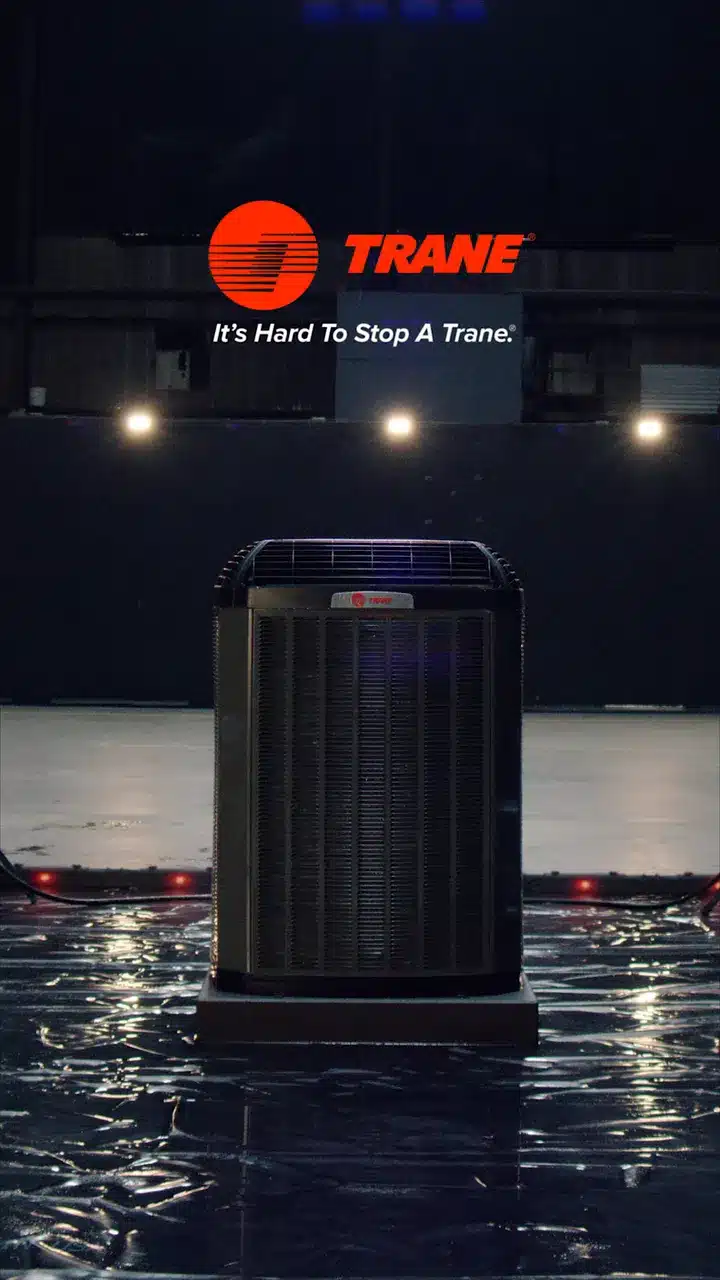
Heat lamps, snow and rain on one outdoor unit: that’s Trane’s own film. We’re a Trane Comfort Specialist, on Trane’s own dealer locator, and when you pick a Trane, our crew puts it in.
Films: Trane’s own.
Book an American Standard repair
Call (703) 997-9757 or book online. A diagnostic visit is $99, and the tech reads the code, finds the part that set it and gives you the price before any work starts. We answer day or night. Our heating check is $67 per system, through December 31: furnace, heat pump or boiler. If someone already quoted you a new system, our free second opinion looks at it first. Rated 5.0 stars across 1,138 reviews on Google, Angi, Yelp, the BBB and Facebook, Virginia Class A license 2705192276.
Questions people ask
What does E3.2 mean on an American Standard furnace?
The first stage pressure switch didn’t close, so the furnace won’t light. The usual causes are a blocked vent, a backed up condensate drain, a split hose or a weak inducer.
What does E09 mean on an American Standard furnace?
The inducer limit or the condensate pressure switch opened. Most of the time the condensate drain is backed up, so check the trap and the pump first.
What does 3 blinks mean on an older American Standard furnace?
The pressure switch didn’t do what the board expected. Same causes as E3.2: the vent, the drain, the hose or the inducer.
Should I replace the pressure switch myself?
No. Most of the time the switch is fine and something else tripped it, and a switch that’s bypassed or wrong for the furnace can let exhaust into the house.


