


The short answer
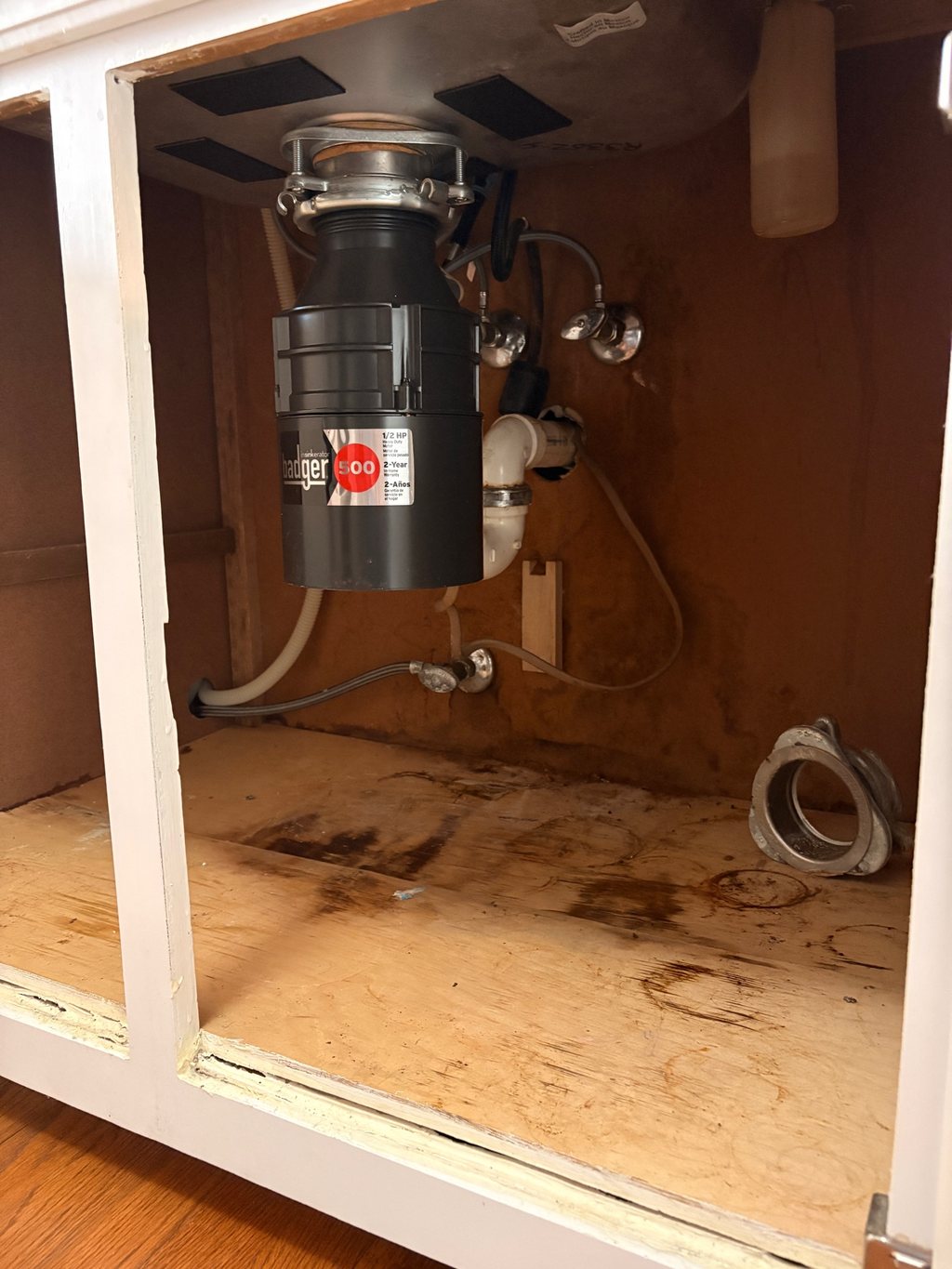
The reset button on a garbage disposal is a small button, usually red, on the bottom of the unit, the side facing the cabinet floor. It’s a thermal overload: a safety switch that cuts the motor when it runs too hot. When it trips, it sticks out about a quarter inch. In a Northern Virginia kitchen, it’s the first thing to check when a disposal goes dead. Turn the wall switch off, reach under with a flashlight, and press it in firmly until it clicks. If it won’t stay in, the motor is still hot. Give it 10 to 20 minutes and try again.
Pressing reset doesn’t fix what tripped it. Something made the motor work too hard: a jam, a load of peels, too little water, or a motor near the end of its life. One trip after a big load is nothing. A disposal that keeps tripping is telling you which of those it is, and one of them means it’s done.
How to reset it, step by step
- Turn the disposal’s wall switch off. If it plugs in under the sink, unplug it. You don’t want it starting the moment the button goes in.
- Find the button on the bottom of the disposal. It’s small, usually red, and when it’s tripped it sits out past the housing.
- Press it firmly until it clicks and stays in. If it pops right back out, the overload hasn’t cooled. Wait 10 to 20 minutes and press it again.
- Turn on the cold water, then the switch. Let it run with water for 15 seconds before you put anything in it.
- If it hums and doesn’t spin, it’s jammed. Turn it off and work it loose with the hex wrench in the center of the bottom (how to unjam a disposal). Then reset it again.
- If there’s no sound at all, go through the power checks next.
$29 Water Test and Plumbing Safety Check
A licensed plumber tests your water's hardness at your kitchen table, in grains per gallon, checks your water heater's age and health and walks the plumbing with photos. Book the $29 test
No sound at all after the reset
If you pressed reset and the switch does nothing, no hum and no click, the disposal isn’t getting power. Check these in order:
- The breaker. Look in the panel for a breaker that’s off or sitting in the middle. Disposals are often on their own circuit, and sometimes share one with the dishwasher.
- A GFCI outlet. If the disposal plugs in, its outlet may be protected by a GFCI, the kind with test and reset buttons, and that GFCI may be one on the counter, not the one under the sink. Press its reset.
- The plug. Cabinets under a sink get crowded, and plugs get knocked half out.
- An air switch. Some kitchens have a round button on the counter instead of a wall switch. It pushes air down a thin tube to a control box under the sink, and that tube can pop off.
- The wall switch. If everything else checks out, the switch or the wiring to it has failed.
If it has power, the reset is in, and it still makes no sound, the motor is done.
Why it keeps tripping
Swipe to see all columns →
Swipe to see all columns →
| What happens | Why | What to do |
|---|---|---|
| Trips once, after a big load of peels or rinds | The motor overheated grinding something stringy or starchy | Reset it. Next time, feed it slower with more cold water. |
| Hums, then trips, every time | A jam: something hard wedged between the impeller and the grinding ring | Work it loose with the hex wrench (the steps). |
| Trips after a few seconds, and the hex wrench turns freely | The motor or its bearings are wearing out | Plan the replacement. |
| Won’t stay in, even after it’s cooled for half an hour | The overload switch or the motor behind it has failed | On a household disposal, that’s a replacement. |
| Trips, and the cabinet floor is wet | Water is getting into the housing | Replace it. A disposal leaking from the bottom can’t be repaired. |
A disposal doesn’t show an error code. The reset button is its only warning light, so how often it trips is the whole diagnosis. Codes from the rest of the house are in error codes and warning lights.
What makes it trip, and how to stop it
- Stringy and starchy food: celery, corn husks, onion skins, potato peels, pasta and rice. They wrap around the plate or swell, and the motor strains (what never goes down a drain).
- Too little water. Run cold water before, during, and for 15 seconds after. Cold keeps grease solid so it grinds and moves on, instead of coating the chamber.
- Too much at once. Feed it a handful at a time.
- Bones, pits, shells, and a dropped spoon. Those are the jams.
- A disposal too small for the kitchen. A 1/3 horsepower unit, the usual builder model, works at its limit in a house that cooks every night (which size to buy).
Disposals last about eight to twelve years. Past that, a button that trips every week, a hum with nothing jammed, a leak from the bottom or rust on the housing all point the same way. A new disposal installed runs $550 to $900 in Northern Virginia, or $350 to $500 if you supply the unit. It’s a short job: watch one go in.
One more thing to check while it’s out: if the sink was slow before the disposal quit, the drain past it is part of the problem, and a new disposal won’t fix that (kitchen sink backing up).
When to call
Call when it hums and the wrench won’t turn it, when it trips every time you run it, when there’s water under it, or when it has power and still won’t run. SwiftPro plumbers handle garbage disposal repair and replacement and check the drain past it on the same visit. You get the price before the work starts. There’s $50 off any plumbing repair over $400, and the whole-house plumbing inspection is included with any repair, a $149 value (every current deal).

Book it
Book a garbage disposal visit. Call (703) 997-9757, or book online from goswiftpro.com/cookiesoffer and a box of warm cookies comes with the visit. Our plumbers work in Ashburn, Leesburg, Sterling, Herndon and across Northern Virginia, 24 hours a day. Rated 5.0 stars across 1,138 reviews on Google, Angi, Yelp, the BBB and Facebook, Virginia Class A license 2705192276.
Questions people ask
On the bottom of the unit, the side facing the cabinet floor. It’s small and usually red. When it’s tripped it sticks out about a quarter inch.
The motor is still too hot. Wait 10 to 20 minutes and press it again. If it still won’t stay in once it’s cool, the overload switch or the motor has failed, and on a household disposal that means replacing it.
Something makes the motor work too hard: a jam, too little water, a big load of peels or starch, or a motor wearing out. If it trips every time with nothing in it and the hex wrench turns freely, the motor is going.
What if my garbage disposal won’t turn on after I press reset?
Check the breaker, any GFCI outlet in the kitchen, the plug under the sink, and the air switch tube if you have one. If it has power and still makes no sound, the motor is done.
How do you reset an InSinkErator garbage disposal?
Turn the switch off, find the red button on the bottom of the unit, and press it until it clicks and stays in. Run cold water, then turn the switch back on. If it hums, it’s jammed: work it loose with the hex wrench in the center of the bottom first.
How much does it cost to replace a garbage disposal?
In Northern Virginia, SwiftPro installs a new disposal for $550 to $900, or $350 to $500 if you supply the unit.


