
The short answer
A water heater thermocouple is a safety sensor that sits in the pilot flame. As long as the flame heats it, it makes a small voltage that holds the gas valve open. If the pilot goes out, the voltage drops and the gas shuts off within a minute or so. In Northern Virginia, a bad thermocouple is the most common reason a gas tank’s pilot lights and then goes out the moment you let go of the knob.
How it works
A thermocouple is two different metals joined at the tip. Heat that joint and it makes about 20 to 30 millivolts, thousandths of a volt, through the copper lead back to the gas control. Inside the control, that tiny current holds a small electromagnet that keeps the gas valve open. No flame, no current, no gas. That’s why you hold the knob down while you light the pilot: you’re holding the valve open by hand until the thermocouple warms up enough to take over.
$99 Water Heater Flush
We drain and flush the tank, check the anode rod and test the relief valve, then go through the house's plumbing with photos, included. See the flush
Want your own number before anyone comes out? The water heater estimator prices your house in a few questions.
Signs it’s failing
- The pilot lights while you hold the knob, then goes out when you let go.
- The pilot stays lit only if you hold the knob a long time, two minutes or more.
- The pilot goes out at random, days apart, and relights fine.
- The tip looks burned, cracked or pitted, or it’s bent out of the flame.
- You’re relighting it more and more often over a few weeks.
A pilot that goes out on its own can also be a dirty pilot, a draft or a clogged air screen. Our post on why a pilot keeps going out sorts those out by when it happens.
How we test it
We check it with a meter that reads millivolts, with the pilot burning, and look at the flame while we’re there. A low reading means the part is worn. A good reading with a pilot that still drops out points at the flame, the gas control or the air supply instead. A loose nut where the lead screws into the gas control causes the same symptoms as a dead thermocouple, so that gets checked first. It takes a few minutes and keeps you from buying a part that wasn’t the problem.
Thermocouple or thermopile?
Tanks with a status light on the gas control, the kind that blinks, use a thermopile instead. It’s a bundle of thermocouples in one probe, and it makes several hundred millivolts, enough to run the control’s electronics too. When it gets weak, the light flashes twice between pauses. Same idea, different part, and they aren’t interchangeable. The blinking light guide covers what each flash count means.
Can you replace it yourself?
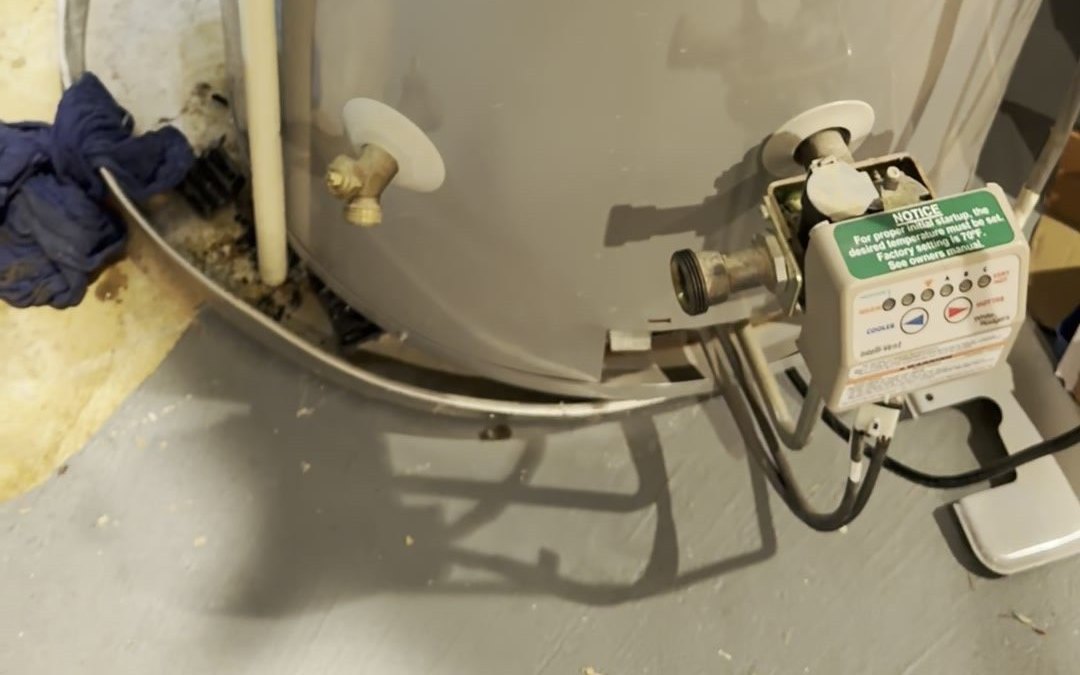
On an older tank with an open burner door, plenty of homeowners swap a thermocouple themselves: gas off, unscrew the old one from the gas control and the pilot bracket, fit the same length, snug it finger tight plus a quarter turn, relight. On most tanks made since 2003, it isn’t that simple. Those tanks have a sealed burner chamber, and the thermocouple comes as part of a pilot assembly kit with a new door gasket. Getting the seal wrong defeats the safety it’s there for. That one’s a plumber’s job.
Furnaces have one too, sort of
An old furnace with a standing pilot uses the same kind of thermocouple, and the furnace pilot light post covers those. Modern furnaces use a flame sensor instead: a bare metal rod in the burner flame that the control board sends a tiny current through. It does the same job, proving there’s a flame, but it fails differently. It gets coated, and the furnace lights, runs a few seconds and shuts off. Most of the time it gets cleaned, not replaced. See the York flame sensor post, the American Standard one, or our flame sensor video.
When the thermocouple isn’t worth it
The part is small. The question is the tank. If yours is past 10 years, here’s how to read its age and how long tanks last. A thermocouple on a 13-year-old tank buys a little time on a tank that’s close to done anyway, and the water heater estimator shows your installed price first, and $500 comes off it. On a younger tank it’s a normal repair, and while we’re there, the water heater flush is $99 (normally $199): we drain and flush the tank, check the anode rod and test the relief valve.
Book it
A plumbing diagnosis visit is $49, or $250 after hours, and you get the price of the fix before we start. Call (703) 997-9757, day or night, or book the water heater flush from goswiftpro.com/cookiesoffer by November 30 and a box of warm MOLTN cookies comes with it. Every current deal is on our offers page. Rated 5.0 stars across 1,138 reviews on Google, Angi, Yelp, the BBB and Facebook, Virginia Class A license 2705192276.
Questions people ask
How do I know if my water heater thermocouple is bad?
The pilot lights while you hold the knob and goes out when you let go. A plumber confirms it with a millivolt meter and checks the connection at the gas control.
What’s the difference between a thermocouple and a thermopile?
A thermopile is a bundle of thermocouples that makes several hundred millivolts instead of 20 to 30. Tanks with a blinking status light use a thermopile. The parts aren’t interchangeable.
Do all water heaters have a thermocouple?
No. Electric tanks, tankless heaters, electronic ignition tanks and tanks with a status-light control don’t. Standing pilot gas tanks do.
How long does a water heater thermocouple last?
Many last 10 years or more. One that sits in a dirty or misaligned pilot flame wears out faster.
Can I replace the thermocouple on a sealed water heater?
On most tanks made since 2003, the thermocouple is part of a sealed pilot assembly with a new door gasket. That’s a plumber’s job, because the seal is the safety feature.