


The short answer
Tree roots get into a sewer line through the joints and cracks, where the pipe seeps a little water into the soil. In Northern Virginia that’s mostly older clay, cast iron and Orangeburg lines under yards with big trees. The signs show up months before a backup: drains that slow down again a few weeks after they’re cleared, a toilet that gurgles, the basement drain backing up first. A root killer slows them down. Cutting or jetting the line clears them. Only sealing or replacing the pipe keeps them out.
How roots get in
Roots don’t break into a sound pipe. They follow water. Older sewer lines were laid in short sections joined end to end, and every joint is a seam where a little water and warm air seep out. A root as thin as a hair finds the seam, slips in, and feeds on what flows past. Inside, it grows into a mat that catches paper and grease, and the line gets slower every season.
Clay pipe, the reddish brown kind, and cast iron with packed joints are the usual victims, along with Orangeburg fiber pipe. A PVC line with glued joints is much harder for roots to get into, though a cracked or shifted one can still let them in. The trees that cause the most trouble are fast growers with thirsty roots, like willows, silver maples and poplars, but any tree or big shrub close to the line can do it.

Free Second Opinion
Holding a big HVAC or plumbing quote? A tech looks at the system you were quoted on and tells you what it actually needs, with our price if you want it. Get a second opinion
Signs roots are in your line
- The main line clogs, gets cleared, and slows down again in a few weeks or months. Roots don’t wash out, and cutting them back is like mowing.
- Several drains are slow at once, worst on the lowest floor.
- A toilet gurgles or bubbles when the washer drains or the tub empties. Why a toilet gurgles.
- The basement floor drain or a basement shower backs up first. Floor drain backing up.
- A strip of lawn over the line grows greener, faster or soggier than the rest.
- Late in the game, a low spot or a small sinkhole along the path of the line.
Do root killers work?
Partly. Copper sulfate, the blue crystals sold as root killer at the hardware store, kills the roots it touches inside the pipe, and the dead roots break down and wash away over the next few weeks. Two things matter. The label says to put it in through a toilet, not a sink or a tub, because copper sulfate corrodes metal drains and traps. And it can’t do anything in a line that’s already stopped up, because it just sits in the standing water. Read the whole label and follow it.
Foaming root killers are a different product. The foam fills the pipe, so it reaches roots hanging from the top of the pipe that crystals in the bottom water never touch. Either way, a root killer treats the roots. It doesn’t close the joint they came in through, so they come back. Regular drain cleaners aren’t made for roots at all, and Drano is a bad bet on old pipe anyway.
What actually clears them
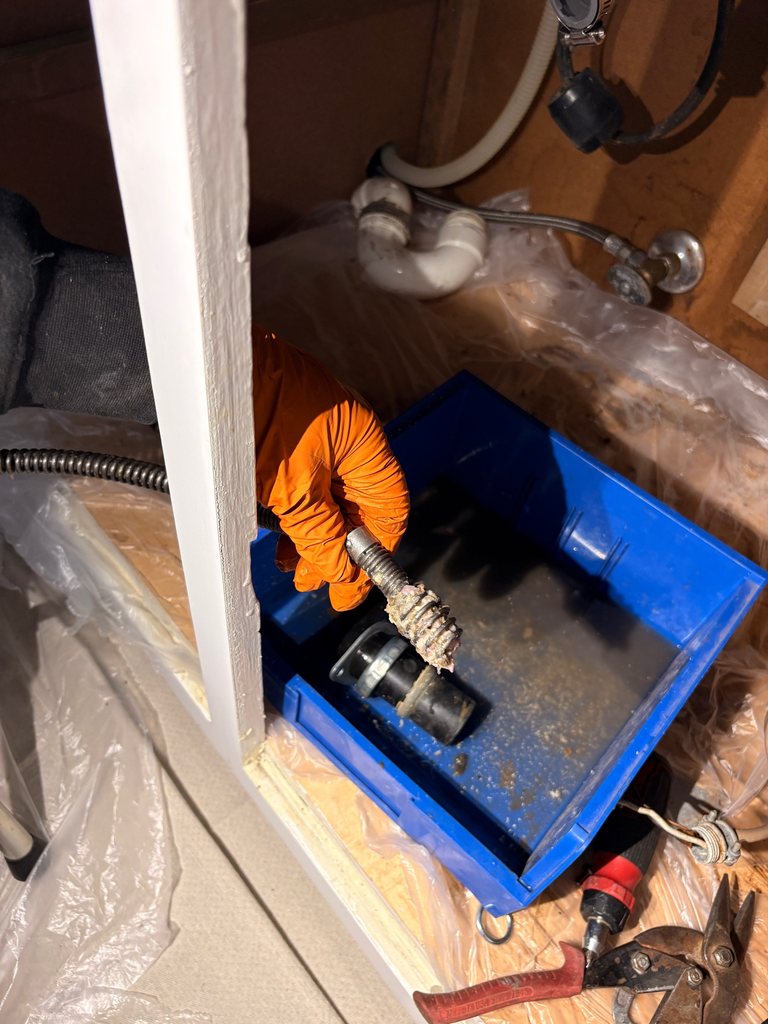
Two tools, often used together. A drain machine with a cutting head goes in through the cleanout and cuts the roots back to the pipe wall, which opens the line the same day. Then hydro jetting washes out the root fibers, grease and sludge the cutter leaves behind, so the pipe is back closer to its full size. Clearing the main line runs $550 to $1,650. Hydro jetting vs snaking explains when each one is the right call.
Then the camera. A camera down the line, $89 added to a visit, shows where the roots are coming in, how many joints, and whether the pipe is cracked, shifted or still round. You see the footage, and that tells you whether to keep cleaning or fix the pipe. When a sewer camera inspection is worth it.
Keeping them out for good
Cutting is maintenance. Roots grow back from what’s left in the joint, so a line with roots at a joint or two often ends up on a yearly cleaning. That’s a fair plan for a line that’s otherwise in good shape.
When roots are in a lot of joints or the pipe is cracking, the fix is the pipe itself. A liner cured inside the old pipe seals every joint, so roots have nowhere to get in, without trenching the yard. Where the pipe has collapsed or sagged, a new PVC line goes in. Trenchless sewer repair explains both, and what a new sewer line costs in Northern Virginia has the prices with the monthly payments next to them.
Planting a tree? Keep it well away from the sewer line. If you don’t know where the line runs, start at the cleanout (where your sewer cleanout is), and a camera with a locator can mark the path on the ground.
Don’t wait for the backup
Roots in a sewer line don’t go away on their own. They grow every season, and the line clogs on the day the house is full of guests. If your drains have slowed down twice in a year and there are big trees out front, get the line looked at while it’s still a choice. Slow drains and a gurgling toilet are your house’s warning lights. Error codes and warning lights at home covers the rest of them.
When you’d rather we do it
A sink clogged at the trap is $99 with our sink clearing offer, up to the P-trap. A toilet, tub, shower or any drain past the trap is drain cleaning, $200 to $800. The main line to the street runs $550 to $1,650, and when grease or roots keep coming back, hydro jetting clears the pipe wall. You get the price before we start. A plumbing diagnosis visit is $49, or $250 after hours.
Call (703) 997-9757, day or night, or see every current deal on our offers page. Rated 5.0 stars across 1,138 reviews on Google, Angi, Yelp, the BBB and Facebook, Virginia Class A license 2705192276.
Questions people ask
How do I know if tree roots are in my sewer line?
Drains that slow down again a few weeks after they’re cleared, gurgling toilets and the lowest drain backing up first are the usual signs. A sewer camera shows the roots for sure.
Does copper sulfate kill roots in a sewer line?
It kills the roots it touches inside the pipe, slowly. Put it in through a toilet, never a sink or tub, because it corrodes metal drains. It can’t clear a line that’s already stopped up.
How do plumbers get tree roots out of a sewer line?
A drain machine with a cutting head cuts them back through the cleanout, and hydro jetting washes out what’s left. A camera afterward shows where they’re getting in.
Will roots come back after the line is cleared?
Yes, as long as the joint they came through is still open. Lining the pipe or replacing the bad section is what keeps them out.
Can tree roots break a sewer pipe?
Roots mostly get in through joints and cracks that are already there, then widen them as they grow. Over years that can crack or shift an old clay or fiber pipe.


