


The short answer
That bang in the wall when the washing machine or dishwasher shuts off is water hammer. Water in Northern Virginia house pipes moves fast, a valve snaps shut, and the whole column of water stops at once and slams into the end of the line. It’s loud, and over time it loosens joints and wears out valves. The usual fixes are lower house pressure, a small arrestor at the machine, and straps on loose pipes.
What causes it
Anything that shuts water off fast. Washing machines and dishwashers are the usual ones, because their valves are electric and close in a blink. Ice makers, single-handle faucets snapped shut and toilet fill valves do it too. Two things make it worse: high water pressure, which means the water hits harder, and loose pipes, which turn that hit into a bang you hear across the house.
$29 Water Test and Plumbing Safety Check
A licensed plumber tests your water's hardness at your kitchen table, in grains per gallon, checks your water heater's age and health and walks the plumbing with photos. Book the $29 test
Check your water pressure
A pressure gauge from the hardware store screws onto an outside hose spigot. Turn the spigot on with nothing else running in the house and read it. Most plumbing codes cap house pressure at 80 psi, and 50 to 70 feels good at the faucet and is easy on everything connected to it. Over 80 means the pressure reducing valve isn’t doing its job, or the house doesn’t have one. Here’s what a pressure reducing valve does and when it fails. If your pressure is low instead, see low water pressure in the whole house.
The fixes
Swipe to see all columns →
Swipe to see all columns →
| Fix | What it does | When it fits |
|---|---|---|
| Adjust or replace the pressure reducing valve | Brings the house down to 50 to 70 psi | Pressure over 80, or bangs all over the house |
| Water hammer arrestors | A small sealed cushion that soaks up the shock | Bangs at the washer or dishwasher |
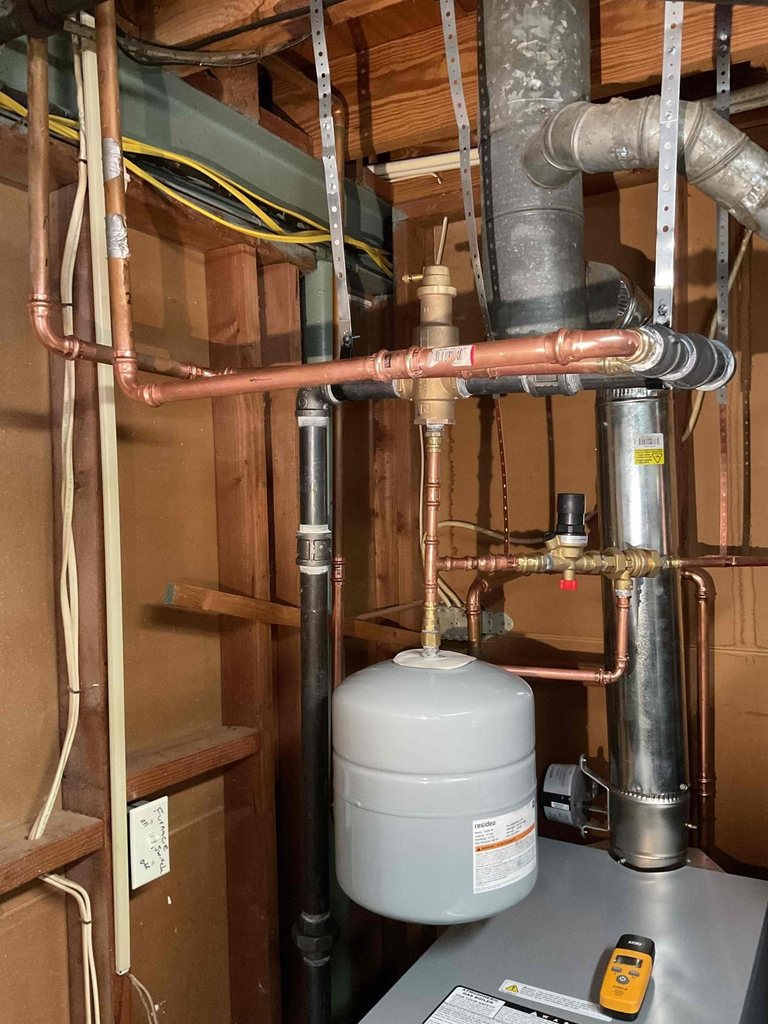
| Recharge the air chambers | Refills the old capped pipe stubs with air | Older homes that used to be quiet |
| Strap loose pipes | Stops the pipe from moving and knocking on the framing | A knock in one spot |
Arrestors are the most common fix we put in. They thread onto the washer valves or go in under the kitchen sink, and they keep working for years. If the bangs are everywhere, though, start with the pressure, because an arrestor is fighting the same problem at one spot.
Recharge the air chambers yourself
Many older houses were built with short capped pipes next to each faucet that hold a pocket of air as a cushion. Over the years water absorbs the air and the cushion is gone. You can refill them:
- Shut off the main water valve.
- Open the highest faucet in the house and the lowest one, like an outside spigot or a basement sink.
- Let everything drain until it stops.
- Close the faucets, then turn the main back on slowly.
If the banging is gone, that was it. If it’s back in a few weeks, arrestors are the lasting fix.
Other pipe noises
- Whistling: a valve partly closed, or a worn washer in a faucet or a toilet fill valve.
- Creaking or ticking on hot lines: copper expanding as hot water runs, rubbing on a joist or a strap. Harmless, and a padded strap quiets it.
- A hum: often high pressure. Check it with the gauge.
- Gurgling drains: that’s the drain side, not the supply side, usually a vent or a slow clog.
- Water running with every tap off: that’s a leak, not a noise. Here’s what water running in the walls means, and how the leak indicator on your water meter proves it in a minute.
Here’s a short video on strange plumbing noises, and every sound in the house is in our guide to house noises.
Bangs from the heating side
If the banging comes from radiators or baseboard heat, it’s the boiler, not the water supply. Trapped air and low pressure are the usual causes: see radiators not heating. A pop from the ducts when the furnace starts is something else again: ductwork popping.
Is it dangerous?
Not on any single bang. Over months, each shock works on joints, valve seats and the rubber supply hoses behind the washer, and a burst washer hose can put a lot of water on the floor in an hour. If one ever lets go, here’s what to do when a pipe bursts. More on everything we fix at our plumbing page.
Book it
A plumbing diagnosis visit is $49, or $250 after hours, and you get the price of the fix before we start. Call (703) 997-9757, day or night. Every current deal is on our offers page. Rated 5.0 stars across 1,138 reviews on Google, Angi, Yelp, the BBB and Facebook, Virginia Class A license 2705192276.
Questions people ask
What causes water hammer?
A valve that shuts fast, like a washing machine or dishwasher valve. The moving water stops all at once and slams into the end of the pipe. High pressure and loose pipes make it worse.
Is water hammer dangerous?
Not on any single bang. Over time the shock loosens joints and wears out valves and washer hoses, and a burst washer hose can flood a room fast.
Why do my pipes bang when the washing machine fills?
The washer’s electric valves close in a blink, and the water slams to a stop. Water hammer arrestors at the washer valves usually stop it.
What water pressure is too high for a house?
Over 80 psi. Most plumbing codes cap a house there, and 50 to 70 psi is comfortable. A gauge on an outside hose spigot tells you in a minute.


