If you only do one thing: before anybody quotes you a new furnace, find the size of the one you have and ask them how they decided whether that number is right. If the answer is “it’s the same as the old one,” that is not a sizing. It is a copy.
Here is the short answer people are looking for, and then why it is only a starting point.
The short answer, by house size
These are the house sizes our furnace estimator asks about, and what a new gas furnace costs installed in Northern Virginia at each one. The spread inside each row is mostly efficiency and how the furnace runs: a basic single-stage 80 percent furnace at the bottom, a high-efficiency two-stage or modulating one at the top.
| House size | At 0% for 60 months | Furnace installed |
|---|---|---|
| Up to 1,250 sq ft | From $71 a month | $4,285 to $11,690 |
| 1,251-1,400 sq ft | From $79 a month | $4,737 to $12,160 |
| 1,401-1,700 sq ft | From $86 a month | $5,189 to $12,630 |
| 1,701-1,900 sq ft | From $94 a month | $5,641 to $13,100 |
| 1,901-2,400 sq ft | From $102 a month | $6,093 to $13,570 |
| 2,401-3,000 sq ft | From $109 a month | $6,545 to $14,040 |
Monthly figures: 60mo @ 0% APR on each starting price, the whole price financed, on approved credit. Longer plans lower the payment and cost more in total. The lender sets the final terms.
Over 3,000 square feet, or a house with two systems, the size depends too much on the house for a square-foot row to mean anything. The estimator still gives you a range, and the measurement settles it.
Notice what the table does not say: how many BTUs. That is on purpose. Two houses with the same square footage can need very different furnaces, and the rest of this page is why.
How to read the size of the furnace you have
Open the front panel and find the data plate, a sticker or metal plate inside the door. It lists the input in BTUs per hour, usually a round number like 60,000, 80,000 or 100,000. On most brands the model number carries it too, rounded to thousands: a 060, 080 or 100 in the middle of it. It is close, not exact (a Lennox 070 is 66,000), so the plate is the number to use.
Input is what the furnace burns. Output is what reaches your ducts, and it depends on efficiency. An 80,000 BTU furnace at 80 percent efficiency puts about 64,000 BTUs into the house. The same 80,000 at 96 percent puts in about 77,000. So when someone tells you a new high-efficiency furnace can be “smaller,” they may simply mean a smaller input number delivering the same heat.
Why “same as the old one” is usually wrong
The old furnace was sized for the house as it was, by whoever installed it, with whatever method they used. Since then the house has probably changed. New windows. More attic insulation. A finished basement that is now heated space. An addition. Every one of those changes the heat the house loses on a cold night, and a few of them cut it a lot.
And the old size may have been wrong on day one. For a long time the habit in this trade was to size generously, because nobody gets a complaint call about a furnace that is too big. They should. A furnace that is too big for the house:
- Heats the air near the thermostat fast and shuts off before the far rooms catch up, so you get hot and cold rooms.
- Runs short, frequent cycles, which is harder on the igniter, the inducer and the heat exchanger than long steady runs. Short cycling, and what it costs you, is here.
- Is louder, because it is moving more air than the ducts were built for.
- Costs more to buy, for capacity you only ever use on paper.
Undersizing is rarer here, and it shows up a different way: the house holds temperature most of the winter and falls behind on the coldest nights. That one has its own explanation, in the thermostat says 66 and it is set to 69.
What sizing actually is
The real method is a heat loss calculation. The industry standard is ACCA’s Manual J, and the idea is simple even if the math is long: work out how much heat the house loses through its walls, windows, ceilings, floors and air leaks when it is 70 inside and cold outside, then pick a furnace that replaces that heat.
“Cold outside” has a specific meaning. It is the design temperature for where you live, the temperature it stays above for about 99 percent of the hours in a year. In Northern Virginia that runs from 14 degrees in Loudoun to 20 in Arlington, Alexandria and Falls Church, with Prince William at 16 and Fairfax at 18. Six degrees sounds small. For the same house, it is about 12 percent more heat to replace on the design night in Ashburn than in Arlington, which can be the difference of a furnace size. The county-by-county table and what it means on a 5 degree night are here. Manual J is also explicit that the contractor should not pad the design conditions with a “safety factor.” Padding is how a house ends up with the oversized furnace described above.
Virginia’s residential code requires heating equipment in new homes to be sized with ACCA Manual S from a Manual J load calculation. For a replacement in an existing house, the code also lets a homeowner swap in equipment of similar size. Legal is not the same as right.
Online furnace size calculators skip all of that and multiply your square footage by a number, usually somewhere between 30 and 60 BTUs. That is why two calculators give you two answers for the same house. Square footage is one input. Windows, insulation, air leakage, ceiling height and how much of the basement is below ground are the rest.
The air conditioner gets a vote
This is the part most sizing articles leave out, and in Northern Virginia it matters. Most furnaces here share their blower and ductwork with a central air conditioner. The furnace has to move enough air for the AC, roughly 350 to 400 cubic feet a minute for every ton of cooling, or the AC coil freezes and the summer goes badly.
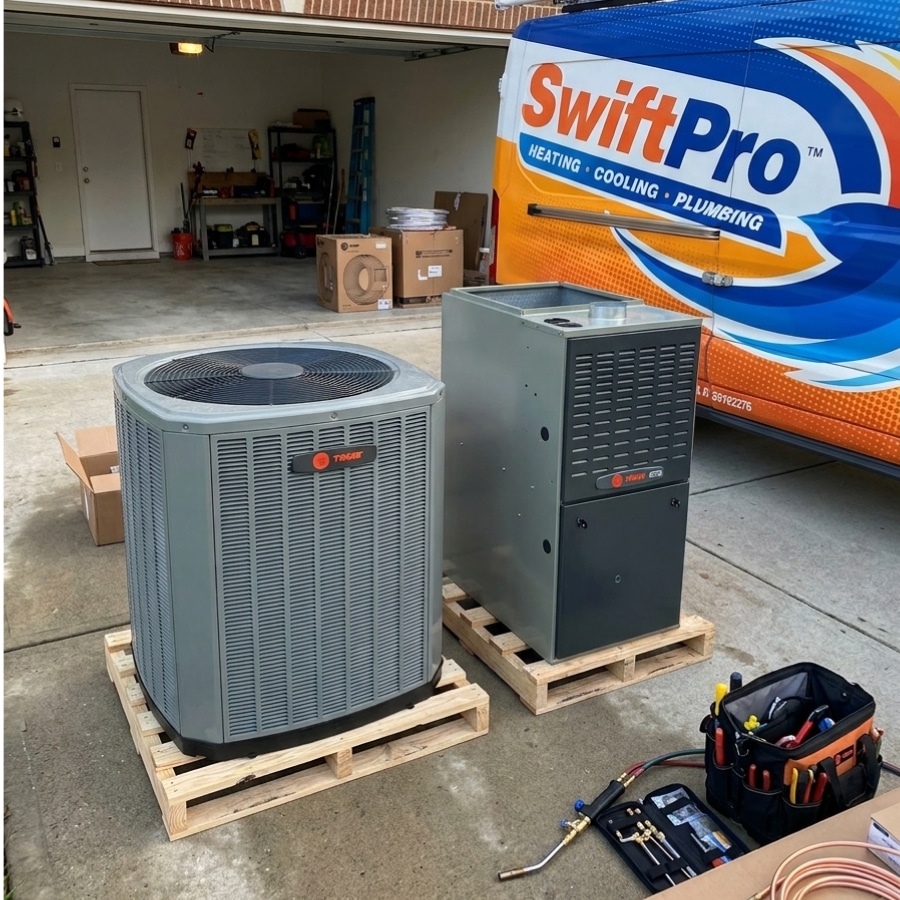
So the cooling side often decides the cabinet, and the heating side ends up bigger than the heat loss alone would ask for. The good answer to that is a two-stage or modulating furnace. It has the big blower the AC needs and spends most of the winter running on low fire, quiet and steady, using full capacity only on the coldest nights. If you are replacing the furnace and the AC at the same time, they should be sized together, and the heating and cooling estimator prices the pair. $8,898 to $23,000 installed, by size. From about $148 a month at 0% APR for 60 months, the whole price financed, on approved credit.
What the measurement checks
When we come out to measure, the questions are the ones a calculator cannot ask. How big are the rooms, really, and which ones are finished? What are the windows? What is in the attic? Can the existing ducts carry the air a new system will move, or is a duct the real bottleneck? Where does the furnace vent, and does the new one vent the same way? Is the gas line big enough?
That last pair matters more than people expect. Going from an old 80 percent furnace on the chimney to a high-efficiency one changes the venting to plastic pipe out a wall or the roof and adds a condensate drain, and if a gas water heater shared the chimney, its vent has to be checked too. It is all routine. It just has to be planned before the install day, not discovered on it. Our crew mapping where a new vent can go, on video. What actually happens on installation day.
If the old furnace is still running, now is the time to get the number: no cold house, no rush, and a published price to hold any other quote against. More on what drives that price: what a new furnace costs in Northern Virginia.
See your furnace price, or book the $67 check
What a new furnace costs in your house. The furnace price estimator asks a few questions about your home and shows the installed price for your size, from $4,285. From about $71 a month at 0% APR for 60 months, the whole price financed, on approved credit. You can book a free in-home measurement from the same page.
Get it checked before the cold. The $67 Heating Check covers one furnace or heat pump, through December 31. If you also want the blower wheel pulled and cleaned with a full tune-up, that is $229.
SwiftPro sizes and installs furnaces across Northern Virginia. Call (703) 997-9757 or book the free measurement online.