If you only do one thing: if your carbon monoxide alarm is sounding four beeps, a pause, and four beeps again, get everyone out of the house now and call 911 from outside, then count heads. Do not go looking for the source. Do not stop to open windows.
That is Fairfax County Fire and Rescue’s instruction, and the Consumer Product Safety Commission’s. Carbon monoxide has no smell and no color, and one of the first things it does is muddle your judgment, which is exactly why the advice is to leave first and figure it out later. When the fire department arrives, they meter the house room by room to find the source. Stay out until they tell you it is safe.
Is it the alarm, or a chirp?
Most calls about a CO alarm are about the chirp, not the alarm. They sound different, and the difference matters.
| What you hear | What it means | What to do |
|---|---|---|
| Four quick beeps, a pause, four beeps, repeating | Carbon monoxide detected | Get out, call 911 from outside |
| A single chirp about once a minute | Low battery, on most models | Replace the battery |
| Two chirps a minute (current Kidde) or five chirps a minute (First Alert) | End of life: the sensor is worn out | Replace the whole alarm |
| Three chirps a minute | The alarm has a fault | Replace it, or check the manual |
| Three long beeps, a pause, repeating (combination units) | Smoke, not CO | Fire: get out, call 911 |
Patterns differ by brand and by model year, so check the label on the back of your own alarm. It lists its sounds and its replace-by date. Two rules hold across all of them: never pull the batteries to stop an alarm, and a hush button is not a fix. On current Kidde units, if it starts again within six minutes of pressing hush, the CO is high. Get out.
A CO alarm does not detect a gas leak. A rotten egg smell is a different emergency: leave, and call 911 and your gas company from outside. That is 844-927-4427, option 1, for Washington Gas, or 1-800-544-5606 for Columbia Gas, which serves parts of Fairfax, Loudoun and Prince William. Use the number on your bill.
Why an alarm means real carbon monoxide
People want the alarm to be a false alarm, and the way these alarms are built makes that unlikely. Listed home CO alarms are tested to a standard called UL 2034, and they are designed to wait. At 70 parts per million, a listed alarm takes at least an hour to sound. At 400, it sounds within 4 to 15 minutes. First Alert’s, for one, are built to stay quiet at a steady 30 parts per million for 30 days.
For scale, the EPA puts an ordinary house without a gas stove at 0.5 to 5 parts per million, and the air near a properly adjusted gas stove at 5 to 15. So an alarm that is sounding has seen carbon monoxide well above normal, for a while. It is designed to go off before most healthy adults feel anything, so nobody feeling sick does not mean it is wrong.
What it can feel like: the CDC lists headache, dizziness, weakness, upset stomach, vomiting, chest pain and confusion, and says the symptoms are often described as flu-like. The tell is feeling sick at home and better when you leave. People who are asleep can be poisoned before they ever feel a symptom, which is why the alarm outside the bedrooms matters more than any other.
Why winter
The Consumer Product Safety Commission’s latest report found that 59 percent of carbon monoxide deaths tied to household products, across 2020 to 2022, happened in November, December, January and February. In 2022, heating equipment was the second largest source, after portable generators. In a Northern Virginia house in winter, these are the usual places it comes from:
- The furnace or boiler. A cracked heat exchanger, a blocked or disconnected flue, or burners that are not burning cleanly. A healthy gas flame is blue. Yellow or orange means the gas is not burning completely. What the color tells a technician, on video. What a cracked heat exchanger is, and how to know the diagnosis is real.
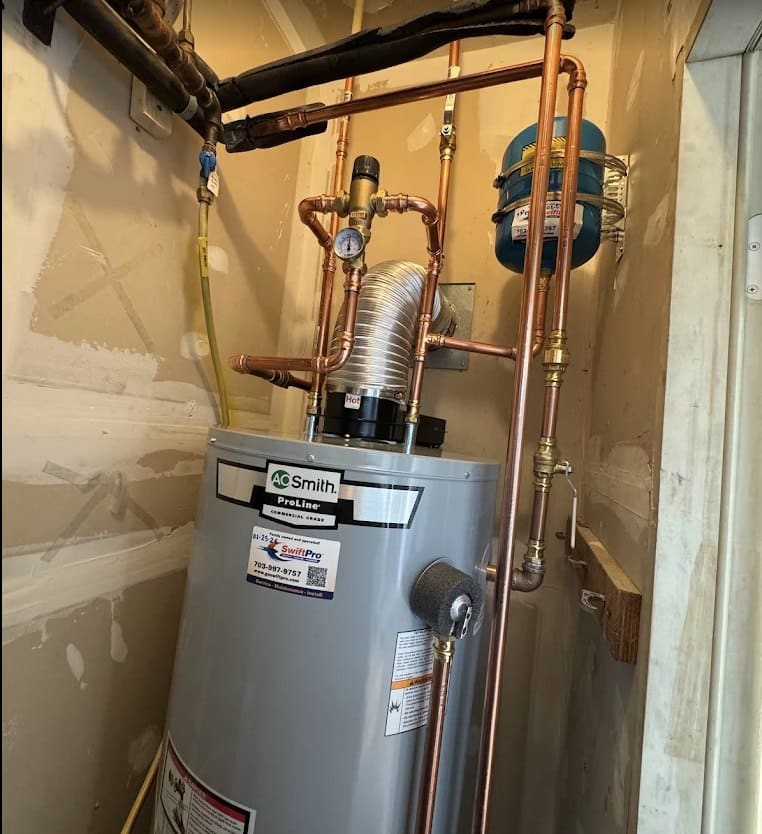
- The gas water heater. Especially in an older house where the furnace was replaced with a high efficiency one that vents out the wall, leaving the water heater alone on a chimney sized for two. Why that vent gets checked.
- Snow over the vents. After a storm, clear the furnace, water heater and dryer vents where they leave the house. NFPA says the same.
- The gas oven used for heat. Never. And never line the bottom of a gas oven with foil.
- A car warming up in an attached garage, even with the garage door open.
- A generator anywhere but outside, well away from the house. What to do when the power goes out in a freeze.
- A fireplace damper closed before the fire is completely out.
After the fire department clears the house
If they find the source is an appliance, they may shut it off. Do not turn it back on until a technician has looked at it. And if the alarm goes off again within a day, go through the same steps, then have every fuel-burning appliance in the house checked, not just the one that seemed likely.
Whoever you call, these are the checks to expect, from the inspection procedure Virginia’s own residential code publishes as guidance:
- A CO reading of the house air the moment they walk in.
- The venting followed end to end, for blockages, leaks, corrosion and disconnected pipe.
- A spillage test under worst-case conditions: doors and windows closed, the dryer and every exhaust fan running, then a check at the water heater and furnace for exhaust coming back into the room.
- The furnace’s heat exchanger inspected for cracks and holes, and the flame watched when the blower starts, because a flame that jumps when the fan comes on can mean a leak.
- Carbon monoxide measured in the flue after the burner has run a few minutes, against the limits: 400 parts per million air-free for a furnace or boiler, 200 for a water heater.
A furnace with a cracked heat exchanger is not a repair at any age. If that is the answer, the furnace estimator prices a replacement for your house size, $4,285 to $14,040 installed. From about $71 a month at 0% APR for 60 months, the whole price financed, on approved credit. We also give free second opinions on that diagnosis, because it is one worth being sure of.
Where the alarms go, and when to replace them
One outside each sleeping area, and one on every level of the house, is what NFPA recommends. Interconnected is best, so one sounding sets them all off. Keep them out of kitchens and away from the furnace and water heater by the distance your alarm’s instructions give. Height matters less than location: plug-in at outlet height and high on the wall both work, so follow your alarm’s instructions.
Replace them by the date on the label, usually 7 or 10 years depending on the model. The test button only checks the electronics, not the sensor, so an old alarm can pass the test and still be past its life.
What the law says here: Virginia requires CO alarms in new homes that have a fuel-burning appliance or an attached garage. We found no Virginia rule that makes an owner add them to an existing house, or that adds them automatically when you replace a furnace or water heater, so in most older houses the alarm is there because somebody bought one. Alarms that are there have to be kept working and replaced at end of life. If you rent, your landlord has to install one within 90 days of your written request. And Fairfax County’s fire department gives alarms to residents who need one: call Community Risk Reduction at 703-246-3801. The county’s CO alarm sheet is here.
The once-a-year part
An alarm tells you something is wrong. A check once a year is how it never gets that far. The $67 Heating Check, through December 31, includes a look at the heat exchanger and the safeties on a gas furnace. What a heating tune-up covers.
Book a repair, or see what a new one costs
Need it fixed? The diagnostic visit is $99, and you get the repair price in writing before any work starts. Book a visit online or call (703) 997-9757, day or night.
What a replacement costs in your house. Answer a few questions and see the installed price for your size: the furnace estimator for a gas furnace (from $4,285) and the heating and cooling estimator for a heat pump or a furnace and AC together (from $8,499). From about $71 a month at 0% APR for 60 months, the whole price financed, on approved credit. Each one lets you book a free in-home measurement.
SwiftPro services gas furnaces, boilers and water heaters across Northern Virginia and answers the phone around the clock. If the alarm is sounding right now, call 911 first.