Written October 2026, with our price book, the furnace estimator and Washington Gas’s rebate page read the same week.
A furnace heater is a furnace. It’s the cabinet in the basement, attic or closet that burns natural gas or propane and blows the heat through your ducts, and it’s how most Northern Virginia houses with gas stay warm. A new gas furnace from us runs $4,285 to $14,040 installed, keeping the air conditioner you have. From about $71 a month at 0% APR for 60 months, the whole price financed, on approved credit. On a 95 percent furnace, Washington Gas pays $500 of that back to its customers ($700 at 97 percent and up), so what you’re really out is the installed price less the rebate. Every size and efficiency is on our furnace replacement page.
No heat tonight? That’s a repair call first. Call (703) 997-9757, we run 24/7 emergency service, and what breaks in a furnace and what each fix costs is on our furnace and heat pump repair page. Not sure it’s a furnace at all? Look for a gas meter outside first; the table below sorts out the rest.
What a furnace heater actually is
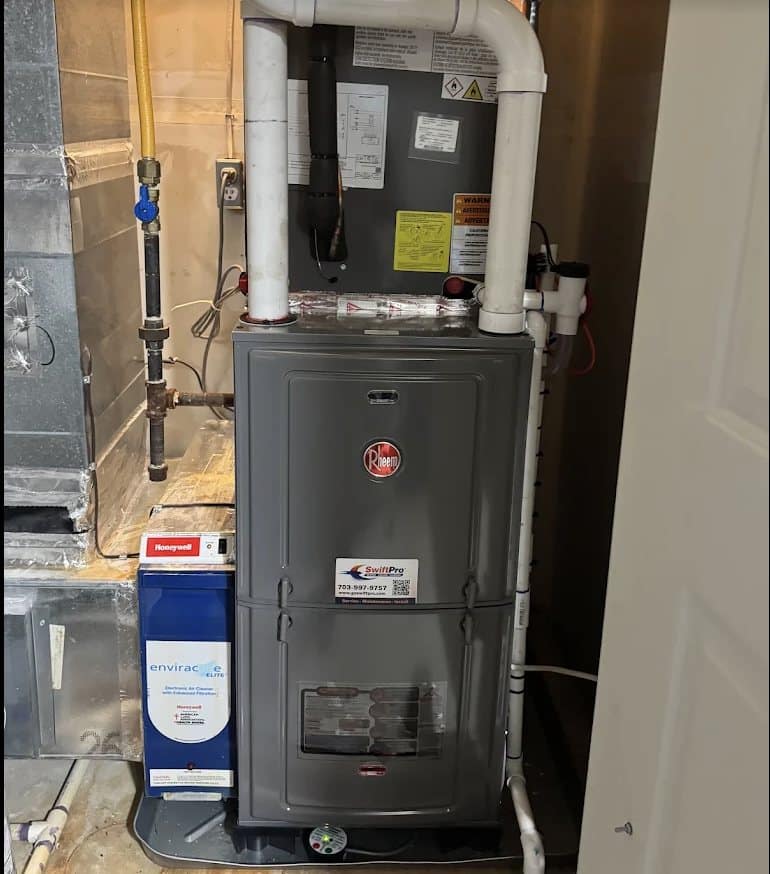
Three parts do the work. Burners light a gas flame inside a sealed metal heat exchanger. A blower pushes the house’s air across the outside of it. The warm air goes out through the ducts to the vents in each room, and the exhaust leaves through a flue or a pipe; the heat exchanger is what keeps the flame’s exhaust out of the air you breathe. A control board runs the sequence, and a flame sensor proves the burners lit before the gas stays on.
The number that matters on a furnace is its AFUE, the share of the gas that ends up as heat in the house. Carrier puts it plainly: “An 80% AFUE furnace converts approximately 80% of the fuel’s energy into usable heat, with the remainder lost primarily through exhaust.” Today’s gas furnaces come in two families, and you can tell them apart by the pipes. An 80 percent furnace vents hot exhaust up a metal flue or the chimney, the way most older furnaces here do. A 95 percent and up furnace pulls so much heat out of the exhaust that it vents through white PVC out a wall or the roof, and it makes water, so it needs a drain. That split also decides the Washington Gas rebate.
How to tell which heating system you have
Start outside. A gas meter on the house means you have natural gas, and a tank in the yard means propane. Most houses here with gas and ducts heat with a furnace. Then look at what’s inside, and at the thermostat.
| What you see | What you have |
|---|---|
| A metal cabinet indoors with a flame you can see through a small window or slots, a metal flue or white PVC pipes, and vents in the floors or ceilings | A gas or propane furnace |
| An outdoor unit that runs all winter as well as all summer, and a thermostat with an AUX or EM heat setting | A heat pump |
| An outdoor unit that runs on mild winter days, and a furnace that takes over on the cold ones | Dual fuel: a heat pump and a gas furnace sharing the work |
| Radiators or baseboard along the walls, no vents, and a boiler with pipes coming off it | A hot water boiler |
| White units high on the walls, each with a remote, and a small outdoor unit | A ductless mini split, which is a heat pump without ducts |
| A box you plug into the wall | A space heater, which heats a room, not a house |
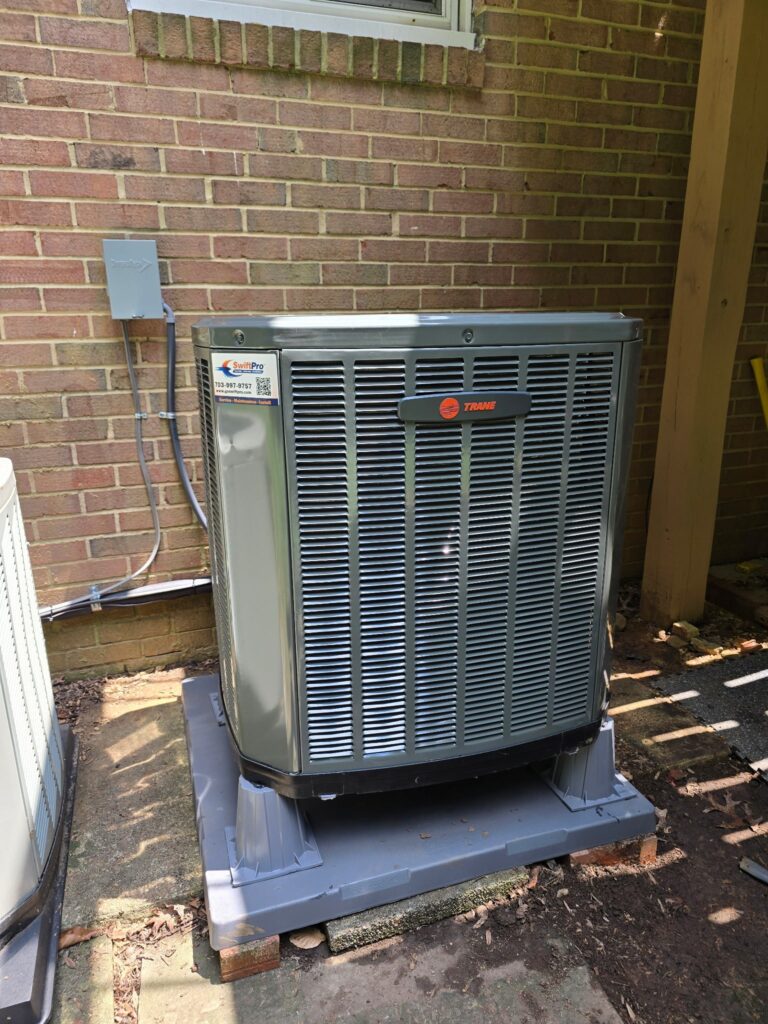
An outdoor unit by itself doesn’t settle it, because an air conditioner looks almost exactly like a heat pump. The thermostat usually does. A heat pump thermostat has an auxiliary or emergency heat setting, because a heat pump has backup heat behind it; what those two settings actually run is in aux heat vs. emergency heat. The rating plate on the outdoor unit settles it for good.

The system we put in first
Built to take a beating. Put in by our crew.
Heat lamps, snow and rain on one outdoor unit: that’s Trane’s own film. We’re a Trane Comfort Specialist, on Trane’s own dealer locator, and when you pick a Trane, our crew puts it in.
Films: Trane’s own.
Furnace or heat pump: the choice most houses here make
A heat pump doesn’t make heat, it moves it. ENERGY STAR says “heat pumps move heat rather than converting it from fuel, as combustion heating systems do.” In winter it pulls heat out of the outdoor air and brings it inside, and in summer it runs the other way as your air conditioner. So one heat pump stands in for both a furnace and an AC, which is why it’s the usual answer for a house with no gas line.
Gas and ducts? Either works, and the choice comes down to the house, the gas and electric rates, and what’s already there. More of the systems we install are heat pumps than anything else, with a gas furnace and AC a close second, so neither one is the odd choice. A heat pump system, the outdoor unit and the air handler, runs $8,499 to $21,650 installed. From about $142 a month at 0% APR for 60 months, the whole price financed, on approved credit. A furnace and an AC replaced together run $8,898 to $23,000. From about $148 a month at 0% APR for 60 months, the whole price financed, on approved credit. The running costs on local rates are worked out in heat pump vs. gas furnace, and heat pumps have their own page: heat pump replacement.
There’s a third answer, too. Dual fuel puts a heat pump outside and keeps a gas furnace inside: the heat pump carries the mild days and the furnace takes the cold ones. ENERGY STAR suggests looking at a heat pump in place of the air conditioner when the furnace is fairly new and the AC is the old half. We price dual fuel at your house, because it depends on the furnace you keep.
Radiators and baseboard: that’s a boiler
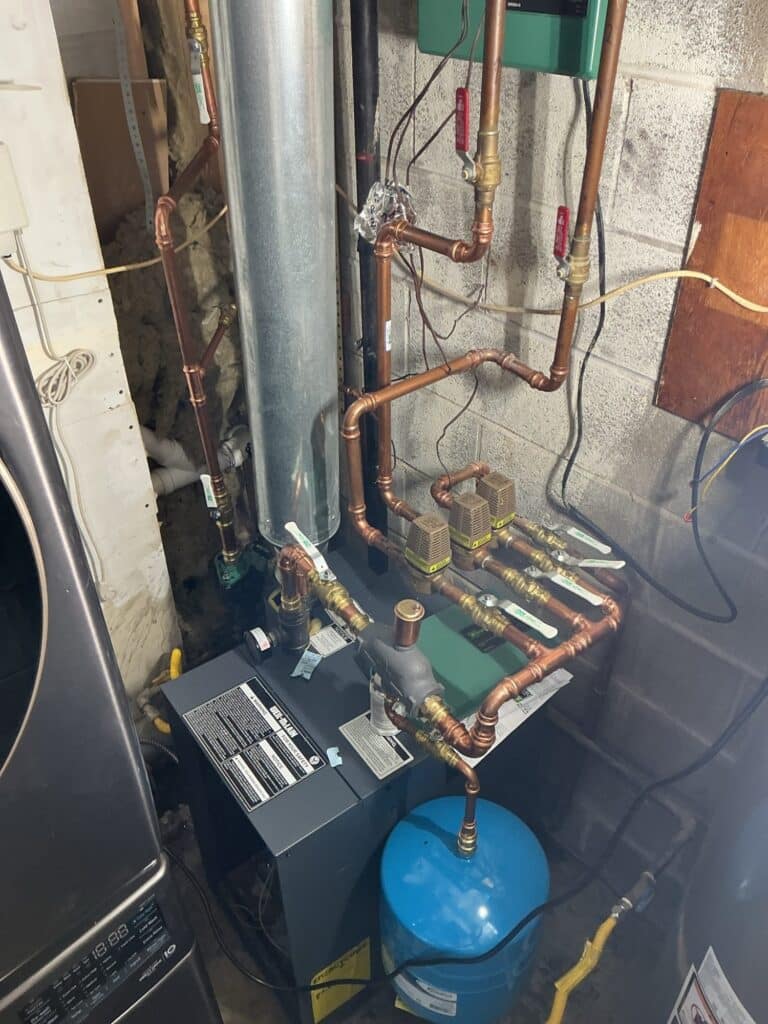
If the heat comes from radiators or baseboard along the walls and there are no vents in the floors, the house has a boiler, not a furnace. A boiler heats water and pumps it through pipes to each room. We repair and replace hot water boilers on gas and propane, and a replacement runs $9,900 to $16,500 installed. From about $165 a month at 0% APR for 60 months, the whole price financed, on approved credit. Steam systems are the exception: we don’t take those on. What a replacement involves is on our boiler page.
Space heaters are a stopgap, not a heating system
A space heater warms the room it’s in. That’s the right tool for a cold home office, or for one night with the furnace down, and the wrong one for a house that won’t stay warm. The US Fire Administration keeps its rules short: keep anything that can burn at least 3 feet from all heat sources, space heaters included, and turn space heaters off when you leave the room or go to bed.
One room that’s always cold is usually the ducts, the airflow, or a room the system was never sized for, and a technician can tell you which; why one room is so cold walks through each. For an addition or a finished basement the ducts never reached, the fix that stays is a ductless mini split. One zone runs $7,000 to $10,000 installed. From about $117 a month at 0% APR for 60 months, the whole price financed, on approved credit. Details are on our ductless mini split page.
What a new gas furnace costs in Northern Virginia
Our installed price for a gas furnace alone, keeping the air conditioner, is $4,285 to $14,040. From about $71 a month at 0% APR for 60 months, the whole price financed, on approved credit. Where yours lands depends on the size the house needs, 80 or 95 percent, single-stage or variable-speed, and the venting: a 95 percent furnace replacing an 80 needs new PVC venting and a drain. The furnace estimator narrows it by your house’s size, and what a new furnace costs goes line by line. Here’s the furnace next to the systems people weigh it against:
| System | Installed | Monthly, from |
|---|---|---|
| Gas furnace alone, keeping your AC | $4,285 to $14,040 | $71/mo at 0% APR for 60 months |
| Gas furnace and AC together | $8,898 to $23,000 | $148/mo at 0% APR for 60 months |
| Heat pump system | $8,499 to $21,650 | $142/mo at 0% APR for 60 months |
| Hot water boiler | $9,900 to $16,500 | $165/mo at 0% APR for 60 months |
Monthly figures: 60mo @ 0% APR on each starting price, the whole price financed, on approved credit. Longer plans lower the payment and cost more in total. The lender sets the final terms.
The Washington Gas rebate. Washington Gas pays back $500 on a new furnace rated 95.1 to 96.9 percent AFUE and $700 at 97 percent and up, for its Virginia customers, through a contractor in its network. We’re in Washington Gas’s contractor network for furnaces. So on a high-efficiency furnace, the number to compare is the installed price less the rebate. Its terms want the application and paperwork “within thirty (30) days of equipment installation.” It’s for Washington Gas customers only, and a house on Columbia Gas, as some in Chantilly and Herndon are, doesn’t qualify, so check the name on your gas bill first.
The federal tax credit ended for furnaces put in after 2025: the IRS says it “will not be allowed for any property placed in service after December 31, 2025.” Whatever we’re running this month is on our offers page, and financing has its own page. In Chantilly? Our page on furnace replacement in Chantilly covers what’s different about the houses there, and so does Ashburn’s.
When a furnace repair beats replacing it
Most furnace repairs are a part, and most parts cost a fraction of a new furnace. From our price book: a flame sensor cleaned runs $95 to $180, an igniter or flame sensor replaced $240 to $410, a control board $550 to $1,180, and a blower motor $670 to $2,400. A diagnostic visit is $99, and it ends with the fault found and the fix priced in writing. Parts the book doesn’t price, an inducer motor or a gas valve, get quoted after we look.
Where it tips is age and the size of the repair. Carrier and Lennox both put most furnaces at 15 to 20 years, and ENERGY STAR lists a furnace “more than 15 years old” as a reason to think about replacing it. Lennox’s rule of thumb: “It’s best to replace your furnace if a repair costs more than half the cost of a new furnace.” And a cracked heat exchanger is the one finding where we’ll tell you to stop running the furnace, whatever its age.
The symptom by symptom version is in our heating repair guide and what furnace repairs cost, and the age question has its own post: how long a furnace lasts.
Furnace heater questions, answered straight
What is a furnace heater?
A furnace: the unit that burns natural gas or propane and blows the heat through your ducts. People call it a furnace heater, a gas heater or just the heat. If the heat comes from an outdoor unit instead, it’s a heat pump; from radiators or baseboard, a boiler.
What is the difference between a furnace and a heater?
A furnace heats the whole house through ducts. “Heater” covers everything from a furnace to a plug-in space heater that warms one room. For a whole house, the choices are a furnace, a heat pump, both together (dual fuel) or a boiler.
How much does a new furnace cost?
From us, a new gas furnace runs $4,285 to $14,040 installed in Northern Virginia, keeping your air conditioner. From about $71 a month at 0% APR for 60 months, the whole price financed, on approved credit. The size, the efficiency and the venting decide where yours lands, and the furnace estimator narrows it to your house.
Is a gas furnace or a heat pump better in Northern Virginia?
No gas at the house: a heat pump. Gas and ducts: either works, and dual fuel gives you both. We’d price them side by side at your house, and our heat pump vs. gas furnace post works out the running costs on local rates.
How do I know if I have a furnace or a heat pump?
A gas meter outside and a flame you can see inside the unit: a furnace. An outdoor unit that runs all winter and a thermostat with an AUX or EM heat setting: a heat pump. Some houses have both, and that’s dual fuel.
Is there a rebate on a new gas furnace in Virginia?
Yes, from Washington Gas, for its customers: $500 back on a furnace rated 95.1 to 96.9 percent AFUE and $700 at 97 percent and up, through a network contractor, with the paperwork in within 30 days. We’re in its network for furnaces. The federal tax credit ended for anything put in after 2025.
How long does a gas furnace last?
Carrier and Lennox both put it at 15 to 20 years. Past 15, any big repair should be priced next to a new furnace before you decide.
Should I repair or replace my furnace?
Repair if it’s under about 15 years old and the fix is a part, a flame sensor, an igniter or a board. Replace if it’s past 15 and the repair is big, if the repairs keep coming, or if the heat exchanger is cracked. Lennox draws the line at half: a repair that costs more than half a new furnace means replace it.
Do you install propane furnaces?
Yes, propane and natural gas furnaces both.
Can I heat my house with space heaters?
For a night, a room at a time, carefully: the US Fire Administration says keep anything that can burn 3 feet away and turn them off when you leave the room or go to bed. For the whole house, no. That’s a furnace or heat pump problem worth getting fixed.
Get a new furnace priced
The furnace estimator shows an installed range for your house’s size in about a minute. Every furnace size and efficiency is on our furnace replacement page, repairs are on the heating page, and Chantilly has its own furnace page.
Call (703) 997-9757 or book online.
SwiftPro Heating, Cooling & Plumbing installs and repairs gas and propane furnaces, heat pumps, dual fuel systems, ductless mini splits and hot water boilers across Northern Virginia, from Chantilly and Ashburn. We’re a Trane Comfort Specialist, a Rheem Pro Partner, Carrier experts and a Mitsubishi Electric Diamond Contractor, and in Washington Gas’s contractor network for furnaces. Family owned, BBB Accredited with an A rating, 24/7 emergency service, Virginia Class A contractor license 2705192276, and rated 5.0 stars across 1,132 reviews on Google, Angi, Yelp, the BBB and Facebook. Read the reviews.