Written October 2026 from our own price book and our plumbers’ pressure readings, with Fairfax Water, Loudoun Water, Prince William Water, Virginia American Water, Arlington County, the 2021 Virginia code, Watts, Zurn and A. O. Smith read at the source the same week.
A pressure reducing valve is the brass bell on your main water line, just past the main shutoff, and its whole job is holding the house near 50 to 60 psi no matter what the street sends. In Northern Virginia that job matters: the Virginia code caps a house at 80 psi, and the water main outside can run well past it. A worn valve can let street pressure seep through while nothing runs, so the house climbs overnight and settles back before anyone looks. A gauge left on a hose thread overnight catches it (the test is below). When the valve is the problem, a pressure reducing valve replacement from us runs $500 to $1,000, and it books through our plumbing service page or at (703) 997-9757.
Not sure it’s the valve? A plumber puts a gauge on it during a $49 plumbing diagnosis visit ($250 after hours) and prices the fix in writing before any work starts. Running toilets, a dripping water heater relief valve and banging pipes are the high pressure signs. Weak water at every faucet is the same valve failing the other way, covered in low water pressure through the whole house.
What a pressure reducing valve does, and where yours is
The main brings water to your house at whatever pressure the street has. The valve takes it down to one steady setting with a spring pushing against a diaphragm: when a faucet opens and the house side drops, it opens to keep up, and when the house side reaches its setting, it closes. A water pressure regulator is the same part. The three we install, the Watts LF25AUB-Z3, the Watts LFN45B-M1 and the Zurn Wilkins NR3XL, all leave the factory set at 50 psi and adjust up to 75.
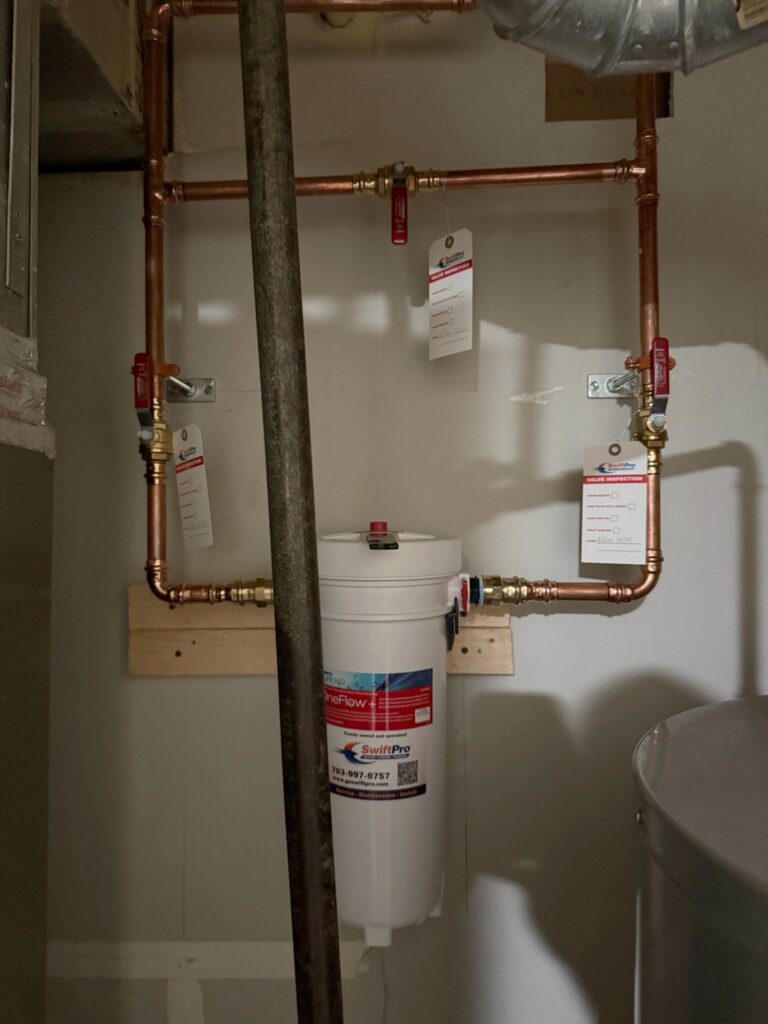
Where it is. Follow the main water line from where it comes through the foundation wall. First comes the main shutoff, then, close by, a brass bell about 4 inches long with a bolt and a lock nut on top. Loudoun Water describes it the same way and says most houses built after 1972 have one. In a finished basement it’s often behind an access panel or a square of drywall.
Whether you have one. Fairfax County changed its plumbing code to require pressure reducing valves on December 4, 1972, according to Fairfax Water’s rules. A house built before then may never have had one. No bell past the shutoff and a gauge reading over 80 means the house needs a valve, not an adjustment.
Why Northern Virginia houses need one: the 80 psi limit, and who owns the valve
The Virginia Residential Code, section P2903.3.2, caps a house’s static water pressure at 80 psi, and where the main runs higher, it requires a pressure reducing valve where the water service comes in. The plumbing code’s version, section 604.8, adds a strainer, and 604.8.1 says the valve has to be built to stay open if it fails. So a dead valve doesn’t shut your water off. It passes street pressure straight through, and nothing tells you.
None of the five water utilities here promises a ceiling on what comes down the main, and every one of them leaves the valve to you:
| Utility | What it promises | The pressure reducing valve |
|---|---|---|
| Fairfax Water | At least 20 psi at the main in the street, and no promise of uniform pressure | The customer buys, installs and maintains it |
| Loudoun Water | No promise of sufficient or uniform pressure | Running and repairing it “strictly lies with the customer” |
| Prince William Water | Pressure set by how far your house sits below the tank serving it | The homeowner’s to install and maintain |
| Virginia American Water (City of Alexandria) | At least 20 psi under normal conditions | The customer installs it |
| Arlington County | Its system ends at the water meter | Past the meter, so it’s yours |
What the street sends depends on where you sit: Prince William Water explains it as the height difference between the tank serving your area and your house. Our plumbers take a pressure reading on whole-home plumbing inspections, and about one house in four reads over 80. The highest they’ve written down this year is 120 psi, in houses in Arlington and Sterling.
McLean, specifically. In August 2021 Fairfax Water expanded its Second-High pressure zone along the Kirby Road and Haycock Road corridors in McLean and the Falls Church area, a stretch the City of Falls Church’s water system used to serve. It mailed letters to the homes it expected to go over 80 psi, and its project page says homes in the zone that got no letter aren’t expected to. If you’re along those corridors and nobody has put a gauge on the house since, run the overnight test below, and our McLean plumbing page is where a valve job there books.
Signs of a bad pressure reducing valve, and of pressure that’s too high
Low pressure is hard to miss. High pressure is quiet, and it shows up as other parts failing early:
| What you notice | Why pressure is the suspect |
|---|---|
| A toilet that refills by itself, or a fill valve you’ve already replaced once | A fill valve is a small seal holding back full house pressure all day, and it gives out early when that pressure is high |
| Water dripping from the pipe on the side of the water heater | The temperature and pressure relief valve opening. Prince William Water lists it as a high pressure sign; a dead expansion tank does it too |
| Pipes that bang when the washer, the dishwasher or a faucet shuts off | Water hammer, and higher pressure hits harder. Virginia’s code also requires hammer arrestors where quick-closing valves are used, so the fix can be both |
| A burst washing machine hose or toilet supply line | Those hoses hold full house pressure whenever their valves are open. More in the five cheap parts that flood houses |
| Faucets that drip, washers and cartridges that wear out early | Prince William Water names quick-wearing faucet washers as a high pressure sign |
| Strong water first thing in the morning, normal by afternoon | Creep: the valve letting street pressure through while nothing runs. The overnight test catches it |
| Water at the valve itself, or a hum, chatter or whistle from it | Zurn’s instructions call a leak at the bell a repair and a leak from the body a replacement, and list noise as a fault of its own |
| Weak water at every faucet at once | The valve failing the other way. That’s the low water pressure checklist |
One of these alone can be something else. Two or three together, and a gauge settles it in a night.
The overnight gauge test most guides skip
Every how-to says to put a gauge on a spigot and read it. That’s one moment, usually an afternoon, and a valve that leaks street pressure through overnight reads fine at 3 p.m.
The gauge. A water pressure test gauge that threads onto a hose connection, with a second, red needle that stays at the highest reading. Hardware stores and supply houses carry them; the Watts IWTG and the Zurn Wilkins HGI-25 are two, and Watts’s own sheet says that left on overnight, the red hand records the highest pressure of the night. A gauge without the red needle only tells you about the minute you looked.
Where to put it. On a hose thread past the pressure reducing valve: the laundry tub faucet, the washing machine’s cold valve with the hose off, or the drain valve on the water heater. Careful with outside spigots. The plumbing code lets the line to an outside spigot come off ahead of the valve, so in some houses the spigot out back reads street pressure while the kitchen doesn’t. If it reads much higher than the laundry tub, that’s why, and now you know what the street sends.
- Evening. With nothing running (dishwasher done, irrigation off, nobody in the shower), thread the gauge on and open its valve all the way. The black needle is your static pressure. Write it down and turn the red needle back to meet it.
- Leave it overnight. Use the house the way you normally would.
- Morning, before anyone runs water. Read both needles. Black is the pressure now. Red is the highest it went all night.
| What the gauge shows | What it means |
|---|---|
| Evening 50 to 70, and the red needle within a few psi of it in the morning | The valve is holding. Test again next year |
| Evening already over 80 | The valve is set too high, has failed open, or isn’t there. Look for the bell, then adjust or replace |
| Evening fine, red needle over 80 by morning | Something pushed the house up overnight: the valve creeping, or the water heater’s expansion with nowhere to go. The ten-minute test tells you which |
| Under 40 at any point | Low pressure, the other failure |
The ten-minute test. Open a cold faucet for a few seconds, close it, and watch the black needle for ten minutes without using any hot water. If it climbs back up on its own, street pressure is getting past the valve. Zurn’s instructions call that a fouled valve, and Watts’s name pressure creep and debris on the seat. If it sits still at the setting, the valve is holding and the overnight spike came from the water heater. Zurn’s sheet describes that kind of rise exactly: it happens each time the heater runs and drops the moment a fixture opens. That points at the expansion tank, below.
Our plumbers see it in their own notes: one house read 70 in the daytime and went to at least 90 at night.
How to adjust a water pressure regulator, and when not to
If the ten-minute test says the valve holds and it’s only set wrong, adjusting it takes ten minutes. Watts and Zurn describe it the same way:
- Put the gauge on first, on a hose thread past the valve, with nothing running.
- Loosen the lock nut on the bolt on top of the bell.
- Turn the bolt clockwise, into the bell, to raise pressure, or counterclockwise to lower it. Small turns, a quarter turn or so at a time.
- Lowering it? Open a faucet for a few seconds so the house bleeds down to the new setting, as Zurn’s instructions say, then close it and read the gauge.
- When the gauge reads what you want with nothing running, tighten the lock nut.
Where to set it. A. O. Smith gives 50 to 60 psi for a house with a water heater, and no higher than 80. We set most new valves between 55 and 65. Past 75 you’re outside the adjustment range of all three valves we install anyway.
Leave it alone when:
- The ten-minute test showed creep. The bolt changes the setting, not the leak past the seat. The pressure will creep right back.
- The bolt is already run most of the way in. Watts says not to bottom out the adjusting screw. A valve that needs cranking to give decent pressure has a different problem, often a clogged strainer or the pipe itself.
- There’s water at the valve. A leak at the bell or the body is a repair or a replacement, not a setting.
- The lock nut or bolt won’t move. Forcing a seized nut twists the pipe the valve sits on.
- The main shutoff won’t close. If anything on the valve has to come apart, the main has to hold. An old gate valve that only slows the water down is common in houses here, and find your shutoffs before you need them covers checking yours.
Water pressure regulator replacement: what it involves and what it costs
A pressure reducing valve replacement from us runs $500 to $1,000, priced in writing before any work starts. The water goes off at the main, the house drains down, the old valve comes out, the new one goes in, and the plumber sets it with a gauge and runs the fixtures. What moves the price inside that range is mostly size (about one in six we replace is a 1-inch valve, the rest are 3/4) and reach, since in finished basements the valve is often behind drywall or a panel.
The main shutoff usually comes with it. More than half the pressure reducing valves we replace go in with a new main shutoff on the same visit. The main is the valve that has to close for the job, and when it’s an old gate valve that won’t seal, it gets replaced while the water’s already off. Sometimes the water utility has to shut the water off at the meter first. Both valves go on one written price.
The valves we install are the Watts LF25AUB-Z3, the Watts LFN45B-M1 and the Zurn Wilkins NR3XL. All three take far more pressure than a house here sees (300 psi in on the LF25AUB-Z3, 400 on the other two), come set at 50, and carry a built-in bypass for thermal expansion, which matters in the next section.
What we’d do in your shoes: if the overnight test shows creep on a valve that’s been in for years, replace it rather than chase a rebuild, and if the main shutoff is an old gate valve, replace that on the same visit. The next time you need that main, it’ll be an emergency.
If you’re not sure the valve is the problem, the $49 plumbing diagnosis visit finds out, and it ends with the price in writing. Current plumbing deals, including the water heater flush that comes with a whole-home plumbing check and a pressure reading, are on our offers page.
A new pressure reducing valve means checking the expansion tank
Water expands when the water heater heats it. With nothing in the way, the extra water pushes back into the main and nobody notices. Put a pressure reducing valve on the line and the house becomes what Rheem calls a closed system: the expansion goes into an expansion tank on the water heater’s cold line, or out the relief valve. Both of Virginia’s codes require it. P2903.4.1 requires a way to control the pressure when expansion pushes the house past the valve’s setting, and plumbing code 607.3 puts that device on the water heater’s cold supply, downstream of the pressure reducing valve.
The bypass doesn’t replace the tank. The bypass on all three of our valves lets expanding water flow back to the main, but only once the house side is higher than the street. Watts’s own instructions say it keeps the house from rising more than 10 psi above supply pressure. So where the main sends 110, the bypass only keeps the house under about 120. The expansion tank is what keeps it near the 55 or 60 the valve is set to.
The tank has to match the valve. Zurn’s instructions set the expansion tank at the valve’s outlet pressure, so a new valve, or a valve turned to a new setting, means a look at the tank too. If the overnight spike survives a new valve, a waterlogged tank is the first suspect.
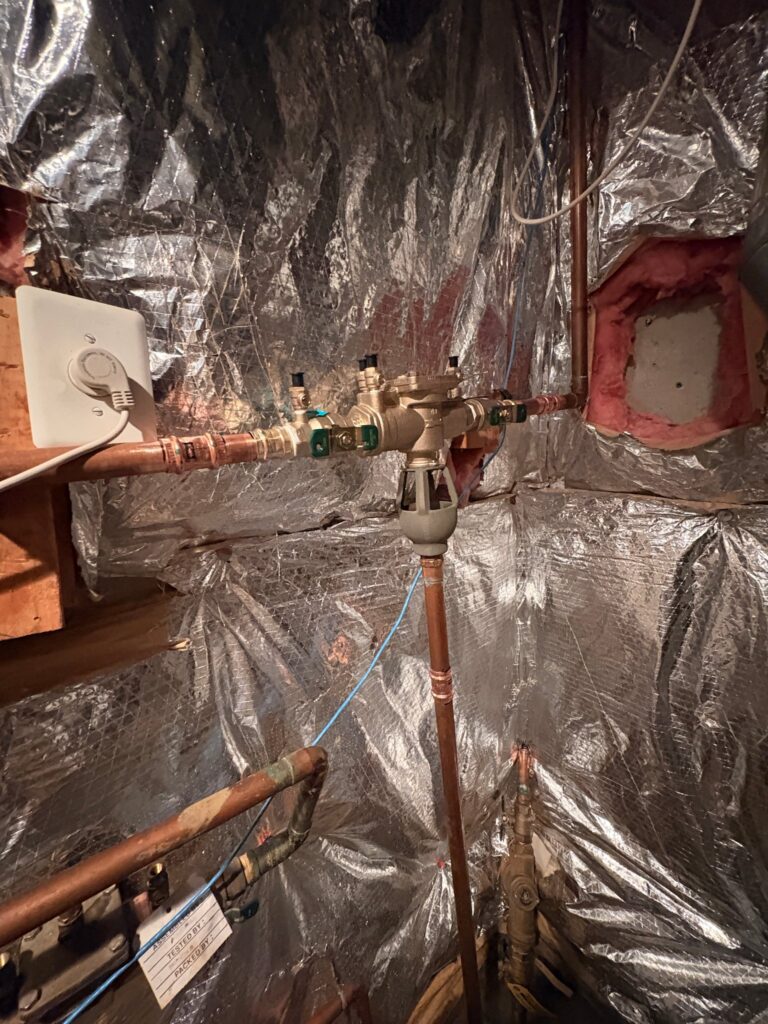
A backflow preventer or a check valve closes the system too (P2903.4.2), which is why a house with no pressure reducing valve can still need an expansion tank. How to check yours, and what it takes to replace it, is in our water heater expansion tank guide. If the water heater itself is near the end, a new one from us is $2,750 to $10,500 installed, with the expansion tank, permit, pan and haul-away in that number. From about $46 a month at 0% APR for 60 months, the whole price financed, on approved credit. The rest is on our water heater page.
Pressure reducing valve questions, answered
What does a pressure reducing valve do?
It takes the water main’s pressure, whatever it is, down to one steady setting for the house, usually 50 to 60 psi. Virginia’s code requires one where the main runs over 80 psi.
How do I know if my pressure reducing valve is bad?
Leave a gauge with a red max needle on a hose thread past the valve overnight. If the house was fine in the evening and reads over 80 by morning, open and close a cold faucet and watch for ten minutes. Pressure that climbs back on its own means the valve is letting street pressure through.
How do you adjust a water pressure regulator?
Gauge on first. Loosen the lock nut on top of the bell, turn the bolt clockwise to raise pressure or counterclockwise to lower it, a little at a time, and tighten the lock nut once the gauge reads 50 to 60 with nothing running. Don’t adjust a valve that’s creeping, leaking or seized.
How much does it cost to replace a water pressure regulator?
From us, a pressure reducing valve replacement runs $500 to $1,000, priced in writing before any work starts. If you’re not sure the valve is the problem, the plumbing diagnosis visit is $49 ($250 after hours). A new main shutoff on the same visit is common and goes on the same price.
What should my house water pressure be?
50 to 60 psi is A. O. Smith’s guidance for a house with a water heater, and Virginia’s code caps a house at 80 psi static. Under 40 at every faucet is low pressure, a different problem.
How long does a pressure reducing valve last?
Neither Watts nor Zurn prints a service life, and both say to check the valve every year. Moen’s guide puts the average at about ten years. A yearly gauge test tells you more than the calendar.
Where is the pressure reducing valve in my house?
On the main water line, just past the main shutoff where the line comes through the foundation, usually in the basement or a utility room. It’s a brass bell about 4 inches long with a bolt and lock nut on top. In a finished basement, check behind access panels.
Do I need an expansion tank with a pressure reducing valve?
With a tank water heater, almost always. The valve closes the system, and Virginia’s code (P2903.4.1, and plumbing code 607.3) requires thermal expansion control when heating pushes the house past the valve’s setting: an expansion tank on the water heater’s cold line.
Who is responsible for the pressure reducing valve, me or the water company?
You. Fairfax Water, Loudoun Water, Prince William Water and Virginia American Water all leave the valve to the customer, and Arlington’s water system stops at the meter.
Do homes in McLean, VA need a pressure reducing valve?
Any house where the main runs over 80 psi needs one by code. In 2021 Fairfax Water raised pressure along the Kirby Road and Haycock Road corridors in McLean and the Falls Church area and wrote to the homes it expected to go over 80. A gauge left on overnight tells you where yours stands. We replace them in McLean: (703) 997-9757.
Pressure reducing valve replacement in Northern Virginia: call (703) 997-9757
Call (703) 997-9757. Often same-day, and we will tell you honestly when we can get there. For anything that can wait, book online, or send the form at the top of this page and the office calls or texts you back. Everything our plumbers do, with prices, is on our plumbing page. Water spraying from the valve right now? Close the main shutoff just before it and call; our emergency plumbing runs 24/7.
SwiftPro Heating, Cooling & Plumbing replaces pressure reducing valves, main shutoffs, expansion tanks and water heaters, and handles the rest of a house’s plumbing, across Northern Virginia from Chantilly and Ashburn, with a dedicated plumbing team. Family owned, BBB Accredited with an A rating, 24/7 emergency service, Virginia Class A contractor license 2705192276, and rated 5.0 stars across 1,132 reviews on Google, Angi, Yelp, the BBB and Facebook. Read the reviews.