Written October 2026, with Virginia’s plumbing code, the local water utilities and the tank makers’ manuals read the same week.
If your house has a pressure reducing valve or a check valve at the water meter, your tank water heater needs an expansion tank. Most houses in Northern Virginia have one or the other. Heated water grows, those valves keep it from pushing back toward the street, and with no tank to take the extra, the pressure climbs until the heater’s relief valve opens. Adding an expansion tank to the heater you have runs $250 to $860 from us, installed. Every new water heater on our water heater replacement page already has one in its price. Before you call anyone, check the tank you have: the tap test below takes ten seconds.
Is the heater itself past ten years old? A new one comes with a new expansion tank. From about $46 a month at 0% APR for 60 months, the whole price financed, on approved credit. That’s on a new tank water heater at $2,757 to $7,494 installed, with the permit, the expansion tank, the drain pan and haul-away in the number. Whatever we’re running right now is on our offers page.
Do I need an expansion tank for my water heater?
Yes, if anything on your main water line stops water from flowing backward toward the street. That’s the whole test. Plumbers and water companies call it a closed system, and three things close one: a pressure reducing valve, a check valve or backflow preventer at the meter, and sometimes a water softener. A. O. Smith’s own technical bulletin says “many PRVs also act as very effective check valves”, so a house with one is closed even if nothing sits at the meter.
Rheem’s thermal expansion bulletin works it through: a 40 gallon heater ends up holding “about 40.53 gallons” once it’s hot, and in a closed system the water reaches 150 psi, enough to open the relief valve, before its temperature has risen 20 degrees. Water doesn’t compress. That extra half gallon goes into an expansion tank, or it goes out the relief valve.
Most houses here have at least one of those valves, and the water companies say so in their own words:
- Fairfax County: the county’s plumbing code has required pressure reducing valves since December 4, 1972, the date Fairfax Water’s rules give for when “the Fairfax County Plumbing Code was amended to require installation of pressure reducing valves”. The valve belongs to the homeowner, not the water company.
- Loudoun: Loudoun Water says “most houses built after 1972 are equipped with a pressure reducing valve (PRV),” and its cross-connection manual puts a dual check valve on every new service connection at a minimum, with older homes assessed for one during water main replacement work.
- Leesburg: the town puts a backflow preventer in the water meter box, and its own handout on thermal expansion says it “creates an isolated or closed plumbing system” that can “set off the relief valve on hot water heaters.”
- Prince William: Prince William Water describes high pressure as the kind that causes “your hot water pressure relief valve to trip,” and leaves pressure reducing valves to the homeowner.
- Arlington: the county owns the line up to the meter, and “the property owner owns and is responsible for the service line from the meter to the plumbing inside your home.” Whatever closed your system, the fix is on your side of the meter.
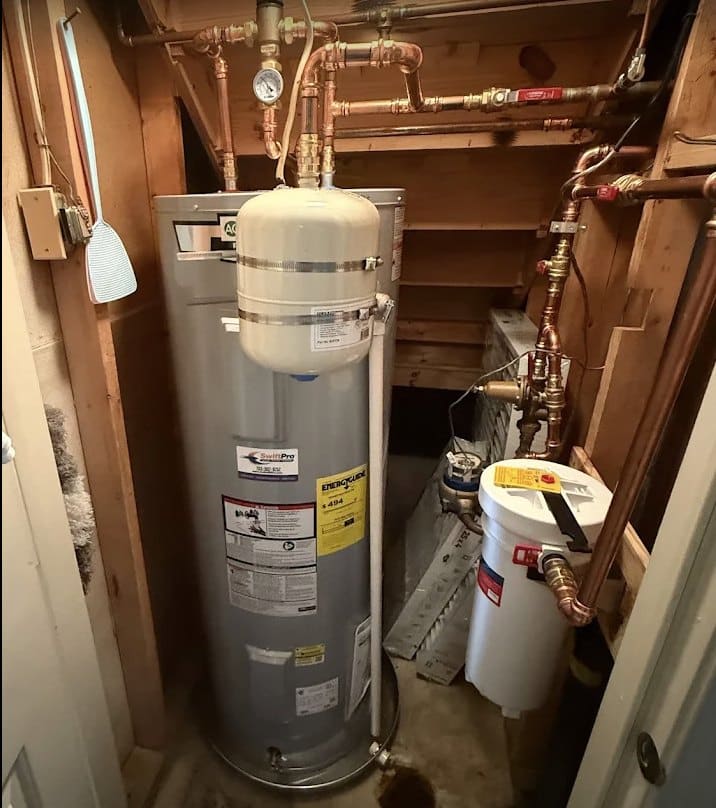
To check your own house, find the main shutoff where the water line comes in. Loudoun Water describes a pressure reducing valve as bell-shaped, about four inches long, near the main valve. If there’s one there, you’re closed. In houses built from 1971 to 1980, Fairfax Water notes, the meter itself is often inside too, on that same line.
No pressure reducing valve and nothing at the meter? Then the extra water can push back into the main, and the code doesn’t call for a tank. That house is getting rare, and it doesn’t stay open: a new pressure reducing valve or a water softener closes it the day it goes in.
What Virginia’s code says about thermal expansion
Virginia builds to the 2021 Uniform Statewide Building Code, in effect since January 18, 2024, per the state’s housing and community development department. For houses and townhouses, the plumbing rules are the Virginia Residential Code, where section P2903.4, adopted without Virginia changes, covers thermal expansion:
- P2903.4.1, behind a pressure reducing valve: a pressure control device is required wherever thermal expansion pushes the pressure past the valve’s setting. With a tank heater behind the valve, Rheem’s numbers say it will.
- P2903.4.2, behind a check valve or backflow preventer: on any system with storage water heating equipment, “a device for controlling pressure shall be installed.”
The Virginia Plumbing Code, for condo buildings, apartments and commercial space, says it more plainly in 607.3: the device goes on the heater’s cold supply “downstream of all check valves, pressure reducing valves and backflow preventers,” sized to the tank maker’s instructions.
One more number from the same chapter: P2903.3.2 caps house pressure at 80 psi static and calls for a pressure reducing valve above that. An expansion tank doesn’t lower your pressure. If a gauge reads over 80 with nothing running, the valve is the first fix, or the valve you have has failed. Our pressure reducing valve guide covers that side.
The heater makers are stricter than the code. A. O. Smith’s technical bulletin says a heater on a closed system “without a properly sized and installed thermal expansion tank will void warranty,” and Bradford White’s current manual says its “Warranties do NOT cover damages from thermal expansion.”
In Fairfax County, replacing a gas water heater takes a permit “even if it is a like-for-like replacement,” with one inspection to check the install against code. The permit and the expansion tank are both in our installed price.
What size expansion tank a water heater needs
Size comes from two numbers: how many gallons the heater holds, and your house’s water pressure. Each tank maker publishes a chart, and read side by side, Amtrol’s, Watts’ and A. O. Smith’s agree more than they disagree:
| Water heater | House pressure | What the charts call for |
|---|---|---|
| 40 or 50 gallon | 40 to 70 psi | About 2 gallons: Amtrol ST-5, Watts PLT-5, A. O. Smith 2 gallon. All three agree. |
| 50 gallon | 80 psi | Watts: its 4.5 gallon PLT-12. Amtrol: still the ST-5 at a 140 degree setting. |
| 50 gallon, set to 160 degrees | 60 psi or more | Amtrol moves up to its 4.4 gallon ST-12. |
| 66 or 75 gallon | 40 to 80 psi | 4.4 to 4.5 gallons (Amtrol, Watts). A. O. Smith allows its 2 gallon on a 66 up to 60 psi. |
| 80 gallon | 40 to 80 psi | 4.4 to 4.5 gallons on every chart. |
The charts assume a heater set around 140 degrees (on Watts’, a rise of no more than 50 degrees) and an air charge that matches the house. Turn the heater up and the tank needs to be bigger. Where two charts disagree, our call is to go up a size: too big just means room it never uses. One of our plumbers wrote up the other mistake last fall: a 75 gallon heater with an expansion tank too small for it.
Expansion tank pressure: match it to the house, with the water off
Inside the tank, a rubber diaphragm splits it in two: air on one side, your water on the other. The air side comes charged from the factory, and the factory number is a guess about your house: Amtrol ships its ST-5 and ST-12 at 50 psi, Watts its PLT series at 20. Both say to reset it. Amtrol’s manual: “With tank empty of water, adjust air precharge to match cold water supply pressure.” Watts: the air charge “should only be adjusted under zero system pressure.”
Set the air side lower than the house and water pushes into the tank the moment it’s connected, filling room the hot water needed later. Set it higher and the tank sits there doing nothing until the pressure climbs past its charge. Either way, the relief valve picks up the slack. This September one of our plumbers found a tank charged to 50 psi on a house running about 60.
Reading your house pressure takes one gauge. Screw a water pressure gauge onto an outside faucet or the washing machine’s cold valve, make sure nothing in the house is running, and open the valve. That’s your static pressure, the number the tank’s air charge should match. Rheem’s target for a house is 40 to 60 psi. Buy the kind of gauge with a second, red needle that stays at the highest reading, and leave it on overnight with no water running. If the red needle sits well above the static reading in the morning, the heater’s cycles pushed it there, and your expansion tank isn’t absorbing them.
How to check an expansion tank: three tests, easiest first
1. The tap test. Rap the tank with a knuckle, starting at the end where the pipe connects and working toward the other end. The pipe end holds water and sounds dull. The far end is the air side and should sound hollow. Dull all the way? The tank is waterlogged. John Siegenthaler, writing in Plumbing & Mechanical about the same kind of tank on a boiler, calls it a hollow “ping” against a muffled “thud.” A tank can ring hollow and still be undercharged, so it’s a first check, not the last.
2. The air valve test. At the end of the tank opposite the pipe is a valve just like the one on a bike tire, under a plastic cap. Shut the main water valve, open a faucet until it stops running, then put a tire gauge on that valve. The reading should match your house pressure. If it’s low, Amtrol’s answer is that “the expansion tank should be replaced.” Then press the valve’s pin for a second. Air should hiss out. If water comes out, the diaphragm has torn and the tank is done; Siegenthaler’s word for it is “toast.” Pumping air back in won’t fix a torn diaphragm, and every check lets a little air out, so don’t make it a weekly habit.
3. Watch the relief valve. That’s the brass valve on the side or top of the heater, with a pipe running toward the floor. A. O. Smith lists the tell plainly: “Relief valve drips during any recovery cycle when no hot or cold water is used.” Rheem’s version is about a cup of water for every ten gallons of heater, each time it heats, so about five cups from a 50 gallon heater after a heat-up with nobody using water. And never cap or plug that pipe; Bradford White’s manual says not to plug it “for any reason.”
Water from the bottom of the heater itself is a different problem, and usually a different answer: see water heater leaking from the bottom vs. the top.
Where the expansion tank goes, and what holds it up
It goes on the cold water line into the heater, between the heater and whatever closed the system. Amtrol’s manual says “between the water heater and backflow preventer or other one-way device,” and the plumbing code says downstream of all of them. A. O. Smith’s tank manual wants it at least 18 inches from the heater’s cold inlet.
Then it has to be held up, and that’s the step that gets skipped. Water weighs 8.34 pounds a gallon by the USGS’s number, so a waterlogged 2 gallon tank weighs a little over 20 pounds and a 4.5 gallon tank close to 50, hanging off a soldered joint or a threaded fitting. Amtrol’s preferred position has the pipe connection on top with the tank hanging below it. Mount it upside down or sideways, and Amtrol says “the body of the tank must be fully and rigidly supported to hold the entire weight of the tank when full of water.” Watts and Rheem both tell installers to brace the piping with straps, hangers or brackets. A wall bracket and two straps, like the one below, is the whole fix.
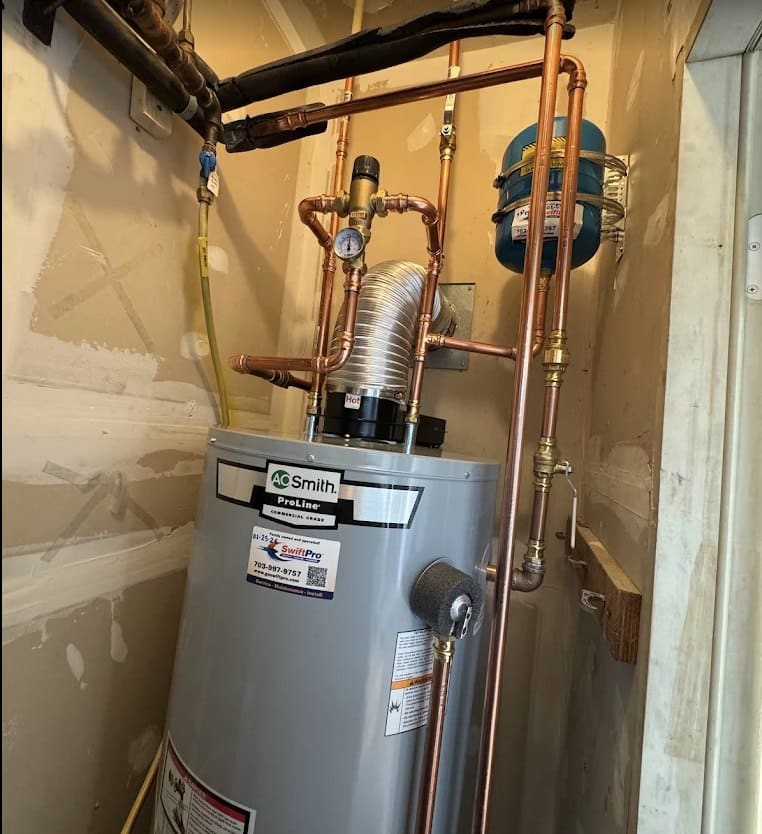
What happens when nobody does it: this July one of our plumbers found a 5 gallon tank hanging upside down from an unsupported copper line in a basement, its diaphragm ruptured and the tank full of water. His note on the job: the weight put the pipe at risk of breaking and flooding the basement.
How long an expansion tank lasts, and what a waterlogged one does
No tank maker puts a number of years on it. The warranties come closest: Amtrol gives its ST-5 and ST-12 a seven year limited warranty, and Watts and A. O. Smith warrant theirs for one year. A. O. Smith’s manual just says: “This expansion tank, as all tanks, will eventually leak.” They give out well before the heaters they sit on. Write the install date on yours with a marker, so the next person who opens that closet knows how old it is.
A waterlogged tank works exactly like no tank. Every heating cycle pushes the pressure up toward the relief valve’s setting, 150 psi at most under the code, the valve weeps, and everything else on the line takes the hit in between. Leesburg’s handout names leaky faucets; Prince William Water adds banging pipes and faucet washers that wear out fast. The heater takes it worst, cycle after cycle, which is why the makers write it out of their warranties.
When we find a waterlogged expansion tank, the heater under it is usually getting old too. Our advice in that spot: if the heater is past ten, don’t put a new tank on it. Put that money toward the heater. A tank on its own runs $250 to $860; a new tank water heater runs $2,757 to $7,494 installed with a new expansion tank already in it. From about $46 a month at 0% APR for 60 months, the whole price financed, on approved credit. How long the heater itself has, and how to read its age off the label, is in how long a water heater lasts.
Does a tankless water heater need an expansion tank?
Sometimes. The code’s check valve rule is written for storage water heating equipment, and a tankless unit doesn’t store a tank of hot water. The makers still hedge. Navien’s installation manual and Rinnai’s both say that in a closed system, such as one with a backflow preventer, “means shall be provided to control thermal expansion,” and both draw an expansion tank into their piping for a recirculation loop. Amtrol makes a small one, the ST-1, for tankless and point-of-use heaters.
Our read: on a recirculation loop, plan on one, the way both makers draw it. Otherwise follow the heater’s manual, and the plumber should tell you which and why. Keeping one running year to year is in tankless water heater maintenance.
Water heater expansion tank cost, from us
Adding an expansion tank to the water heater you have runs $250 to $860 from us, installed: the tank, its connection on the cold side, and the air charge set to your house pressure. Where you land in that range is mostly the size (a 4.5 gallon tank for a 75 or 80 gallon heater costs more than a 2 gallon) and how much copper has to change to fit it into a tight closet.
It often isn’t the only thing on the visit. The same pressure that wore out the tank works on the relief valve and the pressure reducing valve, and plenty of the tank jobs we’ve done from Woodbridge to Ashburn got a new relief valve or a new pressure reducing valve on the same visit. A pressure reducing valve replacement runs $500 to $1,000 in our price book. A plumber checks all of it, your house pressure included, on a $49 plumbing visit ($250 after hours), and you get the price in writing before any work starts. Anything else wrong with the heater is in water heater repair.
A new water heater from us has its expansion tank in the price already, along with the permit, the drain pan and haul-away. Our water heater estimator gives your house its own number in about a minute.
Water heater expansion tank questions, answered
What does an expansion tank do on a water heater?
It gives heated water somewhere to go. Water grows as it warms, about half a gallon in a 40 or 50 gallon heater, and a closed system can’t send it back to the street. The tank’s air side squeezes down and takes it, so the pressure doesn’t climb to the relief valve.
Is an expansion tank required by code in Virginia?
Where the system is closed, yes. The Virginia Residential Code, section P2903.4, requires a device to control thermal expansion behind a pressure reducing valve, a check valve or a backflow preventer, and an expansion tank is the usual device. Virginia adopted that section without changes.
What size expansion tank for a 50 gallon water heater?
About 2 gallons at normal house pressure: Amtrol’s ST-5, Watts’ PLT-5 and A. O. Smith’s 2 gallon all cover a 50 gallon heater up to 70 psi. At 80 psi, or a heater set to 160 degrees, the charts start calling for 4.4 to 4.5 gallons.
What should the pressure be in a water heater expansion tank?
Your house’s static water pressure, read at a faucet with nothing running. Set or check it with the water off and the pressure drained, as Amtrol and Watts both say. Rheem’s target for a house is 40 to 60 psi; over 80, the code wants a pressure reducing valve.
How do I know if my expansion tank is bad?
It sounds dull from end to end when you tap it, water comes out when you press the pin of its air valve, or the relief valve drips after the heater runs with nobody using water. Any one is enough.
How long does a water heater expansion tank last?
No maker says. Amtrol warrants its ST-5 and ST-12 for seven years, Watts and A. O. Smith theirs for one. They give out well before the heater they sit on, which is why every new heater from us gets a new tank.
How much does it cost to add an expansion tank to a water heater?
From us, $250 to $860 installed on the heater you have, with the air charge set to your house pressure. Every new water heater we install has one in its price already.
Does a tankless water heater need an expansion tank?
Not always. The code’s check valve rule is written for storage heaters, but Navien and Rinnai both call for a way to control thermal expansion on a closed system and draw an expansion tank on a recirculation loop. With a loop, plan on one.
Can a bad expansion tank make my relief valve leak?
Yes. When a relief valve drips only while the water heats, test the expansion tank first: A. O. Smith’s and Bradford White’s manuals both name thermal expansion in a closed system as a cause. Never cap the relief valve’s pipe.
Get your expansion tank checked
Call (703) 997-9757 or book online. Tell us the heater’s size, gas or electric, and whether the relief valve has been dripping. If the heater is due, the prices are on our water heater page. If it isn’t, our water heater flush is the yearly visit that keeps it going: we drain and flush the tank, check the anode rod and test the relief valve, then go through the house’s plumbing.
SwiftPro Heating, Cooling & Plumbing installs, repairs and replaces tank and tankless water heaters across Northern Virginia, from Chantilly and Ashburn, any brand. We install Rheem and A. O. Smith tanks and Navien and Rinnai tankless. Family owned, BBB Accredited with an A rating, 24/7 emergency service, Virginia Class A contractor license 2705192276, and rated 5.0 stars across 1,132 reviews on Google, Angi, Yelp, the BBB and Facebook. Read the reviews.