Written October 2026, with our price book and A. O. Smith’s, Rheem’s and Bradford White’s own repair guidance read the same week.
Most water heater repairs come down to one part. On an electric tank it’s usually a heating element or a thermostat. On gas, it’s the thermocouple, the igniter or the gas control valve. The one problem that isn’t a repair is water coming out of the tank itself. Check the breaker or the pilot first (it takes two minutes, below). After that, a plumber finds the part on a $49 diagnosis visit anywhere in Northern Virginia, and you get the repair priced in writing before anything gets fixed. If it does turn out to be the tank, the prices are on our water heater repair and replacement page.
Water on the floor right now? Close the cold water valve on top of the heater, turn the gas control to OFF or flip the breaker off, then call (703) 997-9757. We run 24/7 emergency service. Our town pages for water heater repair in Ashburn and in Chantilly cover what’s different about the houses in each.

What to check before you call a plumber
Two minutes, and sometimes it’s the whole fix.
Electric tank, no hot water. Look at the breaker first. If it tripped, reset it once. If it trips again, leave it off, because something in the heater is shorting and that’s a call. Behind the upper access panel on the tank sits a red reset button, the high-limit, which trips when the water gets too hot. Turn the breaker off before you take that panel off. A reset that holds was a cheap fix. One that keeps tripping usually means a stuck thermostat or a failed element: A. O. Smith names a grounded heating element or a stuck thermostat as what can make an electric tank overheat.
Gas tank, no hot water. Look through the small window near the bottom for the pilot flame. If it’s out, the relighting steps are printed on the label on the tank. If it lights and then goes out when you let go of the knob, that’s usually the thermocouple, the small part that tells the gas valve the pilot is lit. Some newer gas tanks have a status light on the gas control that blinks a code instead, and the label says what each one means. Smell gas? Don’t relight anything. Leave the house and call the gas company from outside.
Tankless, no hot water. Read the error code on the display before you reset anything, and make sure the gas and water valves under the unit are open. What the common codes mean is in tankless water heater problems.
The rest of the list, from lukewarm showers to water that runs out in January, is in no hot water: what to check before you call.
Water heater repair: the parts that fail, and which way each one goes
Most of a tank water heater is built to be fixed in pieces. Rheem says it outright: “Heating elements, thermostats, and anode rods are all designed to be swapped out.” Here’s what fails, how it shows up at the tap, and what we’d do about it.
| Part | What you notice | Usually |
|---|---|---|
| Heating element (electric) | Lukewarm water, or hot water that runs out fast. An electric tank has two, upper and lower | Repair |
| Thermostat (electric) | Water too hot or not hot enough, or a high-limit reset that keeps tripping | Repair |
| Thermocouple or thermopile (gas) | The pilot won’t stay lit | Repair |
| Igniter (power vent and some newer gas tanks) | It clicks or tries to light, and the burner never comes on | Repair |
| Gas control valve | The pilot is lit but the burner won’t fire, or the temperature won’t hold | Repair, priced against the tank’s age |
| Anode rod | A rotten-egg smell from the hot side, or rusty hot water on a younger tank | Repair |
| Dip tube | Hot for a minute, then cold | Repair |
| Temperature and pressure relief valve | Water dripping or running from the pipe on its side | The valve is a repair. Why it opened is the real question |
| Drain valve, supply lines, fittings on top | A drip at the top, or at the drain spigot near the bottom | Repair |
| The tank | Water from the bottom or the body of the tank, rust streaks down the side | Replace |
One part on that list gets handled differently. A. O. Smith treats a defective gas control valve as an emergency repair and says to call a professional immediately. If the burner won’t shut off, or you smell gas near the valve, turn the gas control to OFF and call.
Every repair above is priced in writing at the visit, before any work starts. Our published price book covers the diagnosis visit and every replacement, not each part, so nobody here will guess at a part price over the phone.
Where the water is coming from decides it
Find the source before you decide anything. Dry the tank and the floor with a towel and watch where the water shows up first.
From the top: the cold and hot connections, the supply lines, the threads of the relief valve. Those are fittings, and fittings get fixed. From the relief valve’s pipe: the valve is either doing its job or failing at it, and both are repairs (more on that next). From the drain valve near the bottom: usually the valve itself, also a repair. From under the tank, or out of its body: that’s the steel tank rusted through. Bradford White doesn’t soften it: “Even a small leak means that a water heater will need to be replaced, because leaks are unable to be fixed.” Rheem says the same thing a little more gently: “If the leak is from the tank itself, replacement is usually required. Small valve or fitting leaks may be repairable.”
Leaking from the bottom? Close the cold water valve on top, turn the gas control to OFF or the breaker off, and call. How long you have, and what the next ten minutes look like, is in water heater leaking from the bottom vs. the top.
A dripping relief valve, and the pressure behind it
The temperature and pressure relief valve, the T&P, is the brass valve on the side or top of the tank with a pipe running down toward the floor. It opens when the water inside gets too hot or the pressure climbs too high, and A. O. Smith calls it “vital to the functioning of your unit.” When it drips, the valve may be worn out, or it may be doing exactly what it was built to do against pressure that’s too high.
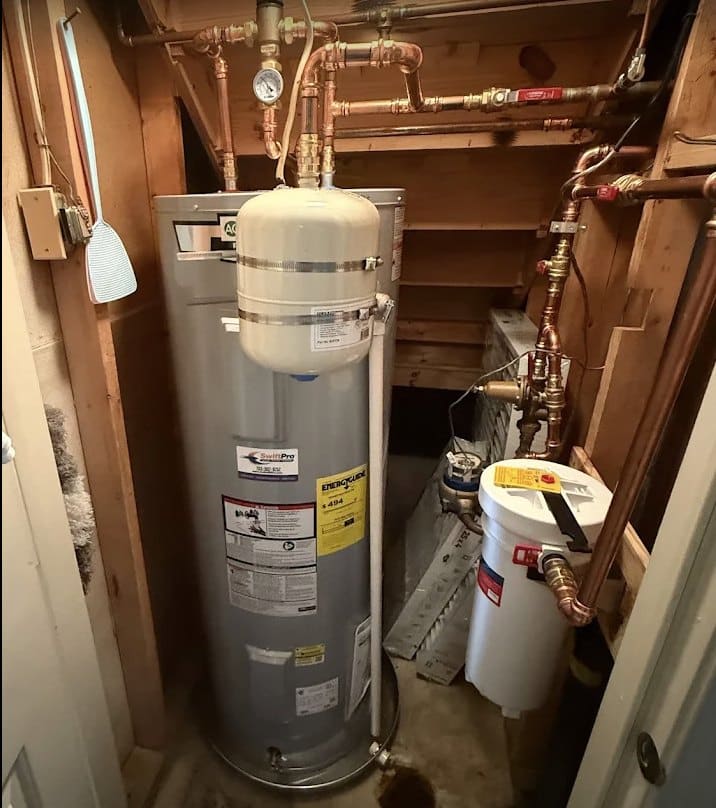
Pressure is the usual suspect. Most houses have a check valve or a pressure reducing valve where the water comes in, so the plumbing is closed: heat the water, it expands, and it has nowhere to go but out the relief valve. In A. O. Smith’s words, most homes “operate as closed plumbing systems, which means all tank-type water heaters require thermal expansion tanks.” Rheem’s target for house pressure is 40 to 60 psi. So a plumber looking at a dripping T&P puts a gauge on an outside faucet, checks the expansion tank and tests the valve, then fixes the cause along with the valve. A pressure reducing valve replacement, when that’s the cause, runs $500 to $1,000 in our price book.
If the gauge says pressure, the overnight pressure reducing valve test tells a failing valve from a missing expansion tank. How to test the tank itself, and what size it should be, is in our water heater expansion tank guide.
One rule with no exceptions: never cap or plug that pipe. That valve is what saves the house if a thermostat sticks.
Repair or replace: the age and tank size rules of thumb
Read the age first. The build date is coded into the serial number on the label, and each brand codes it differently: how long a water heater lasts decodes the common ones. A. O. Smith says most of its tanks last “between 8 and 12 years,” and Rheem gives traditional tanks the same eight to twelve.
Then the rules of thumb, which line up across the makers:
- Under about eight years and not leaking: repair. Rheem draws the line at six to eight years. Under that, with no corrosion on the tank and a repair well under half the price of a new one, fix it.
- Past ten and acting up: hear both numbers. A. O. Smith’s own line is “At 10 years old, replacement is often the smarter move.” A big part in a twelve-year-old tank buys you a tank that’s still twelve years old.
- The 50 percent rule: Rheem’s version is that “if repair costs exceed 50% of the price of a new unit, replacement is almost always the better investment.”
- Leaking from the tank, at any age: replace.
Then the size. A repair gives you back what you had. If you already run out of hot water every morning, a new element won’t change that, because the tank is too small for the house. One to four people is a 50 gallon. Five or more, or four bathrooms, is a 75, or an 80 on electric. Hot water that runs out only in winter is a different story: the water coming in is colder, and the heater is probably fine.
If it’s time, here’s what a new one costs from us, installed, with the permit, the expansion tank, the drain pan, haul-away and labor in the number:
| Water heater | Installed | Monthly, from |
|---|---|---|
| Electric tank, 50 or 80 gallon | $2,757 to $5,493 | $46/mo at 0% APR for 60 months |
| Gas or propane tank, standard vent | $3,379 to $5,485 | $56/mo at 0% APR for 60 months |
| Power vent tank, gas or propane | $5,957 to $7,494 | $99/mo at 0% APR for 60 months |
| Tankless, one condensing unit | $8,886 to $10,486 | $148/mo at 0% APR for 60 months |
Monthly figures: 60mo @ 0% APR on each starting price, the whole price financed, on approved credit. Longer plans lower the payment and cost more in total. The lender sets the final terms.
Any new tank runs $2,757 to $7,494 installed. From about $46 a month at 0% APR for 60 months, the whole price financed, on approved credit. Which row you’re in is how the house vents, and where you land inside it is the size and the warranty. The water heater estimator narrows it to your house in about a minute, and whatever we’re running this month is on our offers page. A hybrid (heat pump) water heater gets priced at the visit. Holding another company’s quote? We’ll give you a free second opinion on it.
The repairs a yearly flush heads off
Popping or rumbling from the tank is sediment. Minerals settle on the bottom, and the burner or the lower element heats through them. A. O. Smith’s advice is to “flush the water heater at least once a year to rid it of collected sediment that causes failure.” The anode rod is the other half of it. It corrodes so the steel tank doesn’t, and Rheem says to replace it every three to four years, because once it’s used up, the tank itself starts to rust.
Our water heater flush drains and flushes the tank, checks the anode rod and tests the relief valve, then goes through the rest of the house’s plumbing on the same visit. Its current price is on that page. Comfort+ members get a water heater flush with a sewer camera inspection as one of their four visits a year, for $199 a year on our membership. The whole routine, flush to valve test, is in water heater maintenance.
Tankless water heater repair
A tankless unit has no tank to rust through, so its repairs are parts and scale. When one stops, the error code on its display is where the plumber starts, which is why it’s worth reading the code off before anyone power-cycles it. The yearly job that keeps one running is a descale: minerals build up inside the heat exchanger the same way sediment settles in a tank. What a descale involves, and how often, is in tankless water heater maintenance, and its price is on the flush page.
Who comes out, and what the visit costs
A water heater call goes to our plumbing team, not the heating and cooling side. The plumbing diagnosis visit is $49, or $250 after hours, and it ends with the problem named and the repair (or the replacement) priced in writing. You decide from there. We repair every brand, tank or tankless, including heaters we didn’t install, and the rest of what our plumbers do is on our plumbing page.
Water heater repair questions, answered straight
How much does water heater repair cost?
From us, the plumbing diagnosis visit is $49 ($250 after hours), and the repair is priced in writing before any work starts. If the tank itself is leaking, it’s a replacement instead: $2,757 to $7,494 installed for a new tank. From about $46 a month at 0% APR for 60 months, the whole price financed, on approved credit.
Is it worth repairing a 10 year old water heater?
If the tank is dry and the part is small, an element or a thermostat, often yes. If it’s leaking, or it needs a big part like a gas control valve, put the replacement price next to the repair before you choose. A. O. Smith’s own line: “At 10 years old, replacement is often the smarter move.”
Why does my water heater pilot light keep going out?
On most gas tanks it’s the thermocouple, the small sensor that tells the gas valve the pilot is lit. A dirty air intake screen or a gas supply problem can do it too; A. O. Smith lists the inlet air screen, the thermopile and the fuel supply among the usual causes. A thermocouple is a repair, not a new heater.
Why is my water heater leaking from the top?
Almost always a fitting: the cold or hot connection, a supply line, or the threads of the relief valve. Those get fixed. Water from the relief valve’s pipe is either the valve doing its job against high pressure or heat, or a worn valve, and both are repairs.
Why is my water heater making a popping noise?
Sediment on the bottom of the tank, with the burner or element heating through it. A flush usually quiets it. If the noise keeps up after a repair, A. O. Smith says the cause may be a failing heating element or a cracked tank, and that’s when we’d look closer.
Why does my hot water smell like rotten eggs?
A. O. Smith puts it down to hydrogen gas reacting with bacteria in the water, and says it happens often on well water. We start with the anode rod, since it’s a part that can be swapped.
Can I fix my water heater myself?
Resetting a breaker, pressing the high-limit reset with the power off, relighting a pilot by the steps on the label: yes. A gas valve, a thermocouple you’ve never changed, or anything that means draining a tank with a bad drain valve: call. A. O. Smith treats a defective gas control valve as an emergency and says to call a professional immediately.
How long does a water heater last?
A. O. Smith and Rheem both put a tank at 8 to 12 years. Tankless lasts longer. Every maker’s number, and how to read the age off your label, is in our post on how long a water heater lasts.
Do you repair water heaters you didn’t install?
Yes, any brand, tank or tankless: repairs, flushes, anode rods and tankless descales.
Get your water heater looked at
Call (703) 997-9757 or book online. Tell us gas or electric, the age on the label if you can find it, and what it’s doing. Replacement prices are on our water heater page, and the estimator gives your house its own number.
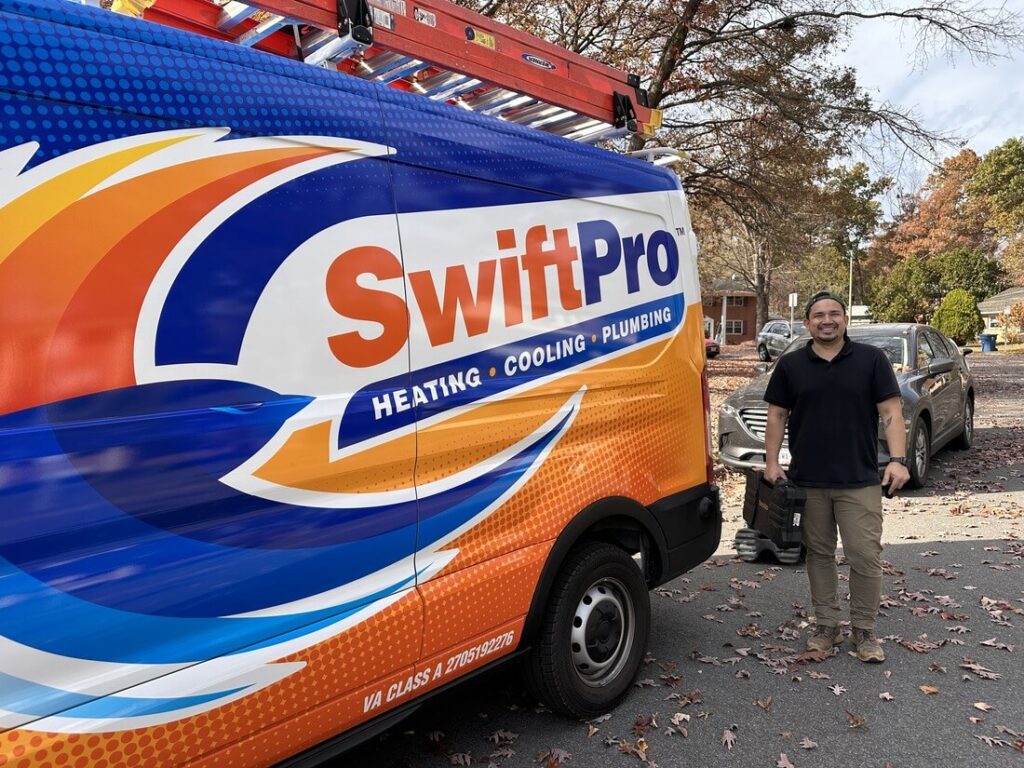
SwiftPro Heating, Cooling & Plumbing repairs and replaces tank and tankless water heaters across Northern Virginia, from Chantilly and Ashburn, any brand. We install Rheem and A. O. Smith tanks and Navien and Rinnai tankless. Family owned, BBB Accredited with an A rating, 24/7 emergency service, Virginia Class A contractor license 2705192276, and rated 5.0 stars across 1,132 reviews on Google, Angi, Yelp, the BBB and Facebook. Read the reviews.