

Filtration and softening are two different jobs and people buy them interchangeably, which is why so many households end up with a system that did not fix the thing that bothered them.
Here is the distinction in one line: a filter removes things floating in the water. A softener removes the dissolved minerals that make it hard. Neither does the other’s job.
Work out what is actually bothering you
Spots on glassware, soap that will not lather, scale on the shower head, a water heater that rumbles. That is hardness. Only a softener changes it. A filter will not.
A chlorine taste or smell. That is disinfectant residual, which every utility uses because it has to. A carbon filter removes it.
Sediment, grit, or cloudy water after a main break. That is particulate. A sediment filter handles it.
Rust-coloured staining, or a metallic taste. On a utility supply, check whether it appears at one tap or all of them; one tap is usually the fixture or the pipe feeding it. On a well, it is more likely iron and needs a different unit entirely.
Concern about specific contaminants. Read your utility’s annual water quality report first. They all publish one, they are free, and they tell you what is actually in your water rather than what a salesperson says might be.
What the numbers are here
Each utility publishes its own hardness figure, and they differ enough to matter: Fairfax Water reports 5 to 10 grains per gallon; Arlington states 8 grains; Alexandria’s most recent report shows roughly 11; Prince William Water runs 3.5 to 7 grains in its main systems and 7 to 10.5 in the Bull Run Mountain, Evergreen and Hoadly Manor systems; Loudoun Water’s central system is in the same 84 to 170 milligram per litre band as Fairfax.
Under about 3.5 grains is soft and above 10.5 is very hard, so most of this region sits in the moderately hard to hard middle. The longer version, and what hardness is doing to your equipment, is here.
If you are on a private well, none of those numbers apply to you. Test first. Well water varies enormously street to street and can carry iron, sulphur, or bacteriological issues that need specific treatment rather than a general-purpose unit.
The four things people install, and what each actually does
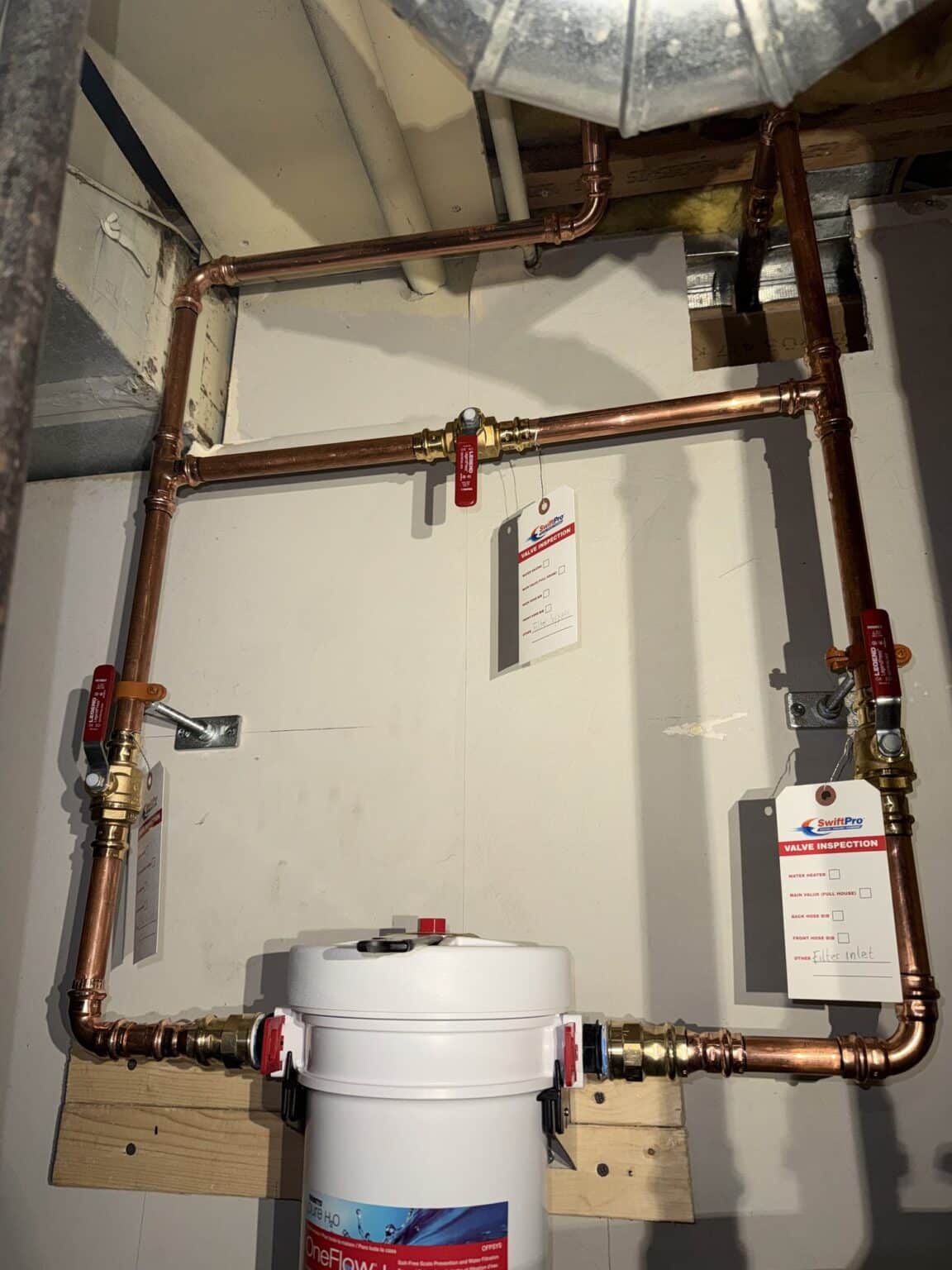
Sediment filter. A cartridge that catches grit and particulate. Inexpensive, easy to service, and genuinely useful if your water carries sediment or you are on a well. Cartridges need changing on a schedule or the filter becomes a restriction.
Carbon filter. Removes chlorine taste and odour, and improves how the water tastes throughout the house. Also has a service life and needs replacing.
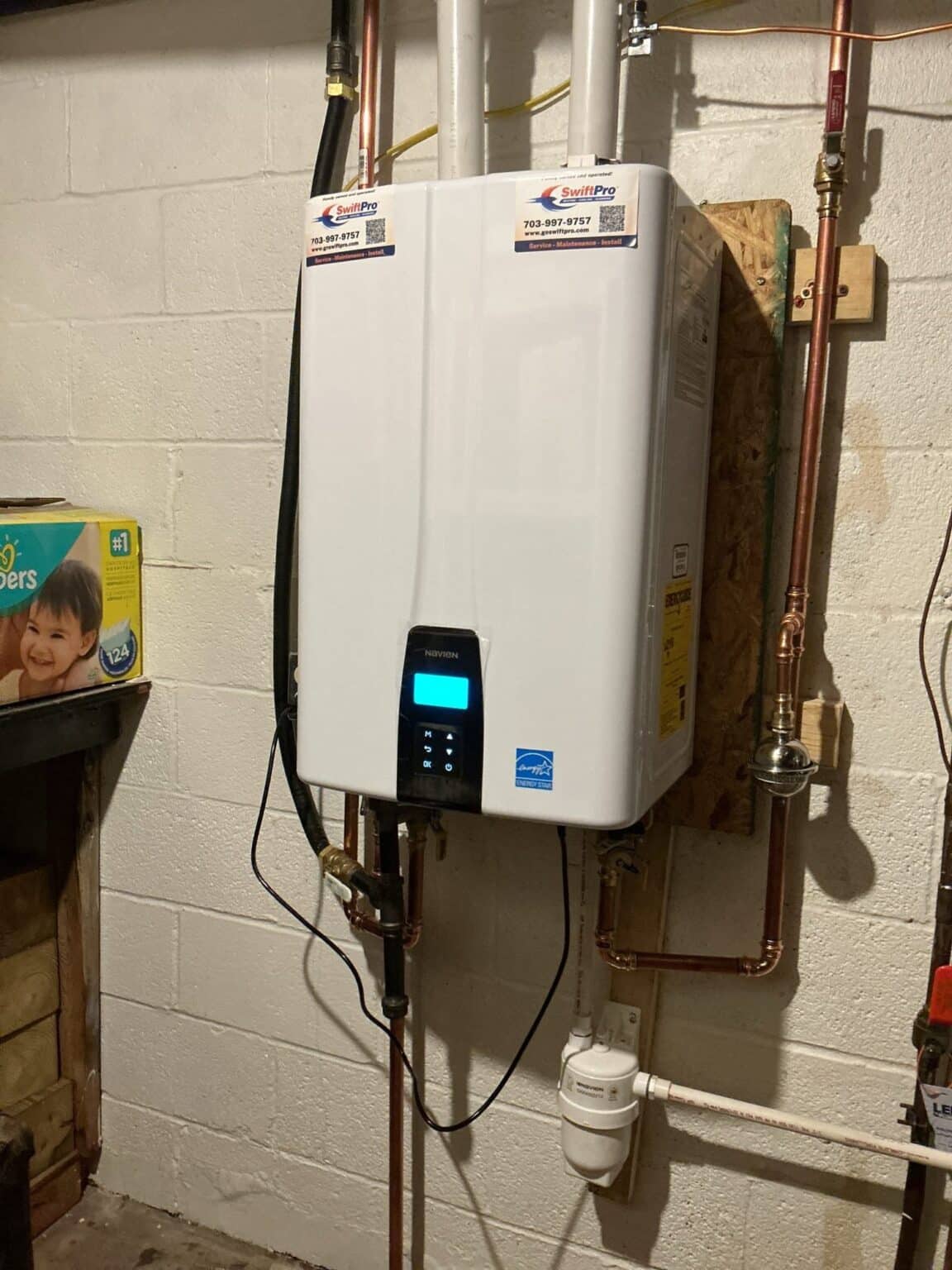
Scale inhibitor. A salt-free unit that conditions water so minerals stay in suspension rather than sticking to hot surfaces. It protects equipment, particularly a tankless water heater. It does not soften: your soap and your spotting will not change. About $800 installed, and we put one on nearly every tankless water heater we install in this water.
Water softener. Ion exchange using salt, which actually removes hardness. This is the only one that changes soap, spotting and skin. The trade-offs are real: it needs a drain and power, you carry salt, it uses water to regenerate, and it adds sodium to the softened water, which matters for anyone on a restricted sodium diet. Most installs leave the kitchen cold tap unsoftened for drinking and cooking.
Point-of-use, which is often the smarter buy
If your concern is drinking water rather than what the house does to your appliances, a good under-sink filter or a reverse osmosis unit at the kitchen tap addresses it for a fraction of a whole-house system. You are treating the few gallons you drink rather than the hundreds you shower and flush with.
That is genuinely the right answer more often than the industry admits. Whole-house treatment is for protecting equipment and changing how the whole house behaves. Point-of-use is for what goes in a glass.
Why we do not put a price on this page
We publish real prices for nearly everything, and a treatment system is the one where a published number would be misleading. It depends on what your water actually measures, what you are trying to fix, whether there is a drain and an outlet near the main, and how the plumbing comes into the house.
What we will do is look at the water, look at the space, and tell you honestly which of the four things above you need, including when the answer is none of them. If somebody quotes a whole-house system without asking what your water measures or looking at your water heater, that is a sales call rather than a diagnosis.
What to do first, this week
Look up your utility’s annual water quality report and find the hardness number. Look at your shower head and your kettle for scale. Ask yourself which specific thing is bothering you, and which of the four products above addresses that thing.
Then, if you have a tankless water heater, do something about scale regardless, because that is the one place hardness costs real money and voids a warranty.
SwiftPro handles water treatment, water heaters and plumbing across Northern Virginia. Call (703) 997-9757 or book online.