Whole Home Humidifier Installation in Northern Virginia
SwiftPro installs whole-home humidifiers across Fairfax, Arlington, Loudoun, Prince William, Fauquier and Stafford counties, from our offices in Ashburn and Chantilly. One mounts on the ductwork at your furnace or heat pump and holds the whole house between 30 and 50 percent humidity all winter. Without one, a heated Northern Virginia house often reads in the teens or low twenties in January, and that’s where the static shocks, the winter gaps in the floorboards and the dry, scratchy mornings come from. We size it to your house and your system, and price it in writing at the visit.
Tell us what heats the house (gas furnace or heat pump), about how big it is, and what you’re noticing: static, floors, dry mornings.
Licensed and insuredVirginia Class A contractor #2705192276
24/7 emergency serviceWe answer day or night, and we will tell you honestly when we can get there.
Our own HVAC installersA dedicated heating and cooling team, separate from our plumbers
Price in writing firstYou see every option priced before anything is ordered
What dry air does
Signs your house is too dry this winter
Cold air holds very little water. Heat it to 70 and its relative humidity drops through the floor, and air that dry pulls moisture out of whatever it touches. Here’s what that looks like in a Northern Virginia house.
Static shocks off every doorknob
Static is the most reliable sign the house is under about 30 percent. Shocks off the light switch, hair standing up, clothes clinging out of the dryer.
Moist air lets a charge bleed away before it builds, which is why the shocks show up in January and not in July.
Gaps in the floor, cracks in the trim
Wood gives up its moisture to dry air and shrinks. Hardwood floors open gaps between the boards in winter and close them in summer, trim pulls apart at the corners, and doors and cabinet joints loosen.
Pianos and guitars drift out of tune for the same reason, and furniture joints work loose.
Dry skin, a dry nose, dry mornings
Air that dry pulls water out of whatever it touches, and that includes your skin and the inside of your nose. Chapped lips, itchy skin, dried-out sinuses, a scratchy throat on a January morning.
Holding the house between 30 and 50 percent keeps the air from pulling that hard.
Dust that clings to everything
Static charge pulls dust onto TV screens, blinds and the wall above the vents, and it holds it there.
A humidifier won’t take dust out of the house, though. That’s the filter’s job, and the ducts’. Both are on our indoor air quality page.
Comfort at a lower setting
Why 68 feels warmer with a humidifier running
Part of how warm you feel comes from how fast moisture evaporates off your skin.
In dry air, moisture leaves your skin faster, and evaporation cools you. That’s why 68 at 20 percent humidity feels chilly and the same 68 at 40 percent feels fine. In a dry house the thermostat creeps up 2 or 3 degrees to make up for it.
Once the humidity is back in range, most people turn the thermostat down a degree or two and feel just as warm.
Reading 66 with the heat set to 69: the kind of January morning a dry house feels colder than the number says.
Measure first
Check your humidity before you buy anything
Ten minutes and an inexpensive gauge tell you whether you need a humidifier at all.
1
Get a hygrometer
A small digital one from any hardware store does the job. Put it in a living area, away from the kitchen and the bathrooms.
2
Read it on a cold morning
Check it on a day below freezing, with the heat running. That’s when the house is driest.
3
Compare it to 30 to 50 percent
That’s the range the EPA recommends for a home. If yours reads 35 or higher on a cold day, you don’t need a humidifier.
More isn’t better. Above about 50 percent in winter, water collects on the inside of the windows, corners stay damp, and dust mites and biological growth get what they want. A humidifier is for holding a range, not maxing it out. Why windows sweat in winter, and what humidity to run.
Bypass, fan-powered or steam
The three kinds of whole-home humidifier
All three mount on the furnace or air handler and reach every room through the ducts. They differ in how much water they put out and what they need to run.
Bypass
Mounts on the supply or return duct and uses the furnace’s own blower to push warm air through a wet pad. Extra water goes down a drain, so it needs one nearby.
The workhorse for an average-size house with a gas furnace.
Fan-powered
The same wet pad with its own fan, so it puts out more moisture and doesn’t need a bypass duct.
Better in a bigger house. Most of what we install is bypass or fan-powered.
Steam
Boils water and puts the steam into the duct. Far more output, holds a setting closely, and works whether or not the heat is running. It needs its own electrical circuit.
For large houses, a lot of hardwood, or instruments.
On a heat pump: a bypass unit depends on warm supply air, and a heat pump’s air comes out cooler than a gas furnace’s, so a fan-powered or steam unit is the better match.
A whole-home humidifier on the ductwork above an HVAC unit in a utility closet.
Install day
What a whole-home humidifier install involves
Most installs take about half a day. What moves the time is how close a water line and a drain are to the furnace.
1
A water line
A small line tapped off a nearby water pipe, with its own shutoff valve.
2
A drain
Bypass and fan-powered units send their extra water to a floor drain, a condensate pump or the furnace’s own condensate line.
3
The opening in the duct
The opening gets cut, the unit mounted, and the seams sealed so the duct doesn’t leak air.
4
The humidistat
Wired to the furnace or air handler so the humidifier runs only when the blower is moving warm air. A steam unit also gets its own circuit.
We’re a Trane Comfort Specialist, and we wire humidifiers to every make of furnace and heat pump, Trane or not, so yours runs only when warm air is moving.
We price it in writing at the visit, after we’ve seen where the water and the drain are. When a humidifier coupon is running, it’s on our offers page. Replacing the furnace this winter anyway? Put the humidifier in with the new furnace or heat pump and it’s one visit.
The system we put in first
Built to take a beating. Put in by our crew.
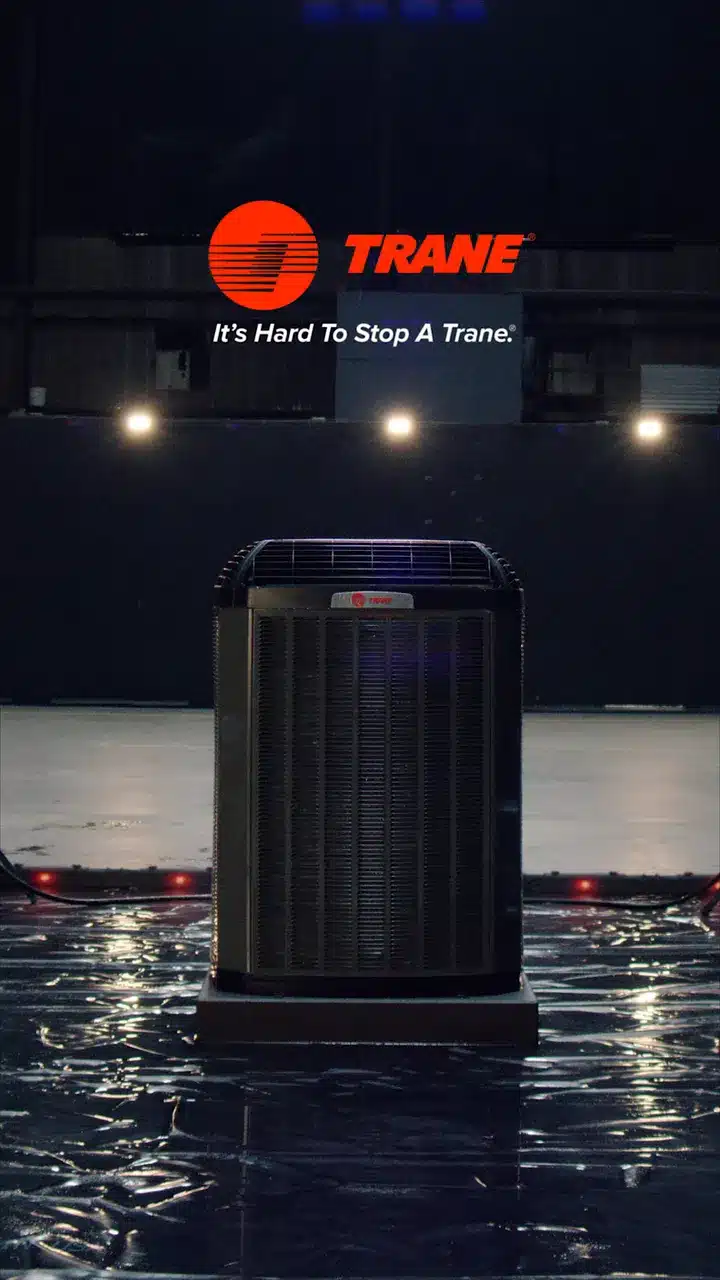
Heat lamps, snow and rain on one outdoor unit: that’s Trane’s own film. We’re a Trane Comfort Specialist, on Trane’s own dealer locator, and when you pick a Trane, our crew puts it in.
Change the water panel (the pad) once a heating season. Hard water scales it until it stops soaking up water, and then the humidifier runs without humidifying.
Open the water valve in October and close it for the summer. A bypass unit also has a damper on its bypass duct: open for winter, closed for summer.
Don’t let it go. A neglected humidifier stops working or leaks onto the furnace below it, and we’ve replaced furnace control boards a dripping humidifier ruined.
Fall is the time for all of it. The $67 Heating Check, $67 per system (through December 31), checks the furnace or heat pump before winter, and it’s an easy visit to have the humidifier pad changed at the same time. Details are on our offers page. Comfort+ members get a fall heating visit as part of the membership.
Two of our technicians at work in a tight utility closet, the kind of space a humidifier often goes into.
When not to buy one
When a humidifier is the wrong purchase
We’d rather tell you now than sell you one you don’t need.
Your hygrometer already reads 35 or higher
On a cold morning, with the heat running, you’re in range. Save your money for something else.
The windows already drip on cold mornings
The house is already holding more moisture than the glass can take, and adding more makes it worse.
I wanted a whole-home humidifier installed because of how dry it gets in the winter. … He went above and beyond to make sure the unit fit and was working properly! … Now my home humidity is at a comfortable level!
New whole-home humidifier
Riley, Google review
★★★★★
…The only thing Steven K. recommended and fortunately, it's the one thing we were looking for is installing a humidifier to our main floor HVAC. … Our sons wake up with dried throats on winter mornings and so this humidifier would be a blessing.…
Humidifier on the main floor
Rahul Vachhani, Google review
★★★★★
…We added a humidifier to our HVAC as my wife is a pianist needing moisture controlled for her piano.…
Humidifier for a piano
Drew Barnett, Google review
★★★★★
…Moises Rojas fixed my home’s whole house humidifier, which I had no idea wasn’t working for over two years since moving into this house, and now the air in my home is very comfortable.
Whole-home humidifier installation across Northern Virginia
We install and repair whole-home humidifiers across Fairfax, Arlington, Loudoun, Prince William, Fauquier and Stafford counties, from our offices in Chantilly and Ashburn.
How much does a whole-home humidifier cost to install in Northern Virginia?
We price it at the visit, in writing, before any work starts. The number depends on the type (bypass, fan-powered or steam) and on how far the water line and the drain have to run to reach the furnace. Steam costs the most, since it needs its own electrical circuit. When a humidifier coupon is running, it’s on our offers page.
What humidity should my house be in winter?
Between 30 and 50 percent, the range the EPA recommends for a home. Heated Northern Virginia houses often read in the teens or low twenties in January. On the coldest nights, run it toward the low end: the window glass is the coldest surface in the house, and it fogs first.
Does a whole-home humidifier make the house feel warmer?
Yes. Moist air slows the evaporation off your skin, so the same thermostat setting feels warmer. Most people turn the thermostat down a degree or two once the humidity is back in range and feel the same.
Bypass, fan-powered or steam: which humidifier do I need?
A bypass unit uses the furnace’s own blower and suits an average-size house with a gas furnace. A fan-powered unit has its own fan and puts out more, so it fits a bigger house. Steam puts out the most, runs whether or not the heat is on and needs its own circuit, for a large house, a lot of hardwood or a piano. Most of what we install is bypass or fan-powered.
Can you put a whole-home humidifier on a heat pump?
Yes, but match the type. A bypass unit depends on warm supply air, and a heat pump’s air comes out cooler than a gas furnace’s, so a fan-powered or steam unit is the better match on a heat pump.
How long does a humidifier installation take?
About half a day for most houses. A long run to the nearest water line or drain, or the electrical circuit a steam unit needs, adds time.
How often does the humidifier pad need replacing?
Once a heating season, every fall. Hard water scales the pad until it stops soaking up water, and then the humidifier runs without humidifying. Open the water valve in October and close it for the summer.
Is a portable humidifier enough?
For one bedroom, yes. For a whole house you’d be filling tanks every day. A whole-home unit is plumbed in, runs with the furnace and reaches every room the ducts reach.
Can you fix a humidifier I already have?
Yes. Most that stopped working have a scaled pad, a water valve that’s closed or clogged, a bypass damper still set for summer, or a humidistat that isn’t calling. Those are the first things we check.
Dry house this winter?
Get your whole-home humidifier priced in writing
Send the form at the top and tell us what heats the house and what you’re noticing. The office calls or texts you back to set a time.
SwiftPro Heating, Cooling & Plumbing
4230 Lafayette Center Dr N, Chantilly, VA 20151
44679 Endicott Dr, Suite 211, Ashburn, VA 20147 SwiftPro Plumber & Water Heaters
4200 Lafayette Center Dr, Suite N, Chantilly, VA 20151
Virginia Class A contractor license #2705192276
Current offers, and what each one covers, are on our offers page.
The number on the side of the van is our license: Virginia Class A #2705192276.