Updated October 2026 with current model names, warranties and our installed prices.
Our first pick for a tankless water heater is Navien, then Rinnai, Rheem and Noritz. A new Navien condensing tankless installed in Northern Virginia runs $8,886 to $10,486 in our price book, with the permit and hauling the old heater away in that number. From about $148 a month at 0% APR for 60 months, the whole price financed, on approved credit. How financing works
Navien and Rinnai are the two we install, Navien most of all, so we know them from the gas line to the yearly descale. A bigger gas line, if your house needs one, is quoted separately and in writing before any work starts.
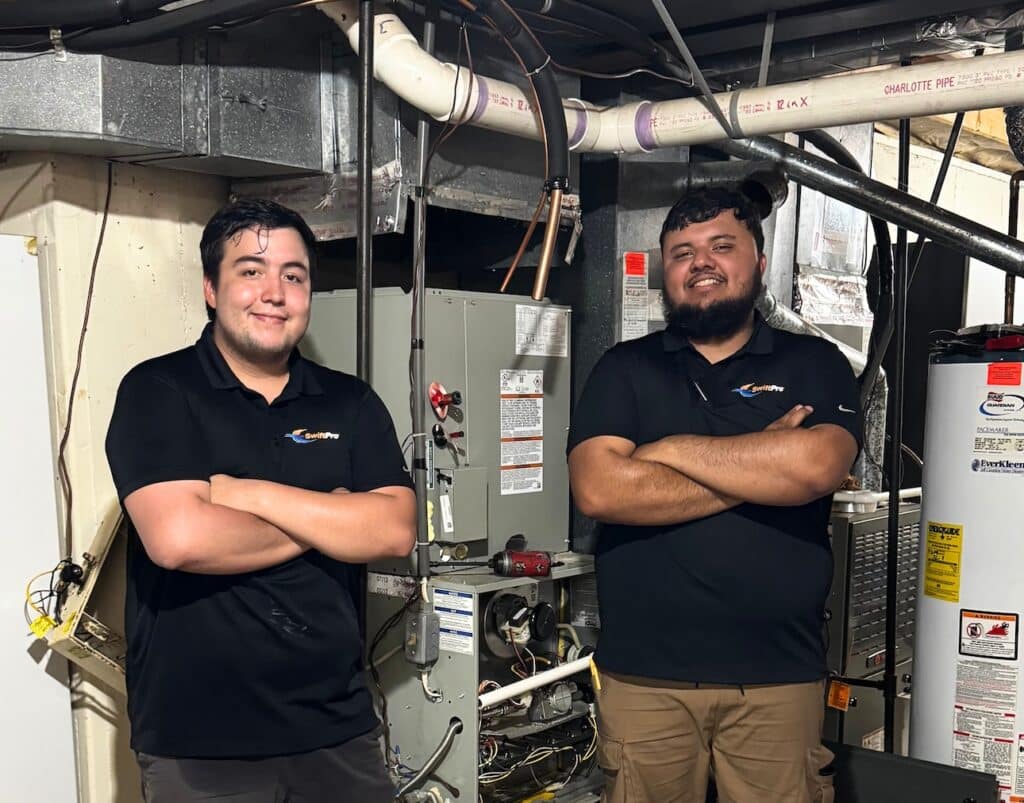
Tankless water heater brands, ranked
| Brand | Best at | Pump built in | Heat exchanger warranty, home use | Do we install it? |
|---|---|---|---|---|
| 1. Navien | Faster hot water at the tap, and a half inch gas line on short runs | NPE-A2 | 15 years | Yes, most of ours |
| 2. Rinnai | Running on a trickle, and a pump model that needs no return line | RXP | 15 years or 12,000 hours | Yes |
| 3. Rheem | A little more winter flow on paper | IKONIC SR | 15 years, up to 12,000 hours | We service it |
| 4. Noritz | The longest heat exchanger warranty | NRCR | 25 years on the EZ, single-family home | We service it |
| 5. Takagi | X3 models with no hard water exclusion | No, external pump | 15 years | We service it |
| 6. A. O. Smith | X3 versions that cover scale damage | Adapt+ | 15 years | We service it |
| 7. Bosch | Gas tankless is discontinued in the US | No current gas model | 15 years on existing Greentherm units | We service it |
| Electric (Stiebel Eltron, EcoSmart) | One bathroom, or a home with no gas | No | Varies | Not for a whole house here |
Warranties are each maker’s own terms for a home; the fine print that changes them is in each section.
Walk into a basement where we’ve put in a tankless and odds are good it’s a Navien. It’s the heater our installed price is built on. Here’s why, and every bit of it is on Navien’s own site.
The NPE-A2 brings its own recirculation. Navien builds a small buffer tank and a recirculation pump into the A2. On a return line, it keeps hot water close to the taps, which fixes the complaint people have most about tankless: standing at the faucet waiting. The NPE-S2 is the same heater without them. One catch: let that pump run around the clock with no control, and Navien cuts the heat exchanger warranty to 5 years. Run it on a schedule or on demand.
The numbers hold up. The NPE-240A2 fires up to 199,900 BTU at 0.95 UEF, with stainless steel heat exchangers. Navien publishes 11.2 gallons a minute at a 35 degree rise and 5.6 at 67, which is about what a January morning here asks of it. It vents in 2 or 3 inch PVC, and it can run on half inch rigid gas pipe for up to 24 feet, which sometimes saves a gas line job.
The warranty is long, and clear about what voids it. In a home: 15 years on the heat exchanger, 5 on parts, 1 on labor. Not covered: hard water deposits, lime or mineral build-up, or a unit bought online. Navien’s manual calls for a yearly flush in a home from 4 grains per gallon up, so in our water, plan on it.
2. Rinnai
Rinnai’s parent company was founded in Nagoya, Japan, in 1920, and its American arm is in Peachtree City, Georgia. The SENSEI is a good condensing heater, and it’s the other tankless we install, just less often than Navien. It does two things better.
It runs on a trickle. Rinnai lists the SENSEI RXP working from 0.13 gallons a minute; Navien lists a 0.5 gallon minimum. A bathroom tap barely cracked open is more likely to run hot on a Rinnai.
Its pump model needs no return line. The RXP can circulate through a crossover valve under a far sink, and the valve comes in the box. The RX199 is the same heater without the pump: 199,000 BTU, 0.98 UEF, up to 11.1 gallons a minute.
The warranty: in a home, 15 years or 12,000 hours on the heat exchanger, whichever comes first, and 5 years on parts. Labor is 5 years if it’s registered within 90 days, 1 if it isn’t. Set it above 160 degrees and the heat exchanger term drops to 8 years. Rinnai wants a flush once a year from 4 grains per gallon up and doesn’t cover scale damage.
3. Rheem
Rheem makes tank and tankless water heaters and has been owned by Paloma, a Japanese company, since 1988. Ruud is its sister brand. Its newest condensing tankless, the IKONIC, comes with or without a pump built in, fires up to 199,900 BTU at 0.96 UEF, and Rheem publishes 5.9 gallons a minute at a 67 degree rise, a touch more than Navien’s 5.6.
Rheem’s warranty certificate gives it 15 years on the heat exchanger in a single-family home, 5 on parts and 1 on labor, up to 12,000 hours of run time, or 3 years if a recirculation pump runs nonstop. Lime and scale damage isn’t covered, and the display shows a 1L code (A01L on the IKONIC) when it finds lime inside. We service Rheem tankless heaters, but we don’t install them. The tankless heaters we put in are Navien and Rinnai.
4. Noritz
Noritz, founded in Kobe, Japan, in 1951, carries the longest heat exchanger warranty here: 25 years, or 15,000 hours of burn time, on its EZ series in a single-family home, with 5 years on parts and 1 on labor. Two catches: it ends if the heater changes hands from the original buyer, and it doesn’t cover a unit from a seller Noritz hasn’t approved.
The EZ111 fires up to 199,900 BTU at 0.98 UEF, up to 11.1 gallons a minute. The pump-built-in model is the NRCR; the EZ takes an external kit. Noritz wants a yearly flush from 3 grains per gallon up unless a softener or its ScaleShield filter is installed, and won’t cover water harder than 12 grains. We don’t see many around here, but it’s a well-built heater.
5. Takagi
Takagi is A. O. Smith’s tankless brand: A. O. Smith bought the rights from Japan’s Takagi Industrial in 2010, by its own annual report, and Takagi warranty claims go to A. O. Smith’s address. The TK-540X3 fires up to 199,000 BTU at 0.95 UEF.
Watch for the X3 in the model number. A standard Takagi warranty doesn’t cover damage from water harder than 7 grains per gallon in a single-family home, and Fairfax Water’s ran as high as 10.8 in 2025. Takagi says X3 models have no hard water exclusions. Around here, if it’s a Takagi, make it an X3. Takagi builds no pump in; it approves an external one.
6. A. O. Smith
Best known for tank water heaters, A. O. Smith also builds the Adapt tankless line: the Adapt+ is premium condensing with a pump built in, the Adapt SC is condensing without one, the Adapt NC is non-condensing. The ATHR-199X3 fires up to 199,000 BTU at 0.95 UEF, with 5.9 gallons a minute at a 67 degree rise. Home use gets 15 years on the heat exchanger, 5 on parts, 1 on labor, and the X3 versions cover scale damage. A. O. Smith also owns State.
7. Bosch
Bosch no longer lists a gas tankless water heater in its US lineup. Its Greentherm 9000 sits under discontinued products on Bosch’s own site, and the water heaters it sells here now are electric: storage tanks, hybrids and the Tronic electric tankless. If you already have a Greentherm, Bosch still publishes its warranty, 15 years on the heat exchanger. When it’s time to replace one, you’re choosing from the brands above.
Electric tankless: Stiebel Eltron and EcoSmart, and gas vs. electric
Electric tankless is a fine answer for a small job: one bathroom far from the water heater, a sink, a home with no gas. For a whole Northern Virginia house in January, the makers’ own spec sheets make the case against it.
It takes a lot of power. Stiebel Eltron’s biggest whole-house model, the Tempra 36 Plus, draws 150 amps and needs at least a 300 amp electric service. EcoSmart’s ECO 36 and Rheem’s RTEX-36 say the same. The smaller ECO 27 draws 113 amps on a 200 amp panel. Rheem and EcoSmart both say panel upgrades are often required.
And it doesn’t make much hot water in winter. Rheem’s chart for its 36 kilowatt RETEX gives 3.1 to 3.6 gallons a minute of 120 degree water where ground water runs 42 to 52 degrees: one shower and a sink. Stiebel and EcoSmart chart for cooler 105 degree shower water, and still land at 3.9 to 4.6 for 36 kilowatts and 2.9 to 3.5 for the ECO 27. Their own sheets say it: “In warmer climates, these models provide enough hot water.”
So for a whole house here, gas. Stiebel Eltron is a family-owned German company founded in 1924 (7 years against leaks, 3 on parts); EcoSmart belongs to Rheem, which bought its maker, Eemax, in 2015. Good heaters, sized for a different job.
Who makes which tankless brand
Sister brands are half the confusion on a tankless shelf. From each company’s own site or filings:
| Brand | Owned by | Home base |
|---|---|---|
| Navien | KD Navien (KyungDong Navien), founded 1978 | South Korea; US headquarters in Irvine, California |
| Rinnai | Rinnai Corporation, founded 1920 | Nagoya, Japan; US arm in Peachtree City, Georgia |
| Rheem, Ruud, EcoSmart | Paloma, since 1988 (EcoSmart through Rheem’s 2015 purchase of Eemax) | Nagoya, Japan |
| Noritz | Noritz Corporation, founded 1951 | Kobe, Japan; US headquarters in Fountain Valley, California |
| A. O. Smith, State, Takagi | A. O. Smith Corporation, founded 1874 | Milwaukee, Wisconsin |
| Stiebel Eltron | Stiebel Eltron group, family owned, founded 1924 | Holzminden, Germany; US office in West Hatfield, Massachusetts |
Condensing or non-condensing?
A condensing tankless has a second heat exchanger that pulls heat out of the exhaust before it leaves, so more of the gas ends up in your water: 0.95 to 0.98 UEF on this list, against about 0.82 for the non-condensing models (Rheem’s Performance Plus and A. O. Smith’s Adapt NC both list 0.82). The exhaust comes out cool enough to vent in PVC. It also makes a little acidic water, pH 3 to 5 by Navien’s manual, which can run straight to a drain, through a neutralizer first, or to a condensate pump.
Replacing a gas tank in a Northern Virginia house, condensing is the one we’d pick almost every time. It’s what our price book quotes, the vent is easier to run, and the gas savings keep adding up over a life that can run twenty years.
Sizing a tankless for a Northern Virginia winter
A tankless doesn’t run out of hot water. It runs out of flow. It burns a fixed amount of gas lifting the water from whatever comes in to whatever you set, so the colder the water coming in, the fewer gallons a minute come out hot.
Brochures quote flow at a 35 degree rise, which is summer water. In a Northern Virginia January, the water reaching your house sits in the mid 40s to low 50s, so getting it to 120 is a rise of about 70 degrees, and you get roughly half the brochure number. Navien publishes 11.2 gallons a minute at a 35 degree rise for the NPE-240A2 and 5.6 at 67. Rheem’s IKONIC: 11.2 and 5.9.
A standard showerhead runs 2.5 gallons a minute; one with the WaterSense label, 2 or less. So in January, one big unit carries two showers at once, with room for a sink if the heads are WaterSense. Two showers, the dishwasher and a hot load of laundry at the same moment is more than any single heater here can keep hot. You’d feel it as lukewarm, not cold.
For a family of four, that usually means one condensing unit at the top of its maker’s range, about 199,000 BTU, sized for January. A house where three or four bathrooms really do run at once may need two units piped together, or a tank. We’ll tell you which at the visit, and why.
Switching from a tank: gas line, venting, condensate, power
Going from a tank to a tankless is more than a new box on the wall. Here’s what it takes to feed one.
- The gas line. Rheem’s standard gas tanks have burners up to 50,000 BTU an hour. A whole-house tankless fires up to about 199,000, roughly four times the gas. The half inch line that fed the tank is often too small and gets replaced. Navien’s NPE-240A2 is the exception on a short run: half inch rigid pipe up to 24 feet.
- The vent. New PVC, usually out a side wall. If the old tank shared a chimney with a gas furnace, that chimney gets checked so the furnace still vents right.
- The condensate. A drain for the acidic water, and a neutralizer ahead of it takes the bite out.
- Power. A regular 120 volt outlet for the board, fan and igniter. No power, no hot water, which is worth knowing before an ice storm.
- Service valves. Shutoffs with small side ports, so the yearly descale is a hookup instead of a plumbing job. Older installs are often missing them.
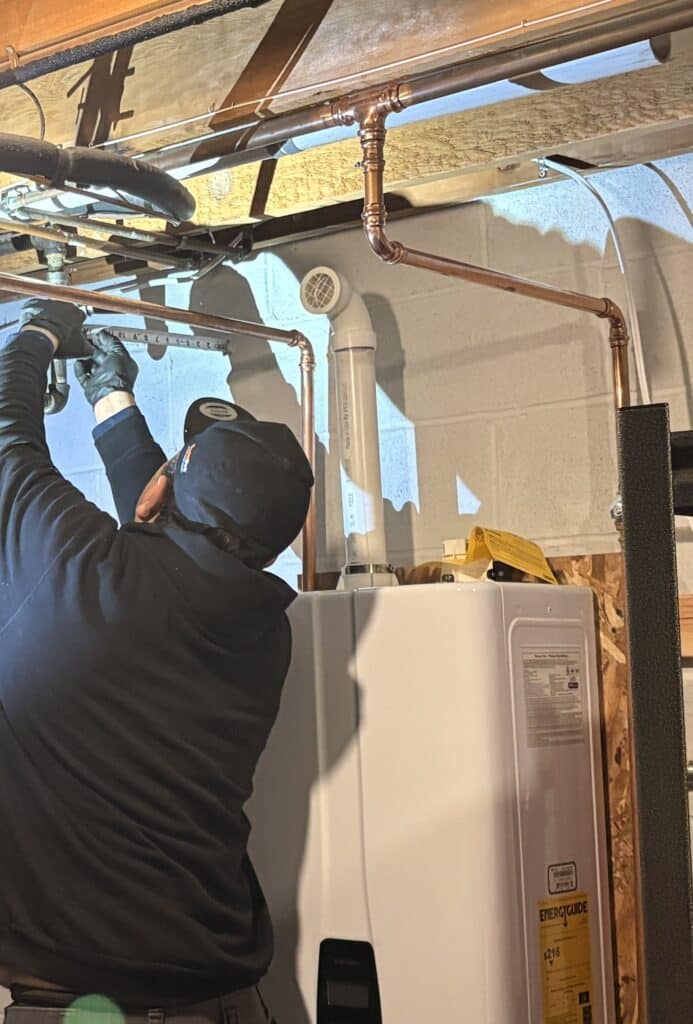
What a tankless costs installed in Northern Virginia
Straight from our price book, the same one our free water heater estimator runs on. The price covers the heater, standard installation, the permit and hauling the old one away.
| Job | Installed, our price book | Monthly, on approved credit |
|---|---|---|
| Navien gas tankless, high-efficiency condensing | $8,886 to $10,486 | $148/mo at 0% APR for 60 months |
| Tank water heater, gas or electric, any size | $2,757 to $7,494 | $46/mo at 0% APR for 60 months |
| Tankless descale, any brand | $300 (regularly $350) | Paid after the visit |
Monthly figures: 60mo @ 0% APR on each starting price, the whole price financed, on approved credit. Longer plans lower the payment and cost more in total. The lender sets the final terms.
A gas line, vent or electrical upgrade, if your house needs one, is quoted separately and in writing before any work starts. That’s the part that varies most on a switch from a tank, which is why we measure first. See your own price in about a minute on our water heater estimator, or read tank vs. tankless, side by side. Whatever we’re running right now is on our offers page.
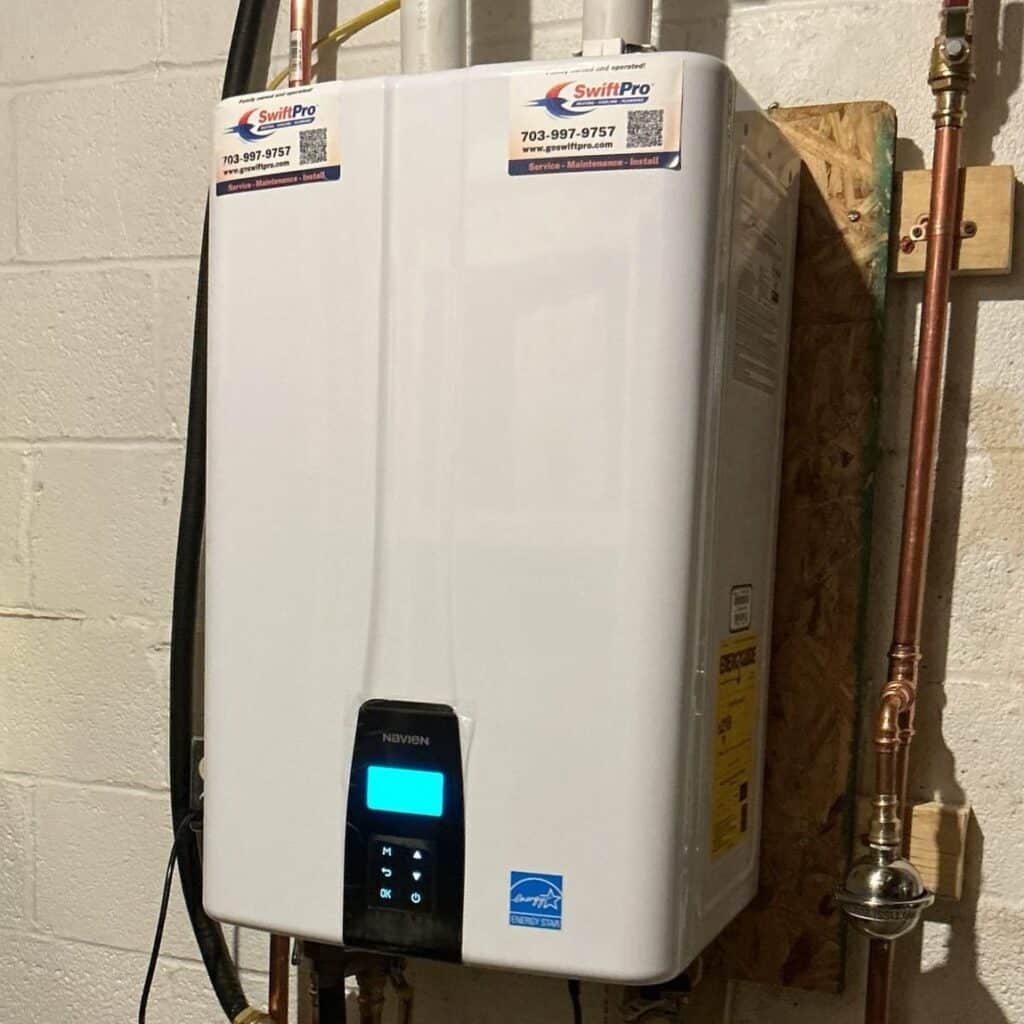
The yearly descale, and why our water decides it
Every brand on this list says it in its own words: scale is what wears these heaters out, and scale damage isn’t covered. A tankless heats water in narrow passages that get very hot, exactly where calcium and magnesium come out of the water and stick.
Fairfax Water’s finished water ran 3.0 to 10.8 grains per gallon through 2025, and most of Northern Virginia drinks Fairfax Water or water much like it. Navien and Rinnai call for a yearly flush in a home from 4 grains up, Noritz from 3, and a standard Takagi warranty stops covering at 7. The City of Manassas, whose lake water tested soft in 2025, is about the only exception around here.
So plan on a descale once a year. Ours is $300 right now, regularly $350, for one tankless of any brand, and the visit includes a whole-home plumbing safety check. Book a descale, see the whole yearly list, or look up how hard your town’s water is.

What matters more than the brand
We’d rather put in a middle-of-the-line heater right than a top-of-the-line one wrong. Three questions for whoever quotes yours, on top of the list above:
- What temperature rise did you size it for? If the answer is the number on the box, it’s sized for July.
- What’s the plan for scale? In our water, a yearly descale or a softener is part of keeping the warranty.
- Who registers it? Rinnai, for one, gives 5 years of labor instead of 1 when it’s registered within 90 days. Get the proof.
Questions people ask about tankless water heater brands
What’s the best tankless water heater brand?
For most Northern Virginia homes, Navien, and it’s the one we install most. Rinnai is right behind it, then Rheem and Noritz. Sizing for January water and a yearly descale matter more than which of the four you pick.
What is the most reliable tankless water heater brand?
Nobody publishes failure rates you can line up side by side, so be wary of anyone who quotes you one. Around here they fail from scale, almost every time, and every maker excludes scale damage. Any of the top four, descaled every year, is a reliable heater.
Yes. It’s the one we put in most often. Navien is the American arm of South Korea’s KD Navien, founded in 1978, and its NPE-2 heaters carry 15 years on the heat exchanger in a home, with a pump built into the A2.
Close enough that the install decides it. Navien’s NPE-A2 has a pump and buffer tank built in and can run on half inch gas pipe for a short run. Rinnai’s RXP needs no return line, keeps running at a lower trickle, and gives 5 years of labor when registered. Both carry 15 years on the heat exchanger. We install more Navien because we know it inside out.
Rinnai vs. Rheem tankless?
Both make good condensing heaters, with or without a pump, with 15 years on the heat exchanger in a home. Rinnai’s RX rates 0.98 UEF to the IKONIC’s 0.96 and can give 5 years of labor. Neither is a mistake; pick the installer.
Close on paper: both condensing, up to 199,900 BTU, 15 years on the heat exchanger. Rheem lists 5.9 gallons a minute at a 67 degree rise to Navien’s 5.6; Navien adds a buffer tank to its pump and can get by on half inch gas pipe on a short run. We lead with Navien because it’s what we install most.
Noritz wins on paper with 25 years on the EZ’s heat exchanger against Navien’s 15, but Noritz’s warranty ends when the heater changes hands, so it doesn’t follow the house if you sell. Navien builds its pump into its main line; at Noritz that’s a separate model, the NRCR.
Who makes Takagi?
A. O. Smith. It acquired the rights from Japan’s Takagi Industrial in 2010. In our water, buy an X3: a standard Takagi warranty doesn’t cover water harder than 7 grains per gallon.
Condensing or non-condensing tankless?
Condensing, for nearly every house here: about 0.95 to 0.98 UEF against about 0.82, a PVC vent, and it’s what our price book quotes. It needs a drain for its condensate.
Gas or electric tankless?
Gas, for a whole house here. A 36 kilowatt electric unit needs a 300 amp service, and Rheem’s own chart gives it 3.1 to 3.6 gallons a minute of 120 degree water in winter: one shower and a sink. Electric suits one bathroom or a home with no gas.
What size tankless does a family of four need?
Usually one condensing gas unit around 199,000 BTU, sized for a January rise of about 70 degrees. That carries two showers at once. If three showers regularly run together, plan on two units or a tank.
Which tankless water heaters have built-in recirculation?
Navien’s NPE-A2, Rinnai’s RXP, Rheem’s IKONIC SR, Noritz’s NRCR and A. O. Smith’s Adapt+. Rinnai’s RXP is the one that works through a valve under a sink with no return line.
How long does a tankless water heater last?
Navien and Rinnai both say up to 20 years, and the Department of Energy says more than 20, against 10 to 15 for a tank. The ones that die young around here usually die of scale.
Does a tankless water heater need maintenance?
Yes: a descale once a year, because our water is hard. Ours is $300 right now, regularly $350, any brand. The rest is small checks: the inlet filter, the air filter on models that have one, the condensate neutralizer and the vent.
How much does a tankless water heater cost installed?
In our price book, $8,886 to $10,486 for a Navien high-efficiency condensing gas unit, with the permit and haul-away included. From about $148 a month at 0% APR for 60 months, the whole price financed, on approved credit. A gas line or vent upgrade, if your house needs one, is quoted separately after we measure.
Thinking about going tankless?
Pick from the top of this list, then put your real questions to the installer. Did they size it for January? Is the gas line in the quote? Who descales it, and what does that cost? If you’d like us to take a look, call (703) 997-9757 or book online. Already have a tankless that’s acting up? Start with what each symptom means.
More brand rankings from our installers: the best HVAC brands, furnace brands, heat pump brands, mini split brands and water heater brands.
SwiftPro Heating, Cooling & Plumbing installs and services tank and tankless water heaters across Northern Virginia, out of Chantilly and Ashburn. We’re family owned, BBB Accredited with an A rating and a Rheem Pro Partner, with 24/7 emergency service. Virginia Class A contractor license 2705192276, rated 5.0 stars across 1,131 reviews on Google, Angi, Yelp, the BBB and Facebook. Read the reviews.