The short answer
The best winter thermostat setting in Northern Virginia is 68 while you’re home and awake, turned back 7 to 10 degrees for about 8 hours while you sleep or go out. That’s the Department of Energy’s number, and they say it can save as much as 10 percent a year. Two exceptions change the answer: a heat pump gets a small setback, and a hard freeze gets no setback at all.
What to set, by system
Swipe to see all columns →
| Your system | Home and awake | Asleep or out |
|---|---|---|
| Gas or propane furnace | 68 | 58 to 61 if you’re comfortable, or whatever you can live with |
| Boiler | 68 | A smaller setback, because boilers are slow to bring a house back up |
| Heat pump | 68 | 66, unless your thermostat is made to recover without backup heat |
| Any system, about 20 degrees outside or colder | Pick a number and hold it | Same number. No setback |
| Nobody home for days | 55 or higher | The going away list |
Those are starting points. If 68 feels cold to you, set 70 and turn it back the same amount. Comfort is your call, and the savings come from how far and how long you set back.
Why a heat pump is different
A heat pump’s outdoor unit brings heat in gently. Ask for 8 degrees all at once on a cold morning, and it calls the backup electric strips to help, and those cost far more to run. That’s why a small setback is usually the better deal. Aux heat and emergency heat explains the two settings people mix up. And heat pumps do fine in a Virginia winter when they’re set right.

Why you hold steady in a freeze
When it’s around 20 outside, a pipe in an outside wall is close to freezing, and the Red Cross says keep the thermostat at the same temperature day and night. A setback on that night could cost you a lot more than it saves. What not to do if a pipe freezes anyway.
What people get wrong
Setting it to 85 to warm up faster. The system puts out the same heat at any setting. It just runs longer and overshoots.
Thinking a setback uses more energy to recover. The DOE says it doesn’t. A cooler house loses heat more slowly, so you save during those hours.
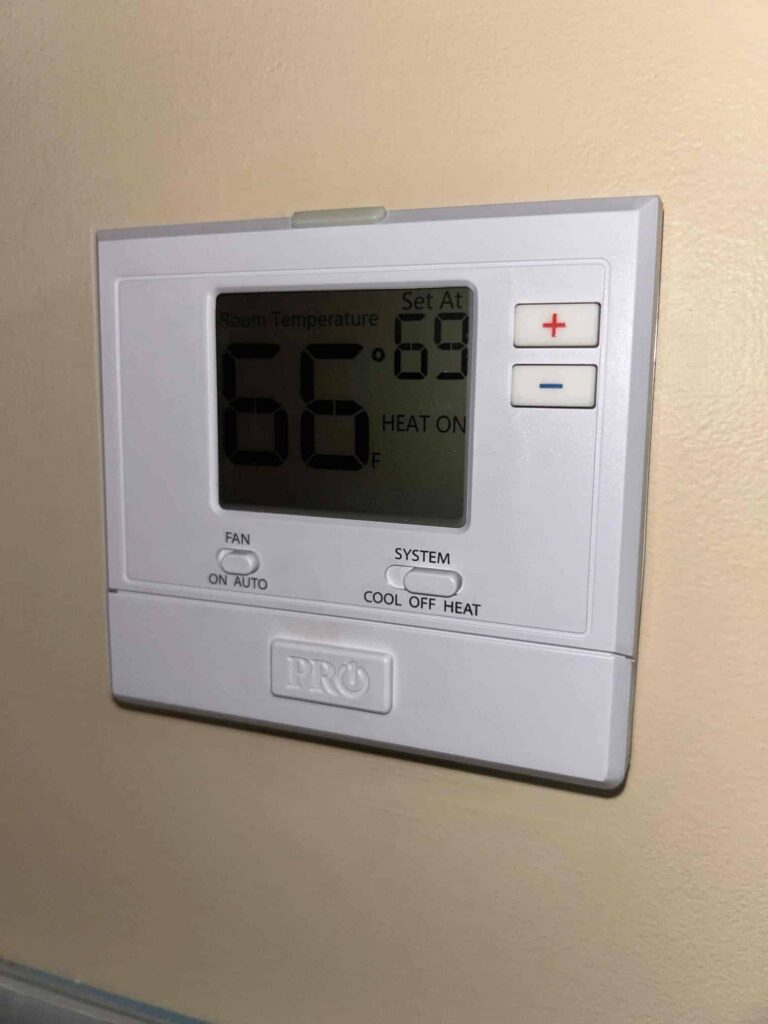
Leaving the fan on ON. On a furnace or a heat pump, ON blows air through the house between cycles, and it can feel cool. Use AUTO.
Heating the thermostat by accident. A lamp, sunny window or space heater near it makes it think the house is warm. The back bedrooms pay for it.
Closing vents to make up for a setting. It doesn’t send more heat anywhere useful, and it’s hard on the system. The rest of what not to do.
When the number won’t hold
On the coldest days a system may run all day and sit a couple of degrees short. Here is when that is normal. If it’s way short, or the screen is blank, check the thermostat first. A clogged filter is still the most common cause we’d rule out first, and it costs almost nothing to check.
Book it
If your setting won’t hold, or you just want the system looked at before the cold settles in, we can do that. The heating check is $67 per system through December 31, on a furnace, heat pump or boiler. Book it from goswiftpro.com/cookiesoffer and free MOLTN cookies come with the visit. Or call (703) 997-9757. SwiftPro is rated 5.0 stars across 1,138 reviews on Google, Angi, Yelp, the BBB and Facebook, Virginia Class A license 2705192276.
Questions people ask
What’s the best thermostat setting for winter?
The Department of Energy’s number is 68 while you’re home and awake, turned back 7 to 10 degrees for about 8 hours while you’re asleep or out, if you have a furnace or boiler. Heat pumps do better with a small setback.
Is it cheaper to leave the heat on all day or turn it down?
Turning it down. The DOE says a house loses less heat when it’s cooler inside, so you use less than it takes to warm back up. Turning it back 7 to 10 degrees for 8 hours a day can save as much as 10 percent a year.
How far should I set back a heat pump?
Just a couple of degrees, unless your thermostat is made to recover without the backup strips. A big setback makes the electric strips run on the way back up.
Should I turn the heat down at night during a hard freeze?
No. When it’s around 20 outside or colder, the Red Cross says hold the same temperature day and night, because pipes in outside walls are at risk.