

The short answer
A typical 40 gallon gas tank in a Northern Virginia home heats a full tank of cold water in about an hour. A 50 gallon electric tank takes about twice as long. In winter both take longer, because the water coming in from the street is colder.
The part most people don’t know
The number on the tank, 40 or 50 gallons, isn’t the one that matters most. What matters is how fast the burner or elements heat new water, called the recovery rate, and the first hour rating: how many gallons of hot water the heater can deliver in an hour, starting with a full tank of hot water, in DOE’s words. A smaller gas tank beats a bigger electric one:
Swipe to see all columns →
Swipe to see all columns →
| Water heater (maker’s spec sheet) | Tank | Recovery | First hour rating |
|---|---|---|---|
| Gas, atmospheric vent (A. O. Smith ProLine GUC-40) | 40 gallons | 41 gallons an hour | 83 gallons |
| Gas, power vent (A. O. Smith ProLine XE GPVL-40) | 40 gallons | 44.7 gallons an hour | 73 gallons |
| Electric, 4,500 W elements (Rheem XE50T09CG45U0) | 50 gallons | 21 gallons an hour at a 90° rise | 63 gallons |
A gas burner puts heat into the water much faster than electric elements do, and most electric tanks run one element at a time. The Rheem sheet lists its elements as non-simultaneous: the upper one heats first, then hands off to the lower one.

$99 Water Heater Flush
We drain and flush the tank, check the anode rod and test the relief valve, then go through the house's plumbing with photos, included. See the flush
Want your own number before anyone comes out? The water heater estimator prices your house in a few questions.
The math on an electric tank
That electric tank recovers 21 gallons an hour when it has to raise the water 90 degrees, so 50 gallons takes about 2 hours 25 minutes. Raising 58 degree water to 120 is less work, closer to 30 gallons an hour, or about 1 hour 40 minutes for the full tank, by our math. The gas tanks recover about 41 to 45 gallons an hour, so 40 gallons takes about an hour.
Why it’s slower in winter
The federal test assumes 58°F water coming in. In winter the water from the street is colder than in summer, so every gallon needs more heat and recovery slows. The first hour rating also assumes the tank started full of hot water. After back-to-back showers it didn’t. That’s why the same tank runs out sooner in January: why hot water runs out faster in winter.
When slow recovery means a problem
If your tank used to keep up and now doesn’t, something changed. Bradford White’s service manual says slow recovery on an electric heater usually comes down to sediment or lime built up around the element. And because the upper element heats first, a tank whose lower element has quit still heats the top of the tank: you get a short run of hot water, then it goes cold.
On gas, sediment settles over the burner and sits between the flame and the water. You’ll often hear it before you notice it: popping and rumbling during a reheat. See what water heater noises mean and our sediment video. If the light on a gas control is blinking, our error codes and warning lights guide covers what the blinks mean.

Turn it to 120, not 140
DOE says 120°F is enough for most homes, and a tank set at 140°F can waste $36 to $61 a year in standby heat loss, on top of a real scald risk. A hotter setting also means more to reheat after every shower.
Running out vs waiting at the tap
Those are two different problems. Running out mid-shower is recovery and size: a flush, a repair or the right tank fixes it, and tank vs tankless lays out the choice. Waiting a minute for hot water to reach the faucet is distance, not the heater: why hot water takes so long to reach the tap. No hot water at all? Start with what to check first.
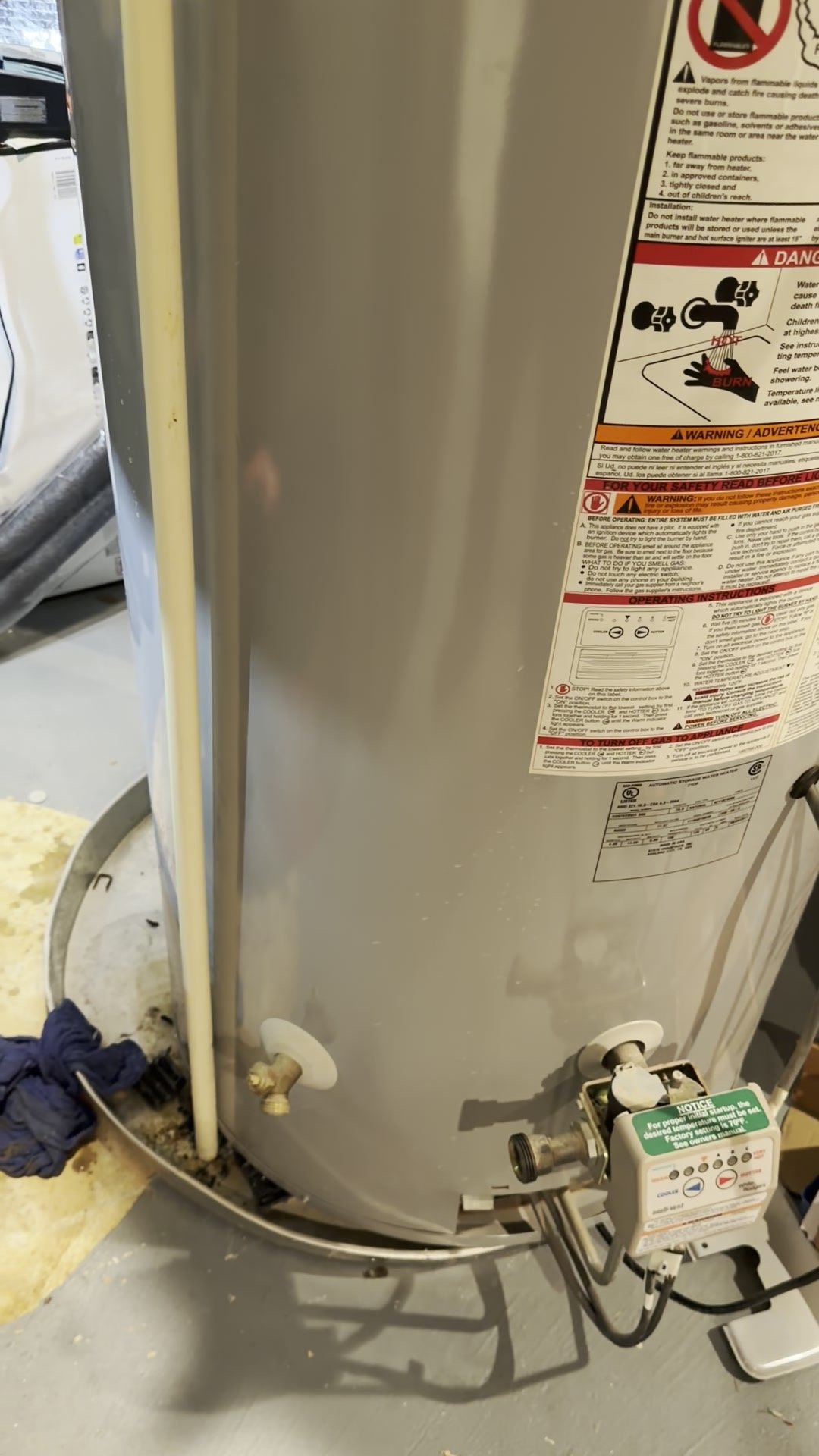
What we check
Our water heater flush is $99: we drain and flush the tank, check the anode rod and test the relief valve, then go through the house’s plumbing with photos, included. If the tank is getting on in years, how long a water heater lasts tells you what to expect. If the tank is the problem, our water heater estimator shows your installed price first, then $500 comes off a new water heater, any size, replaced by our own plumbers.
Book it
Book the water heater flush, call (703) 997-9757, or book online from goswiftpro.com/cookiesoffer and a box of warm cookies comes with the visit. Rated 5.0 stars across 1,138 reviews on Google, Angi, Yelp, the BBB and Facebook, Virginia Class A license 2705192276.
Questions people ask
How long does a gas water heater take to heat up?
About an hour for a typical 40 gallon tank. The maker spec sheets we checked list gas recovery at about 41 to 45 gallons an hour.
How long does an electric water heater take to heat up?
About 1 hour 40 minutes to 2 hours 25 minutes for a 50 gallon tank with 4,500 watt elements, depending on how cold the incoming water is. Most electric tanks heat with one element at a time.
Why does my water heater take so long to recover?
Usually sediment. On gas it sits between the burner and the water. On electric it builds up around the element. A failed lower element on an electric tank also cuts recovery. A flush and a look at the burner or elements tell you which.
What temperature should my water heater be set to?
120°F for most homes, per the Department of Energy. A higher setting wastes standby heat and raises the scald risk.

