The short answer
In Northern Virginia, the water utility owns the main in the street and the meter, and you own the pipe from the meter to your house. So a leak between the meter and the house is yours to fix, and every gallon it loses goes through your meter and onto your bill. Fairfax Water, Loudoun Water, Arlington County and Prince William Water all draw the line in about the same place.
If that’s what’s behind a water bill that jumped, most utilities here give a credit once the leak is fixed (how to ask for a leak adjustment). The sewer pipe has its own split, and who is responsible for the sewer line covers it.
Who owns what, utility by utility
Swipe to see all columns →
| Utility | Theirs | Yours |
|---|---|---|
| Fairfax Water | The main and the meter | Everything from the meter, or the valve near the street, to your faucets, the pressure reducing valve included |
| Loudoun Water | The service connection: the tap on the main, the pipe to the meter, the meter and its box | The pipe from the meter to the inside of your wall, repaired by a plumber you hire |
| Arlington County | The main, the line to the meter, the meter and its box | The pipe from the meter to the house |
| Prince William Water | The meters | The lines on your property, and all the water that passes through the meter |
A few towns run their own water, among them Leesburg, Herndon, Vienna and the City of Manassas. If your bill comes from one of them, their rules decide it, and the bill tells you who to ask.
Older houses can have the meter inside. Fairfax Water says many houses built from 1971 to 1980 have an inside meter with a remote reader outside. Fairfax Water puts your side starting at the meter or the valve near the street, so on those houses the buried line from that valve is yours too.
How it shows up
- The meter test. Shut the main valve where the line comes into the house, then watch the leak indicator on the meter. If it keeps turning with the main shut, the leak is between the meter and that valve (how to read the leak indicator).
- A wet or green strip in the yard. A line of grass greener than the rest, or soggy ground, running from the meter toward the house, most of all in a dry spell.
- A soft or sinking patch along the same path, or water seeping up near the spot where the line comes through the foundation.
- Water in the meter pit. Some after a rain is normal. A pit that stays full in dry weather is worth a call to the utility first, since the pit and the meter are theirs.
- Low pressure everywhere at once. A big enough leak steals pressure from every faucet (low water pressure in the whole house).
- A higher bill with no change in how the house uses water.
A leak under the house itself looks different, with warm spots and cracks inside, and slab leak signs covers that one.
What the fix is
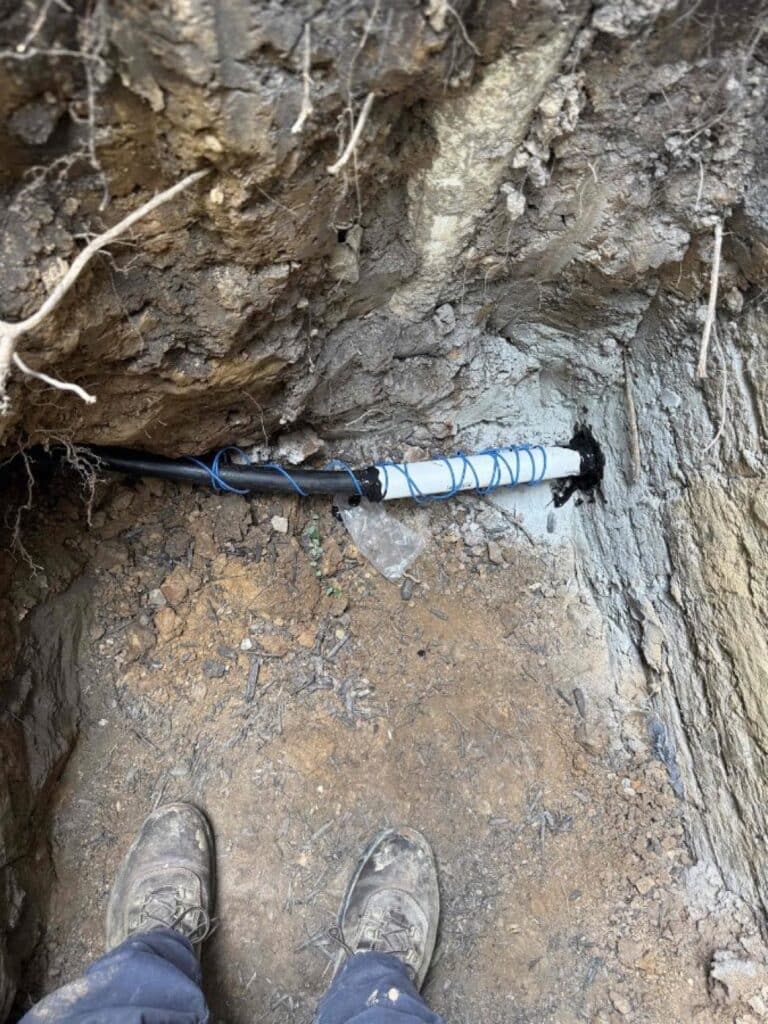
First it gets found. With the meter test done, a plumber listens along the line with acoustic gear and pressure tests it to pin down the spot, so the dig is one hole instead of the whole yard. Leak detection runs $200 to $500 (how leak detection works). Then one of two repairs:
- A spot repair. Dig at the leak, cut out the bad section, join in new pipe. It makes sense on a newer line with one failure.
- A new service line. On an old line, galvanized steel or polybutylene, or one that has leaked before, replacing the whole run from the meter to the house is the fix that stays fixed. A new water service line runs $3,500 to $8,000. From about $58 a month at 0% APR for 60 months, the whole price financed, on approved credit.
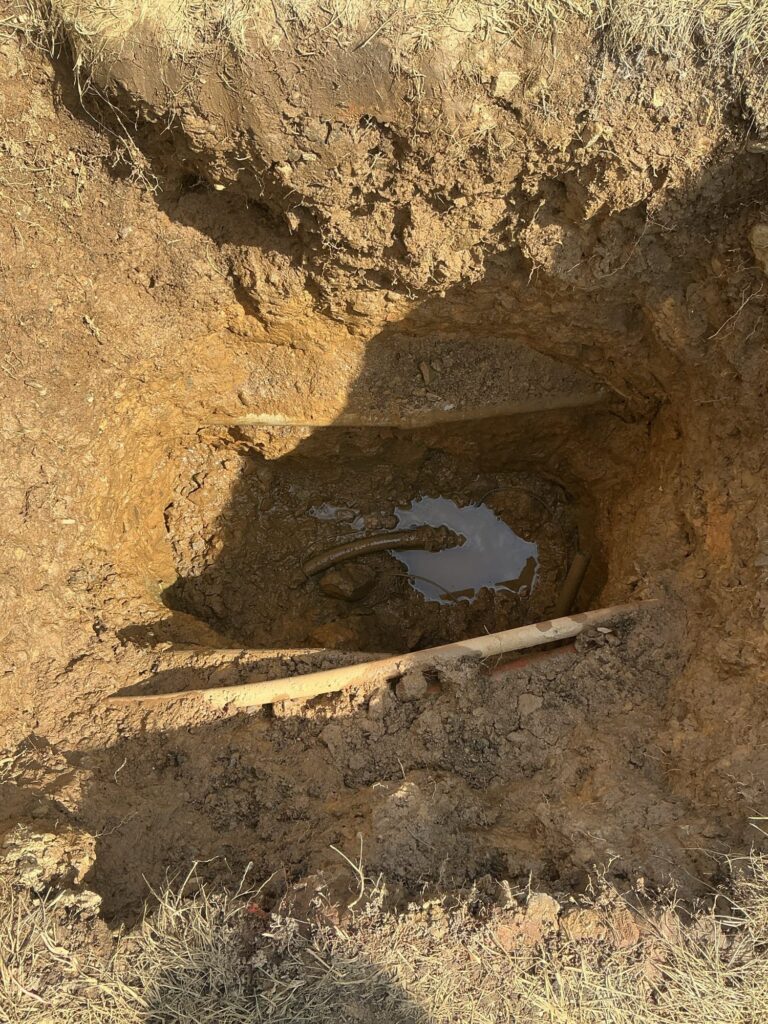
What it looks like: a water line leak in the yard and the main water line to a house. More on the job itself: water line replacement.
While the line is open is the time to replace a main shutoff that won’t close all the way (main water shutoff valve replacement). Not sure where yours is? Find your shutoff valves before you need them.
Getting the water back off the bill
The water you lost went through your meter, so it’s on your bill, but most utilities here give a leak credit once the repair is done. Loudoun Water rules give a water and sewer credit for an underground leak between the meter and the house’s main shutoff when it’s repaired within 30 days. Fairfax Water allows a courtesy adjustment once every five years. Keep the plumber’s invoice: it’s your proof. How to ask for the adjustment.
If you already know something’s leaking, a plumbing visit is $49 in regular hours, and the price of the fix is in writing before we start. Booking a plumbing repair? The whole-house plumbing inspection is included, so the next drip gets caught too.
Get a plumber on it
Book a plumber online, call (703) 997-9757, or book the $29 plumbing safety check. We answer day or night. Rated 5.0 stars across 1,138 reviews on Google, Angi, Yelp, the BBB and Facebook, Virginia Class A license 2705192276.
Questions people ask
Who is responsible for a water leak between the meter and the house?
In Fairfax Water, Loudoun Water, Arlington County and Prince William Water territory, you are. The utility owns the main and the meter; the pipe from the meter to your house is yours to repair, and the water it loses goes on your bill.
How do I know if my water line is leaking in the yard?
Shut the main valve inside the house and watch the leak indicator on the meter. If it keeps turning, the leak is between the meter and the house. A green or soggy strip from the meter toward the house usually marks the spot.
Will the water company pay for a leak on my side of the meter?
Not for the repair. Most give a credit on the water bill once it’s fixed, and Loudoun Water wants the repair done within 30 days. Keep the plumber’s invoice.
How much does it cost to replace a water service line?
A new line from the meter to the house runs $3,500 to $8,000 in Northern Virginia, depending on its length and the yard. From about $58 a month at 0% APR for 60 months, the whole price financed, on approved credit.