The short answer
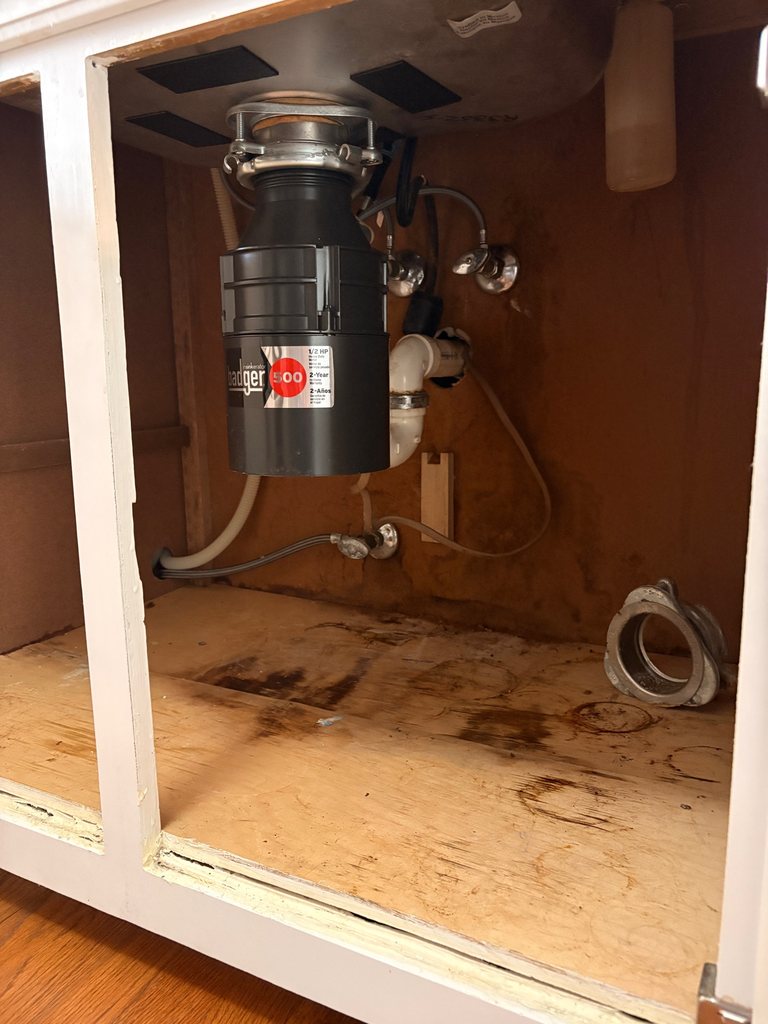
Water under a kitchen sink comes from one of a handful of places: the supply lines and their shutoff valves, the faucet base, the sprayer hose, the drain basket, the trap, or the two appliances tied in, the disposal and the dishwasher. In Northern Virginia kitchens most of them are a quick fix. The trick is finding which one, and a few dry paper towels do that better than staring.
A drain that drips only while the faucet runs won’t move the water bill much. A supply line that seeps runs all day and all night (why the water bill is high). If the water is coming down from a ceiling instead, start with the bathroom over it.
The dry paper towel test
- Empty the cabinet and dry everything: pipes, valves, the cabinet floor. Lay a dry paper towel flat on the cabinet floor.
- Leave the water off for 10 minutes, then wrap a dry towel around each supply line and valve. If one gets wet with nothing running, it’s a supply leak, and it leaks around the clock.
- Run the faucet, hot then cold, with the drain open, for a minute. Check a towel at the faucet base and along the sprayer hose.
- Fill the sink a few inches, then pull the stopper. A rush of water shows leaks at the basket strainer, the trap and its slip nuts.
- Run the disposal with water, then run the dishwasher. Check the disposal’s top, side and bottom, and the dishwasher’s drain hose.
The wet spot on the towel points straight at the drip.
Where it’s leaking and what fixes it
Swipe to see all columns →
| Where | What you see | The fix |
|---|---|---|
| Supply lines and shutoff valves | Wet with nothing running, a drip at a nut or a valve stem | Tighten or replace the supply line; an old valve that seeps gets replaced |
| Faucet base | Water pooling around the faucet up top, wet underneath while it runs | New seals, or a new faucet |
| Sprayer hose | Wet only when you use the sprayer | A new hose or sprayer |
| Basket strainer | Wet right under the bowl when the sink drains | Reset it with new putty or a gasket |
| Trap and slip nuts | Drips at the curved pipe while it drains | Tighten or replace the washers; a cracked trap gets replaced |
| Disposal | Top: the sink flange. Side: the drain or dishwasher connection. Bottom: the unit itself | Top and side reseal. A leak from the bottom means it’s done |
| Dishwasher | Wet after the dishwasher runs | Clamp or replace the drain hose, check its supply line |
A disposal leaking from the bottom can’t be fixed: the seals inside have failed. A new disposal runs $550 to $900, installed. More at garbage disposal repair and repair or replace. If it only hums, try the reset button first.
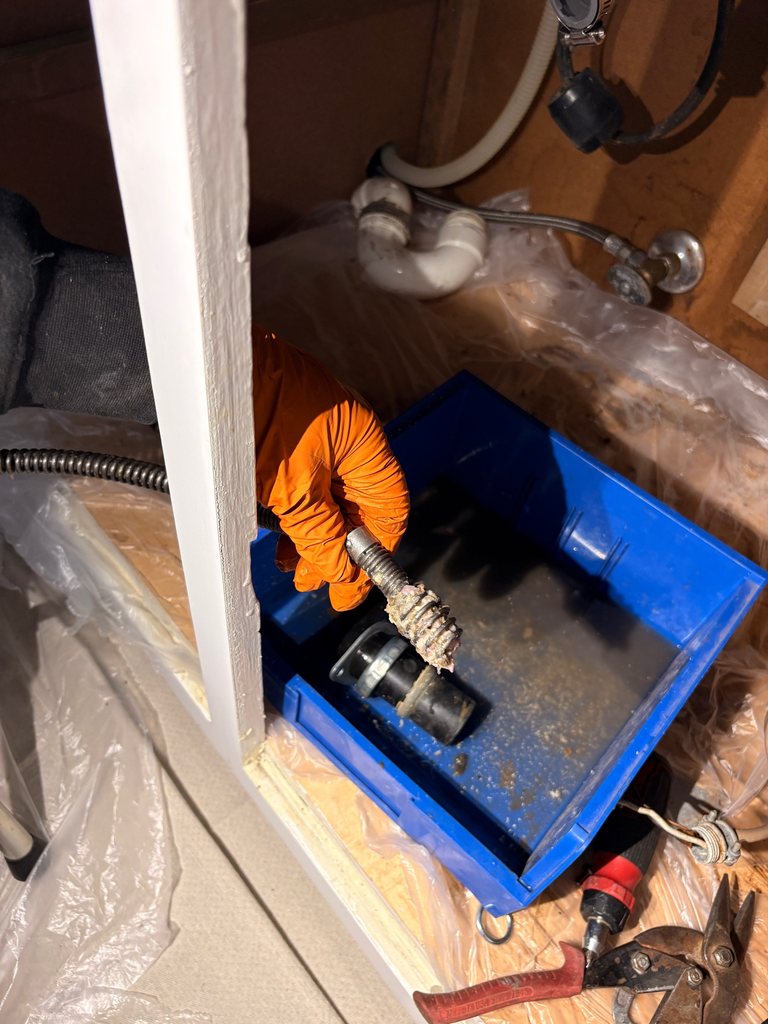
When it’s really a drain problem
A trap that leaks only when the sink is backed up is telling you about a clog: water sits higher in the pipe and finds the weak slip nut. Clear the clog and the drip often stops. See kitchen sink backing up and dishwasher not draining. Drain cleaning on one fixture runs $200 to $800.
Don’t wait on the cabinet floor
A lot of sink cabinets are particleboard, and particleboard swells and crumbles when it stays wet. Rings and stains on the cabinet floor mean an old drip that dried, or one that’s still going when nobody’s looking. A smell from the cabinet is often the drain itself (smelly sink drain). Weak flow at the faucet is usually the aerator or the cartridge (low water pressure at the kitchen sink), and a faucet dripping into the bowl is its own steady waste of water.
The laundry room is the other place a supply hose lets go without warning (how often to replace washer hoses).
If you already know something’s leaking, a plumbing visit is $49 in regular hours, and the price of the fix is in writing before we start. Booking a plumbing repair? The whole-house plumbing inspection is included, so the next drip gets caught too.
Get a plumber on it
Book a plumber online, call (703) 997-9757, or book the $29 plumbing safety check. We answer day or night. Rated 5.0 stars across 1,138 reviews on Google, Angi, Yelp, the BBB and Facebook, Virginia Class A license 2705192276.
Questions people ask
Why is there water under my kitchen sink?
Usually a supply line or valve, the faucet base, the trap’s slip nuts, the disposal or the dishwasher drain hose. Dry everything, lay paper towels down and run each one in turn to see which one wets the towel.
Why does my kitchen sink leak only when the water is running?
Then it’s the faucet base, the sprayer, the basket strainer or the trap. A leak with nothing running is a supply line or a shutoff valve.
Can a leaking garbage disposal be fixed?
From the top or the side, usually yes: it’s the sink flange or a hose connection. From the bottom, no. The seals inside have failed and the disposal needs replacing.
Is a leak under the kitchen sink an emergency?
A drip at the trap can wait for a scheduled visit with a bowl under it. A supply line that’s spraying can’t: shut the valves under the sink, or the main, and call.