The short answer
A water softener cleans itself by regenerating: it rinses salt water through the resin and sends it down the drain, usually overnight, for an hour or two. If its valve sticks, it can keep sending water down the drain for hours or days. In Northern Virginia homes with a softener, that’s a quiet leak that never shows as a puddle, only on the meter and the bill. Put the softener in bypass and watch the meter: if the meter stops, the softener was the leak.
It’s one of the things to rule out when the water bill is suddenly higher, and the leak indicator on the meter is the test (how to read it). If you hear water running at night with everything off, the softener’s drain line is one of the first places to listen (water running in the walls).
How a softener uses water when it’s working right
A softener regenerates on a schedule. Older ones run on a timer, often set for the early morning, around 2 a.m., when nobody’s using water. Newer ones are metered: they count the gallons the house uses and regenerate when the resin is due. Either way the cycle runs a set time and stops, and the brine tank refills a measured amount.
Hard water is why most people have one (hard water in Northern Virginia). Whether you need a softener or a filter is its own question: whole-house filter vs softener.
Signs it’s stuck
- Water running to the drain in the middle of the day, or for hours. Most softener drain lines end at a floor drain, a laundry sink or a standpipe, often with an air gap where you can see and hear it.
- The meter’s leak indicator turning at night with everything else off.
- The brine tank full of water, or salt that isn’t going down at all, or going down much faster than it used to.
- A display stuck on one regeneration step, or a clock showing the wrong time. After a power outage, many timer softeners run on the wrong schedule until someone resets the clock.
- Hard water spots, and soap that won’t lather, coming back.
- A water bill that jumped with no change in how the house uses water.
The bypass test
- Turn off everything in the house that uses water.
- Watch the meter’s leak indicator. If it’s turning, keep going.
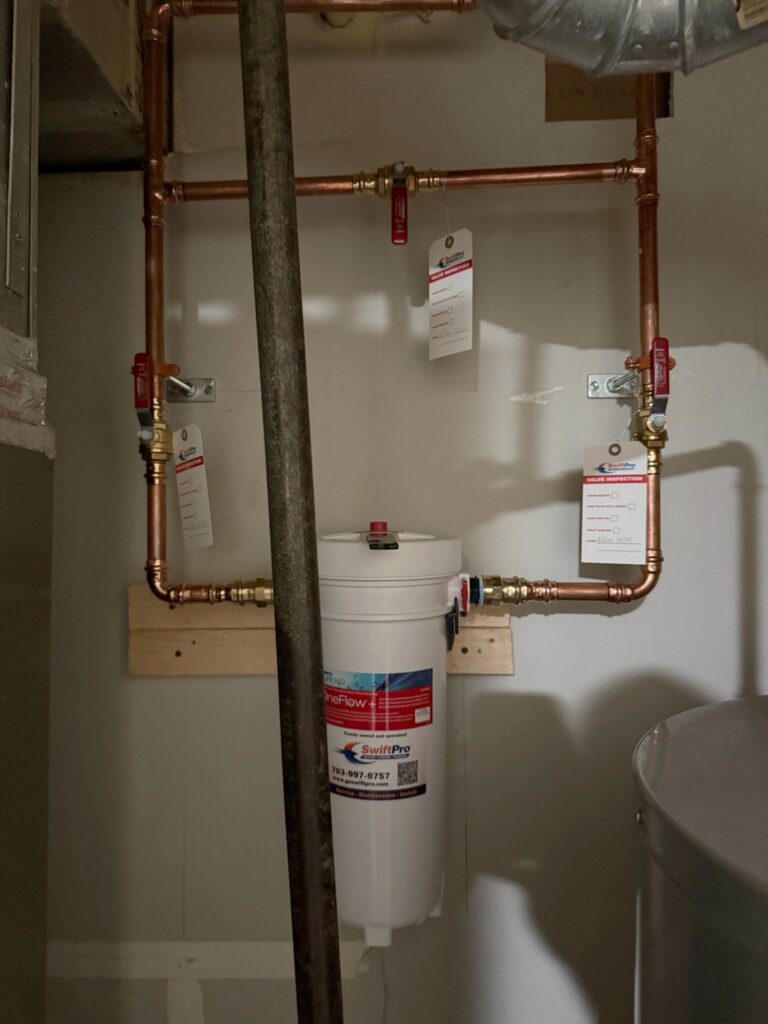
- Put the softener in bypass. Most have a bypass valve on the back, a push button, knob or lever, or three valves on the pipes beside it.
- Watch the meter again for two minutes. If it stopped, the softener was the leak. If it’s still turning, the leak is somewhere else.
What makes one stick
- The timer or the motor. The motor that turns the valve through its cycle fails, or the timer loses its place.
- The piston and seals. Inside the control valve, a worn seal or a scored piston lets water slip past to the drain.
- The brine valve or float. If it sticks open, the brine tank overfills and keeps drawing water.
- A clogged injector. The small part that pulls brine out of the tank plugs with sediment, and the cycle can’t finish right.
- Settings. A softener set to regenerate far more often than the house needs wastes water every time it runs.
- A salt bridge. A hard crust of salt over an empty space in the tank. The cycle runs but can’t make brine, and the hard water comes back.
What fixes it
- Reset the clock after any power outage.
- Leave it in bypass while you wait for a repair. The house gets hard water for a few days, but the drain stops running.
- Break up a salt bridge gently with a broom handle.
- A sticking valve gets a rebuild, new seals and a piston, or a new control valve. An old softener whose valve has failed can be worth replacing whole.
Already gave the utility a few days of water? Most here give a credit for a fixed leak (how to ask for it).
Our Water Test and Plumbing Safety Check is $29: a licensed plumber walks your plumbing with photos, checks the water heater and tests your water’s hardness at the kitchen table. It’s a good first step if you’re not sure the softener is set right for your water. If you already know something’s leaking, a plumbing visit is $49 in regular hours, and the price of the fix is in writing before we start.
Get a plumber on it
Book a plumber online, call (703) 997-9757, or book the $29 plumbing safety check. We answer day or night. Rated 5.0 stars across 1,138 reviews on Google, Angi, Yelp, the BBB and Facebook, Virginia Class A license 2705192276.
Questions people ask
How do I know if my water softener is stuck in regeneration?
Water keeps running to its drain line, the meter’s leak indicator moves with everything off, or the display sits on one regeneration step. Put it in bypass: if the meter stops, it’s the softener.
How long should a water softener regeneration take?
Usually an hour or two, once every few days or at a set time overnight. Running to the drain for hours, or in the middle of the day, means something’s stuck.
Can a water softener make my water bill high?
Yes. One stuck in regeneration, or set to regenerate too often, sends clean water down the drain all day. It never shows as a puddle, only on the meter and the bill.
Is it safe to put my water softener in bypass?
Yes. The water goes around the softener, so you get hard water for a while and nothing else changes. It’s the right move while you wait for a repair.