The short answer
A comfort height toilet puts the seat 17 to 19 inches off the floor, the same height as a dining chair, instead of about 15 inches for a standard toilet. For most adults in Northern Virginia, and anyone with sore knees or hips, it’s easier to sit down on and stand up from. Shorter adults and small kids can find it too tall. Before you buy, check four things: the height, the rough-in, the bowl shape, and the gallons per flush, 1.28 or less with the WaterSense label.
Standard height or comfort height
Swipe to see all columns →
| Standard height | Comfort height | |
|---|---|---|
| Seat height off the floor | About 15 inches | 17 to 19 inches |
| Easier for | Shorter adults and kids | Most adults, tall people, sore knees and hips |
| Also called | Regular height | Chair height, right height, ADA height |
| Fits the same drain | Yes | Yes |
The 17 to 19 inch range comes from the accessibility rules for public restrooms, and makers use their own names for it. If the people in the house are aging in place, it’s one of the easiest changes to make, and it goes on the same drain as the toilet you have. If someone’s feet won’t reach the floor, a small step stool fixes that for kids, but it’s worth sitting on one in a showroom first.
Round or elongated
An elongated bowl is about 2 inches longer than a round one, and most adults find it more comfortable. A round bowl fits a small powder room better. Measure from the wall behind the toilet to the door swing or the vanity. Code wants at least 21 inches clear in front of the bowl and 15 inches from the center of the toilet to a side wall or vanity.
Gallons per flush, low flow and WaterSense
Every toilet sold since 1994 uses 1.6 gallons a flush or less. A WaterSense labeled toilet uses 1.28 or less and has passed a flush test. Toilets from the 1980s use 3.5 gallons or more, and how much water an old toilet uses works out what that costs. Don’t buy on gallons alone. Look for the flush test score on the box, called MaP and given in grams. WaterSense requires at least 350 grams, many toilets score far higher, and the higher the number, the stronger the flush.
Early low flow toilets from the mid 1990s earned a bad name because many of them didn’t flush well. Newer ones use less water and flush harder, mostly because of bigger flush valves and better bowl shapes.
Dual flush
A dual flush toilet has two buttons, a light flush for liquid and a full flush for solids. It saves water if people use the light one. The tradeoff is parts: the buttons and the seal are made for that model, so a repair means finding the maker’s part instead of a generic one from the hardware store.
What to check before you buy
- The rough-in, the distance from the wall to the drain. Most homes are 12 inches; the toilet rough-in shows how to measure yours.
- Height: comfort height or standard, for the people using it.
- Bowl shape: elongated if there’s room.
- WaterSense label and a strong MaP score.
- One piece or two piece. One piece has no tank bolts to leak. Two piece costs less and is lighter to carry.
- Skirted or not. A skirted toilet has smooth sides that are easy to clean, and it takes longer to set.
- The shutoff valve on the wall. If it’s old, replace it with the toilet. The toilet shut off valve explains why.
Repair or replace
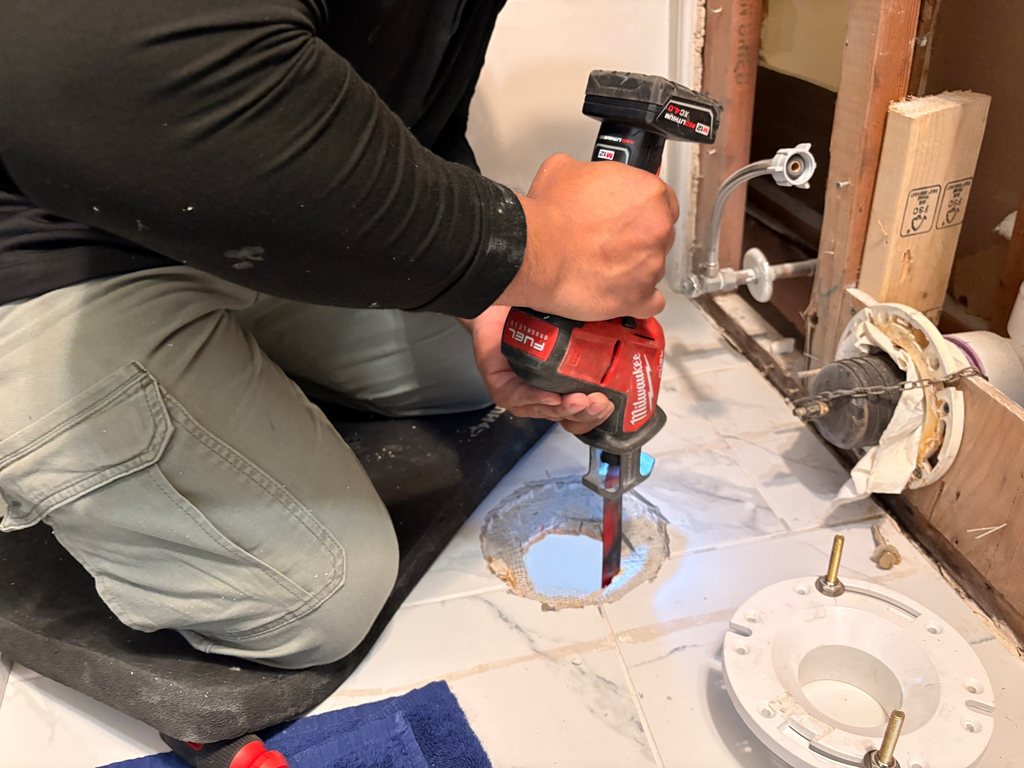
Most toilets don’t need replacing. A toilet that rocks needs a flange or shims, covered in wobbly toilet, and a wet floor at the base is usually a wax ring, covered in toilet leaking at the base. Replace it for height, for a crack, for 3.5 gallons a flush, or when the parts are gone. Toilet replacement cost breaks down what changes the price.
A toilet that’s hard to get up from isn’t a warning sign, but plenty of other things in the house are. Every warning sign around the house, from a furnace’s blinking light to the sounds a house makes, is in one guide.
Fix it or replace it
Most toilets don’t need replacing. A flapper, a fill valve, a wax ring or a loose tank is a repair, and almost everything we find wrong with a toilet is repairable. A new one makes sense when the porcelain is cracked, it uses 3.5 gallons or more a flush, the parts aren’t made anymore, or the height or shape just doesn’t fit the people using it.
What it costs when we do it
A new toilet installed runs $800 to $1,300, and we check the flange, the shutoff valve and the supply line when we set it, because a new toilet on an old flange is the next leak. This month’s coupons on our offers page take $100 off a new toilet, or $50 off any plumbing repair over $400. If the toilet you have just needs a part, toilet repair runs $250 to $900, priced in writing before we start. Any plumbing repair also comes with a whole-house plumbing inspection, a $149 value. A plumbing diagnosis visit is $49, or $250 after hours.
Call (703) 997-9757, day or night, or book a toilet repair online. Rated 5.0 stars across 1,138 reviews on Google, Angi, Yelp, the BBB and Facebook, Virginia Class A license 2705192276.
Questions people ask
What is a comfort height toilet?
A toilet with the seat 17 to 19 inches off the floor, about chair height. A standard toilet is about 15 inches.
Is a comfort height toilet better for seniors?
For most older adults, yes. Sitting down and standing up is easier on knees and hips. For someone short, check that their feet still rest on the floor.
How tall is a standard toilet?
About 15 inches from the floor to the top of the seat.
What is the best toilet to buy?
There isn’t one best for every bathroom. Look for the WaterSense label, a strong MaP flush score, the height that fits the people using it, an elongated bowl if there’s room, and a rough-in that matches your drain.
How much does it cost to install a comfort height toilet?
A new toilet installed runs $800 to $1,300 when we do it, the same as a standard height one, and this month’s coupons take $100 off.