The short answer
The fill valve is the tall valve on one side of the toilet tank that refills it after a flush and shuts off when the water reaches the line. In a Northern Virginia home, a fill valve that runs into the overflow tube, hisses long after a flush, fills slowly or won’t shut off is usually set too high, clogged with grit, or worn out. Set the water about an inch under the top of the overflow tube, flush the grit out, and if it still misbehaves, replace it. It’s about a 20 minute job with the water off.
What it does
After a flush, the float drops with the water and opens the valve. Water fills the tank, and a small rubber refill tube sends a little of it down the overflow tube to refill the bowl. When the float rises to the set level, the valve closes. Older toilets have a ball float on a long arm. Most newer ones have a float cup that rides up and down the valve itself.
Swipe to see all columns →
| What it’s doing | Usually | The fix |
|---|---|---|
| Water trickles into the overflow tube | Level set too high, or the valve won’t close | Lower the float; replace it if it still runs |
| Tank fills slowly | Grit in the valve, or the valve on the wall half closed | Flush the valve out; open the wall valve all the way |
| Hisses long after the flush | A worn seal inside the valve | Clean it or replace it |
| Shuts off, then turns back on by itself | The flapper is leaking, not the fill valve | The dye test, then a new flapper |
| Bowl sits low after a flush | The refill tube came off its clip | Clip it back on |
| Bangs when it shuts off | Water pressure too high | Check the pressure at the main |
A slow fill has its own walkthrough in toilet tank not filling, and a valve that turns on by itself is usually the flapper, which the toilet flapper tests in ten minutes. A bang when the valve shuts can mean the house pressure is high, and the pressure reducing valve is where that’s set.
Set the water level
There’s usually a line marked inside the tank. If there isn’t, the water should stop about an inch under the top of the overflow tube. On a float cup valve, turn the adjustment screw or squeeze the clip on the rod and slide the cup down. On an older ball float, turn the screw on top of the valve. Flush, let it refill, and check where it stops. Too low gives a weak flush. Too high runs into the overflow tube all day.
Flush the grit out
- Turn the valve behind the toilet clockwise until it stops, and flush to empty the tank.
- Take the cap off the top of the fill valve. On many, you press down and turn it a quarter turn.
- Hold a cup upside down over the open valve and turn the water on for a few seconds. The rush pushes grit out of the line and into the cup.
- Look at the rubber seal in the cap. If it’s split, swollen or grooved, the valve is worn.
- Put the cap back on, open the valve and let it fill.
Grit gets in after the water main on the street is worked on, or after the main in the house is shut off and turned back on. If every toilet in the house started acting up at once, that’s usually why.
The refill tube
The little rubber tube should clip to the top of the overflow tube with its end out of the water. If it gets pushed down inside the overflow tube, under the water line, it siphons tank water down the drain and the valve keeps topping it up. That’s one of the most common causes of a toilet that refills by itself, and it’s free to fix.
Replacing it
- Shut the valve behind the toilet, flush, and sponge the last water out of the tank.
- Put a towel down and unscrew the supply line from the bottom of the tank.
- Unscrew the big plastic nut under the tank and lift the old valve out.
- Set the new valve’s height to fit the tank, drop it in, and tighten the nut by hand plus a quarter turn. Too tight cracks the plastic.
- Put on a new braided supply line while it’s apart.
- Open the valve, set the level, and check under the tank with a dry paper towel for a day.
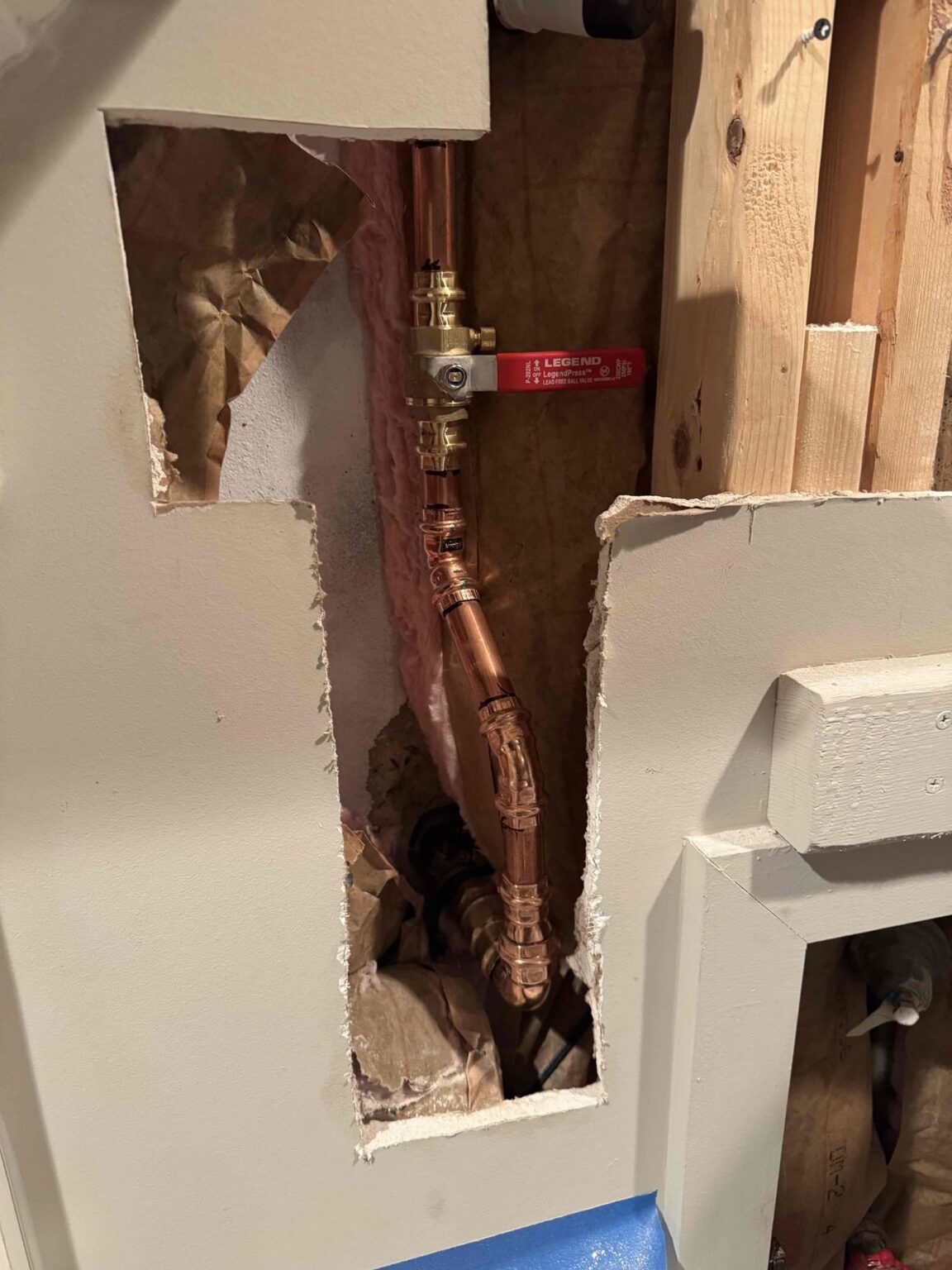
Call instead when the valve on the wall won’t turn or drips once you move it. Forcing an old one is how a 20 minute job turns into a flooded bathroom, and the toilet shut off valve covers what to do with it.
A fill valve that won’t stop is one of the warning signs you can hear. Every warning sign around the house, from a furnace’s blinking light to the sounds a house makes, is in one guide.
Fix it small, fix it now
A toilet problem caught early stays cheap three ways. The water and sewer bill stops climbing. The water stays out of the floor and the ceiling under it. And it stays a part and an hour instead of a subfloor later. Almost everything we find wrong inside a toilet is repairable, and once it’s fixed right, you stop listening for it.
What it costs when we fix it
Flappers, fill valves, handles, shutoff valves and supply lines are all toilet repair, $250 to $900, with the price in writing before we start, and we check the rest of the toilet while the lid is off. When the toilet itself is worn out, a new one installed runs $800 to $1,300, and this month’s coupons on our offers page take $100 off a new toilet, or $50 off any plumbing repair over $400. Any plumbing repair also comes with a whole-house plumbing inspection, a $149 value. If water is showing up where it shouldn’t and you can’t tell where it starts, leak detection runs $200 to $500. A plumbing diagnosis visit is $49, or $250 after hours.
Call (703) 997-9757, day or night, or book a toilet repair online. Rated 5.0 stars across 1,138 reviews on Google, Angi, Yelp, the BBB and Facebook, Virginia Class A license 2705192276.
Questions people ask
How do I adjust a toilet fill valve?
Turn the adjustment screw or slide the float cup down the rod until the water stops at the line inside the tank, or about an inch under the top of the overflow tube.
Why does my toilet fill valve keep running?
It’s set too high and spilling into the overflow tube, grit is holding it open, or the seal in the cap is worn. If it shuts off and comes back on, it’s the flapper.
How long does a toilet fill valve last?
Most last somewhere around five to ten years. Grit and high water pressure shorten that.
Can I replace a toilet fill valve myself?
Yes, if the valve behind the toilet turns off cleanly. It’s about 20 minutes with a towel, a sponge and a new supply line.
How much does it cost to replace a toilet fill valve?
The part is inexpensive. When we do it, a fill valve is a toilet repair, $250 to $900, priced in writing before we start, and we check the flapper and the shutoff valve while we’re there.