


Written October 2026 from the maintenance checklists Trane, Carrier and Mitsubishi Electric publish and ENERGY STAR’s, each read at the source the same week, and from our own price book.
It’s late October in Northern Virginia, so the HVAC service visit due now is the heating one. Our $67 Heating Check covers one furnace or heat pump through December 31, and a seasonal tune-up on any one system is $99 on our tune-up page. How often: twice a year, the heat in the fall and the cooling in the spring. Below is the checklist for that visit, system by system: what the technician should measure, clean and test, and what you should have in hand when the van leaves. Every way we service a system, with every price, is on our HVAC service page.
Use it the way you’d use an inspection sheet on a used car. You don’t need to know how to do any of it. You only need to know whether it got done.

The HVAC service checklist every system starts with
Whatever heats and cools your house, five items sit on every visit. ENERGY STAR publishes them as what “a typical maintenance check-up should include,” and the manufacturers’ own lists match it.
- The thermostat. Settings checked, then the system called on to run so the technician can watch it answer.
- The electrical side. Connections tightened, and in ENERGY STAR’s words, “measure voltage and current on motors.” Those readings only mean something next to the numbers printed on each motor’s label, so ask what they were.
- Moving parts. Lubricated where the design calls for it. Plenty of newer motors are sealed: Carrier’s furnace manual says its inducer and blower motors are “pre-lubricated and require no additional lubrication.”
- The condensate drain. The pan, the trap and the line, plus the float switch that shuts the system off when water backs up. ENERGY STAR’s reason: “A plugged drain can cause water damage in the house.”
- The controls and one full cycle. ENERGY STAR asks the technician to “check the starting cycle of the equipment to assure the system starts, operates, and shuts off properly.” That means watching it from the first click to the last fan turn.
Then the filter: looked at, changed if it’s dirty, and its size written down so the next one you buy fits. Which filter to buy is in our filter guide.
How often: twice a year for most houses here. ENERGY STAR says to check “the cooling system in the spring and the heating system in the fall.” Trane schedules a heat pump “twice a year,” a gas furnace every fall and an air conditioner every spring, so a furnace with central air comes to two visits as well. The month-by-month calendar, and what Trane’s, Carrier’s and Rheem’s warranties say about skipping a visit, are in HVAC maintenance. This post is the visit itself.
Gas furnace: what the technician checks in the fall, line by line
Carrier prints this list in its own furnace owner’s manual, under the heading “A check-up checklist,” and asks for “a professional check-up annually.” Trane’s dealer checklist for a gas furnace covers the same ground. In the order a technician usually works:
- The burners and the flame. Burners and flame sensor cleaned, the igniter looked at, then the flame watched. Trane’s description of a good one: “a steady blue flame.”
- The heat exchanger. Checked “for cracks, holes, or leaks,” in Trane’s words, along with the flue passages and the inducer that pulls exhaust through them (Carrier). It’s the metal wall that keeps the exhaust on its own side.
- The venting. On an older furnace, the metal flue pipe, sloping up and sound. On a high-efficiency furnace, the two white PVC pipes, inside the house and where they end outside. Carrier wants all of it inspected, the ends outside included.
- The gas. The pipes to and inside the furnace checked for leaks (Carrier), and the gas pressure checked at the valve and adjusted if it’s off (Trane).
- The temperature rise. The supply air temperature minus the return air temperature, read with the furnace running. Carrier’s installation instructions say it “must be within the limits specified on the unit rating plate.” Every furnace has its own range printed on that plate, and the reading should land inside it.
- The blower. Motor and wheel inspected and cleaned; both manufacturers list it. A wheel packed with dust moves less air, and a furnace short on air runs hot.
- The condensate drain, on a high-efficiency furnace. Carrier: “The condensate removal system should be cleaned annually by a qualified service agency.”
- The safeties and one full heat cycle, from the inducer starting to the blower shutting off. Carrier calls it “an operational checkout.”
- The rest of the box. Wiring and connections, the return duct sealed to the furnace, the furnace sitting level and solid (Carrier and Trane both list that one), and the filter.
One more to ask about: whether the visit includes a combustion or carbon monoxide reading at the flue, and if it does, what the number was.

What ours covers. The $67 Heating Check is the safety and operation half of that list on one furnace or heat pump: burners, igniter, flame sensor and heat exchanger inspected on a gas furnace, electrical tested, the thermostat checked and set, airflow and temperature rise measured, and photos of anything we flag, in writing, before we leave. The Blower Wheel Deep Clean is $229, regularly $467: everything in the check, the blower wheel out and cleaned blade by blade, a new standard filter, the dampers set for winter, and a full furnace tune-up with gas pressure, temperature rise, safeties and sequence of operation. Rather listen to your own furnace first? Here’s the twenty-minute test run. What the fall visit usually finds, and what each of those parts costs, is in our furnace tune-up guide.
The system we put in first
Built to take a beating. Put in by our crew.
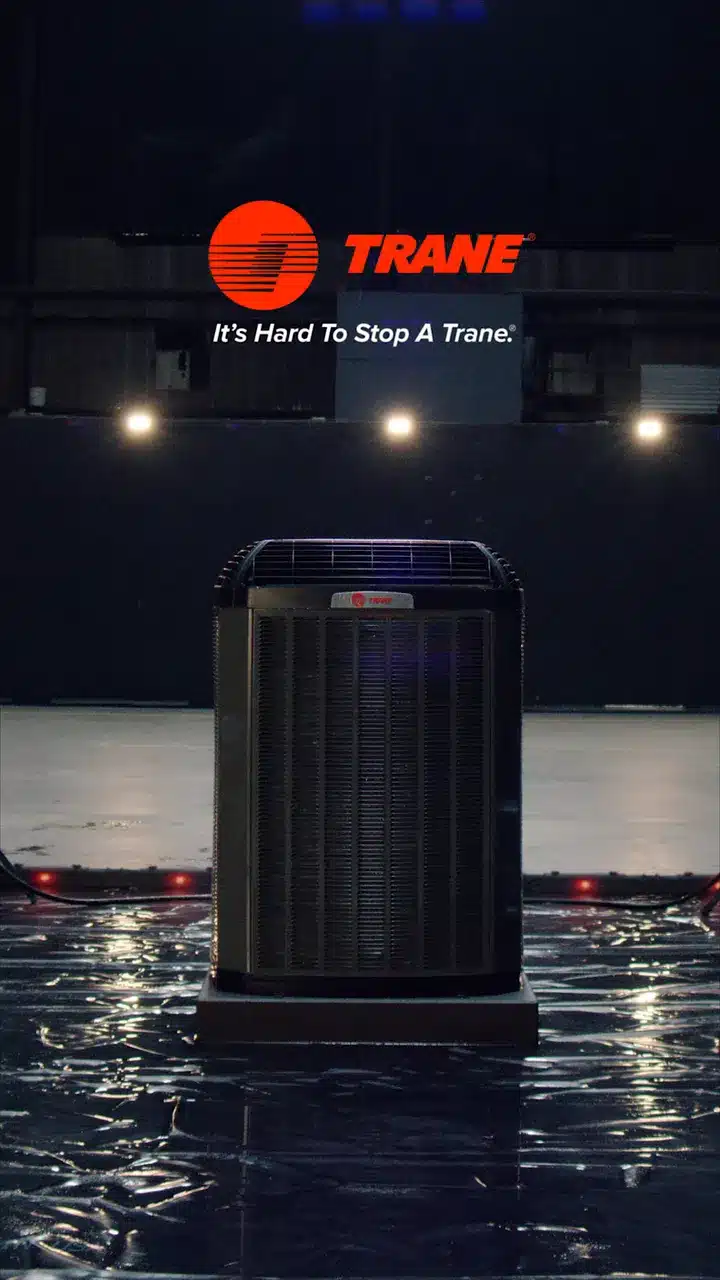
Heat lamps, snow and rain on one outdoor unit: that’s Trane’s own film. We’re a Trane Comfort Specialist, on Trane’s own dealer locator, and when you pick a Trane, our crew puts it in.
Films: Trane’s own.
Heat pump: two visits a year, and what the fall one adds
A heat pump heats and cools, so it runs most of the year, and Trane books it “twice a year,” fall and spring. Its dealer checklist:
- Dirt and airflow. The ducts, filters, blower, outdoor fan motor and both coils checked for dirt, and the airflow confirmed. Coils cleaned if they need it, which Trane says “may need a separate service visit.”
- Refrigerant. The level checked, and the system checked for leaks.
- The reversing valve, the part that flips the system between heating and cooling, inspected.
- Defrost, checked “in the fall only.” That’s the cycle that clears frost off the outdoor coil on a cold morning.
- The controls, “making sure that heating is locked out when the thermostat calls for cooling and vice versa,” and the sensors verified.
- Electrical. Terminals cleaned and tightened, and motors lubricated where they take it.
- The base pan. The drain holes in the bottom of the outdoor unit cleared of debris.
Add one line for our winters: the backup heat. On most heat pumps with an air handler that’s electric heat strips, and the fall visit is when you want to know they come on, not the first frozen morning. If the thermostat shows AUX more than you’d expect, here’s what AUX and emergency heat mean. The Heating Check covers a heat pump the same as a furnace, one system per visit.
Central air conditioner: the spring visit
Carrier’s owner’s guides for its newest air conditioners and heat pumps carry a maintenance table that marks every technician item “Annual.” The outdoor half:
- Wiring and connections inspected and tightened, the disconnect checked, and a “functional test of equipment.”
- “Check refrigerant system subcooling and/or superheat (system dependent).”
- The condenser coil inspected and cleaned if dirt is on it, and the fan checked so it “spins freely.”
The indoor half: the filter, the blower housing, wheel and motor cleaned, the evaporator coil inspected, and the “condensate pan, trap, and drain lines” cleaned. Trane’s AC checklist adds the thermostat and “voltage and amps,” and it’s frank about one line: the outdoor and indoor coils get cleaned “as needed, most likely with an additional charge.” Why each item matters, in the order it tends to cost people money, is in what an AC tune-up actually includes.

Two readings worth asking for. Superheat and subcooling are how a technician judges the refrigerant charge, and which one applies depends on the system, as Carrier’s table says. “The pressures look fine” isn’t the same answer. Then the capacitor, the small can that gives the compressor and fan their start: Trane notes they’re rated in microfarads, and a technician tests one “with a multimeter to see if it works properly or needs replacing.” One reading weak against the rating printed on it is a part to replace in May instead of July.
On a newer system that runs on R-454B refrigerant, there’s a line older checklists don’t have. Carrier’s R-454B systems carry a refrigerant leak sensor, and its owner’s guide says to “wipe or vacuum away dust/debris from refrigerant sensor” and press the test button on the dissipation control board. If your system went in recently, make sure that’s on the list. The homeowner’s half of the spring visit is our DIY air conditioner checklist.
Ductless mini split: the filters, the coil and the drain behind the panel
A mini split has no ductwork to hide dust in, so all of it ends up at the indoor head: on the filters, the coil behind them and the long blower wheel across the front. Trane says to schedule professional ductless maintenance “at least annually,” and “twice a year is better” when the system heats and cools. Its list for the technician: “thoroughly inspect and clean the units,” check for refrigerant leaks, check the electrical connections, and replace filters that are old or damaged. Mitsubishi Electric puts it plainly: the “annual tune-up” is one of the things “best left to professionals,” and the contractor will “inspect the working components inside and clean them as needed.”

Your part is the filters. Trane says to clean them by your owner’s manual, which “can be as often as every two weeks during peak heating or cooling season.” Each indoor head is its own unit with its own filters, coil and drain, so a house with four heads has four of each on the visit. Ask how the visit is priced for more than one head before it starts. More on these systems on our ductless mini split page.
Hot water boilers: a different list, kept short here
A hot water boiler shares the gas half of the furnace list (the burners, the combustion, the flue) and swaps the air half for water: the pressure gauge, the relief valve, the expansion tank, the low water cutoff where one is fitted, and the circulator and zone valves. The full list, and what you can check yourself in a half hour, is in boiler service before winter. A boiler tune-up with us is $99, on hot water boilers running on gas or propane, not steam. The rest is on our boiler page.
What you should have in hand when the technician leaves
A service visit produces information, and you paid for it. Before the van pulls away, ask for:
- The readings. On a furnace, the temperature rise and the range on its rating plate. On an AC or heat pump, superheat or subcooling, and the amps on each motor. On any system with one, the capacitor readings.
- What got cleaned and what got changed, filter size included.
- Photos of anything flagged. A rusted pan, a cracked part, a wheel caked in dust. If it’s worth fixing, it’s worth showing you.
- A written price for each repair, before anyone starts it, and the choice to say no.
Trane gives the same advice from the other side of the counter: before booking, “ask to see their AC maintenance checklist, so you know what’s included and what’s not,” because “some HVAC companies charge extra for certain tasks.” It also says a repair the technician finds is “not included in the AC maintenance charge.” That’s normal everywhere. What matters is seeing the price before the work.

With us: anything we flag on the Heating Check comes to you as photos, in writing, before we leave, and any repair a tune-up turns up is quoted in writing before any work. You decide. Comfort+ members don’t have to keep track of any of it: we book every visit and keep the maintenance records.
A real HVAC service visit vs. a filter swap and a sticker
Both can end with a dated sticker on the cabinet. Here’s how to tell them apart, line by line:
| On the list | A real service visit | A filter swap and a sticker |
|---|---|---|
| The flame | Burners and flame sensor cleaned, the flame watched through a full cycle | “It lit” |
| Airflow | Temperature rise measured and compared with the rating plate | A hand held up to a vent |
| Refrigerant | Superheat or subcooling read on gauges, and a leak looked for before any is added | “Pressures look fine,” or a top-off with no question about where it went |
| Electrical | Amps read on each motor, capacitors tested with a meter | Looked at |
| The drain | Pan, trap and line cleared, float switch tested | Not opened |
| Heat exchanger | Inspected for cracks, holes or leaks | Not mentioned |
| When it’s done | Readings, photos of anything flagged, written prices | A sticker with the date on it |
The sticker isn’t the problem; a dated record of the visit is worth keeping, and our maintenance guide explains why a warranty might ask for one. The problem is when the sticker is the whole visit. Our rule of thumb: if nobody measured anything, nothing got serviced. Watch for the opposite too, a visit that ends with “you need a new system” and no readings to show why. If that happens, get our free second opinion before you sign anything.
What HVAC service costs with us this fall
- The $67 Heating Check, one furnace or heat pump, through December 31: the safety and operation check above, with photos of anything we flag.
- The Blower Wheel Deep Clean, $229, regularly $467: the check, plus the wheel cleaned and a full furnace tune-up. The wheel doesn’t need pulling every year; every three to five years is plenty for most houses.
- A seasonal tune-up, $99, one system: the AC before summer or the furnace before winter, and heat pumps, boilers and ductless mini splits at the same price. It books on our tune-up page.
- Comfort+, $199 a year, or $20 a month, month to month. Its four visits every year are a heating maintenance visit in the fall, a cooling maintenance visit in the spring, a dryer vent cleaning, and a water heater flush with a sewer camera inspection, and members take 15% off any service.
When something has already stopped working, that’s a repair call, not a service visit: the diagnostic is $99, included for Comfort+ members. The dated offers above run out, so whatever we’re running when you read this is on our offers page. The full cost answer, from a tune-up to a repair call, is in what HVAC service costs.
HVAC service checklist questions, answered
What is included in HVAC service?
On every system: the thermostat, the electrical connections with voltage and amps read on the motors, the moving parts, the condensate drain and one full start-to-stop cycle. A gas furnace adds the burners, flame sensor, heat exchanger, venting, gas pressure and temperature rise. An AC or heat pump adds the refrigerant charge, read as superheat or subcooling, and the coils. A heat pump’s fall visit adds the defrost control and the reversing valve.
How often should HVAC be serviced?
Twice a year for most houses: the heating in the fall and the cooling in the spring, which is ENERGY STAR’s schedule. A heat pump gets both visits, and a furnace with central air gets one each season. Look at the filter every month in between.
Is an HVAC tune-up the same as HVAC service?
For the seasonal visit, yes: tune-up, maintenance and service get used for the same thing. What counts is what’s on the list, so ask to see it before you book, as Trane suggests. A repair call is different: something is already broken, and the visit is about finding it.
How much does an HVAC tune-up cost?
With us, a seasonal tune-up on one system is $99. This fall the Heating Check is $67 per furnace or heat pump through December 31, and Comfort+ covers the fall and spring visits for $199 a year. More in what HVAC service costs.
What does an HVAC service technician check on a furnace?
The burners, igniter and flame sensor, the heat exchanger, the flue or the PVC vent pipes, the gas lines and gas pressure, the blower, the condensate drain on a high-efficiency furnace, the safeties, and the temperature rise against the range on the furnace’s rating plate.
Should I get a written report after HVAC service?
Ask for one: the readings, what was cleaned or changed, photos of anything flagged, and a written price for any repair. With us, anything we flag on the Heating Check comes as photos, in writing, before we leave.
Does a heat pump need service twice a year?
Yes. It heats and cools, so Trane schedules it in the fall and the spring. The fall visit adds the defrost control and a check that the backup heat comes on.
Do I need HVAC service if nothing is wrong?
That’s when it does the most good. Mitsubishi Electric’s advice is to bring a contractor out before the heating season “even if there’s nothing wrong with your system.” A weak capacitor or a slow drain is a quick fix on a booked visit and a long night when it quits in a cold snap.
Can I do my own HVAC service?
Part of it: the filter, two feet of clearance around the outdoor unit, an eye on the drain, and the mini split filters. Anything with a panel off, gauges on or the power cut at the disconnect is a technician’s job. Our DIY air conditioner checklist has the homeowner’s half.
Book your HVAC service in Northern Virginia
Call (703) 997-9757, book online, or send the form at the top of this page and the office calls or texts you back. Every way we service a system is on our HVAC service page; the fall visit books on the Heating Check page and the spring one on our tune-up page. Heat or cooling out right now? That’s a repair, not a service visit: here’s emergency HVAC service, and we run 24/7 emergency service.

SwiftPro Heating, Cooling & Plumbing services, repairs and installs furnaces, heat pumps, air conditioners, ductless mini splits and hot water boilers across Northern Virginia, from Chantilly and Ashburn, with a dedicated HVAC team and a separate plumbing team. Trane Comfort Specialist, Rheem Pro Partner, Carrier experts and Mitsubishi Electric Diamond Contractor, and we service Lennox, Goodman, Amana, Daikin, York, Bryant, Ruud, Payne, Coleman, Luxaire and the rest too, including systems somebody else put in. Family owned, BBB Accredited with an A rating, 24/7 emergency service, Virginia Class A contractor license 2705192276, and rated 5.0 stars across 1,132 reviews on Google, Angi, Yelp, the BBB and Facebook. Read the reviews.


