


Written October 2026 from our own price book, with Washington Gas, Fairfax County Fire and Rescue, the U.S. Fire Administration, the American Red Cross, Trane and ENERGY STAR read at the source the same week.
Call now if you smell gas, a carbon monoxide alarm is sounding, water is pouring out of the indoor unit, something smells like it’s burning, or the heat is out in freezing weather with someone very young, elderly or sick at home. For gas or carbon monoxide, get everyone outside before you call anyone. For everything else, take five minutes on the checks below first, because a tripped breaker, a dead thermostat battery or a full drain pan can bring a system back without anyone coming out. If they don’t, we run 24/7 emergency service across Northern Virginia at (703) 997-9757, and a technician finds the fault on a $99 diagnostic, with the repair priced in writing before any work starts. Everything a heating or cooling call covers is on our HVAC service page.
When it’s the heat, the visit books as furnace and heat pump repair; when it’s the cooling, AC repair. Calling at night or on a weekend? Ask what the visit costs before anyone heads out. And if your thermostat has an EM HEAT setting, that’s a different thing from emergency service. More on it below.

Emergency HVAC service: what can’t wait until morning, and what can
Most of what goes wrong with a furnace, heat pump or air conditioner is a problem, not an emergency. The test is two questions. Is anyone in danger right now? Is the house about to get damaged? If either answer is yes, call tonight. If the house is uncomfortable but holding, the checks come first and a daytime visit is usually fine.
| What’s happening | Do this first | Then |
|---|---|---|
| A rotten-egg smell (gas) | Everyone out. Don’t flip switches or use a phone inside | 911 and Washington Gas, from outside |
| A carbon monoxide alarm | Everyone out. Don’t open windows to air it out | 911 from a neighbor’s house |
| Water pouring from the indoor unit or through a ceiling | Thermostat to Off, catch what you can | Call us now |
| A burning or electrical smell, or a breaker that trips again | Thermostat to Off, then the breaker. Smoke or flame: everyone out | Smoke or flame: 911. Otherwise, call us now |
| No heat below freezing, with someone very young, elderly or sick at home | The five checks, then one warm room, safely | Call us now |
| No cooling in a heat wave, with someone at risk at home | The checks, then cool the person first | Call us now |
| No heat, but the house is holding and everyone’s well | The five checks | A daytime visit is usually fine |
| Running, but louder, or one room won’t keep up | Note when it happens | Book a daytime visit |
| Heat pump steaming, frost that comes and goes | Nothing: that’s defrost | No call needed |

Gas, carbon monoxide, water and burning smells: what to do right now
A gas smell. Natural gas smells like sulfur or rotten eggs. Washington Gas says to leave right away, leaving doors and windows open behind you if you can, then call 911 and its Emergency Leak Line, 844-WASHGAS (927-4427), option 1, from somewhere safe. Don’t switch lights or appliances on or off as you go, and don’t make the call from inside: Washington Gas counts phones among the things that can spark. It sends its own technicians out 24 hours a day, 7 days a week to check a reported gas smell. On propane, call 911 and your propane supplier from outside. Once the house has been made safe, if the smell traced back to the furnace, call us.
A carbon monoxide alarm. Fairfax County Fire and Rescue says everyone out at once and 911 from a neighbor’s house. Notice the one difference from a gas smell: don’t open doors and windows to air the house out, because the crews take readings around the house to find the source. Once they’ve cleared it, we’ll find out why it went off. More in what to do when a carbon monoxide alarm goes off.
Water pouring out. Set the thermostat to Off. An air conditioner wrings water out of the air and a high-efficiency furnace makes its own, so turning the system off stops new water coming. Then towels and a bucket, and stay clear of any light fixture in a wet ceiling. Many systems have a float switch that shuts everything down when the drain pan fills, which, per Trane, is there “to help prevent water damage from a clog.” If yours shut itself off with a full pan, the drain is the problem, and clearing it is one of the smaller repairs on our list.
A burning or electrical smell. Set the thermostat to Off, then switch off the system’s breaker if you can reach the panel without going near the smell. Smoke or flame means everyone out and 911. One smell that usually isn’t an emergency: the first heat of the season often smells dusty for a few minutes while dust burns off inside the furnace. If it fades, it’s dust. If it’s sharp, like hot plastic or wiring, and doesn’t fade, call. The first cold night goes through the smells one by one.
The five-minute checks before you call for emergency HVAC service
In this order, heat or cooling. None of them needs a tool or a ladder.
- The thermostat. Heat or Cool, not Off, and set a few degrees past the room. A blank screen usually means dead batteries. Trane adds the one that catches people out: someone got cold and changed the settings without saying so. Then give it five minutes. A gas furnace runs its draft fan first and holds the blower until the burners are warm, so a minute of nothing is normal. More in thermostat not working.
- The breaker, the furnace switch and the door. Most systems have two breakers, one for the indoor unit and one for the outdoor unit. Next to a furnace there’s a shutoff that, in Trane’s words, “may look like a light switch,” and it gets bumped with laundry baskets. The furnace’s front panel has a safety switch behind it too: if someone changed the filter and didn’t seat the door, the furnace won’t start. Trane says not to flip a tripped breaker at all. Ours is one reset, once. If it trips again, leave it off and call. On propane, look at the tank gauge.
- The filter. Hold it up to a light. If none comes through, put in a new one. ENERGY STAR says to look at it every month. A choked filter is how a furnace overheats and shuts its burners off on a safety, and how an AC coil freezes.
- The drain and its float switch. Water in the pan under the indoor unit, and a system that shut itself off? That’s the float switch doing its job. The fix is clearing the drain, not the switch, so don’t tape it down or bypass it.
- A heat pump in defrost. In cold, damp weather a heat pump’s outdoor coil frosts over and the unit melts it off. Trane calls it “a totally normal process that may cause a cloud of steam to rise from the outdoor unit,” and says the heat pump goes back to heating “in a few minutes.” Ice that stays and keeps growing is a repair.
Thermostat showing AUX or EM HEAT? Neither one means you need emergency service. Aux heat is the backup heat helping on a cold morning or while the heat pump defrosts. EM HEAT is a setting you choose that shuts the heat pump off and runs the backup heat alone. When to use it: aux heat vs. emergency heat.
The system we put in first
Built to take a beating. Put in by our crew.
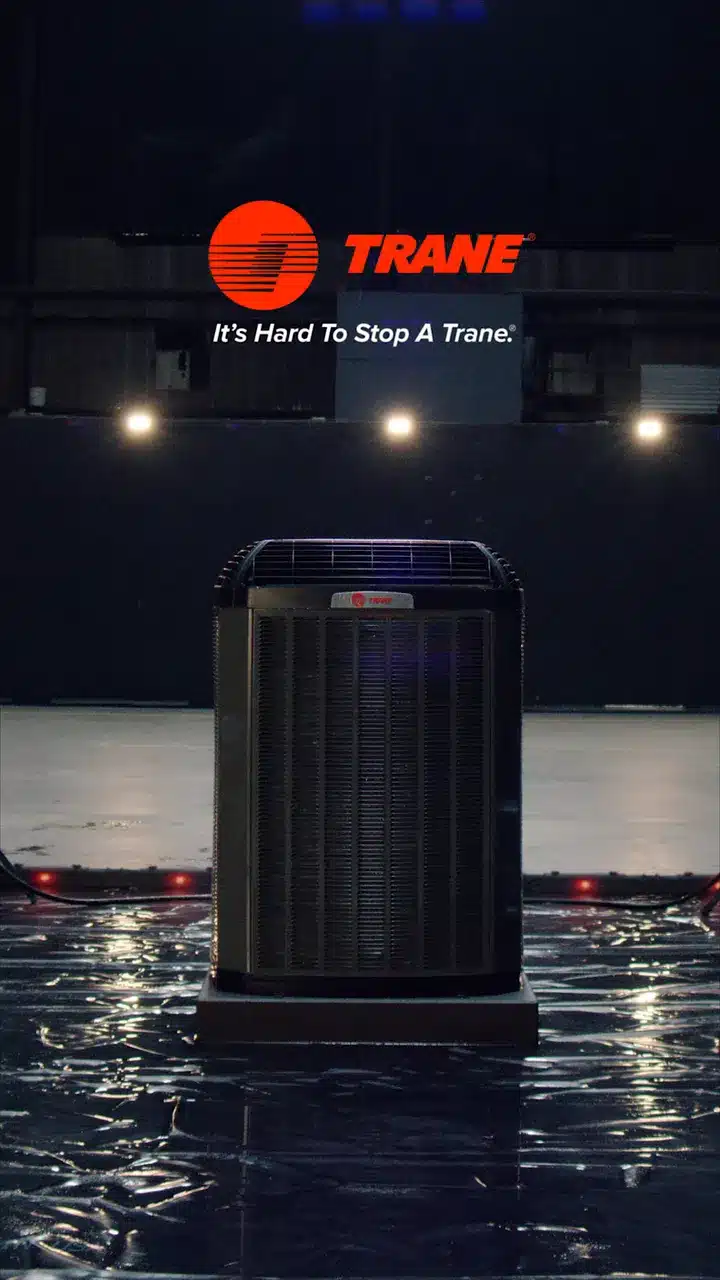
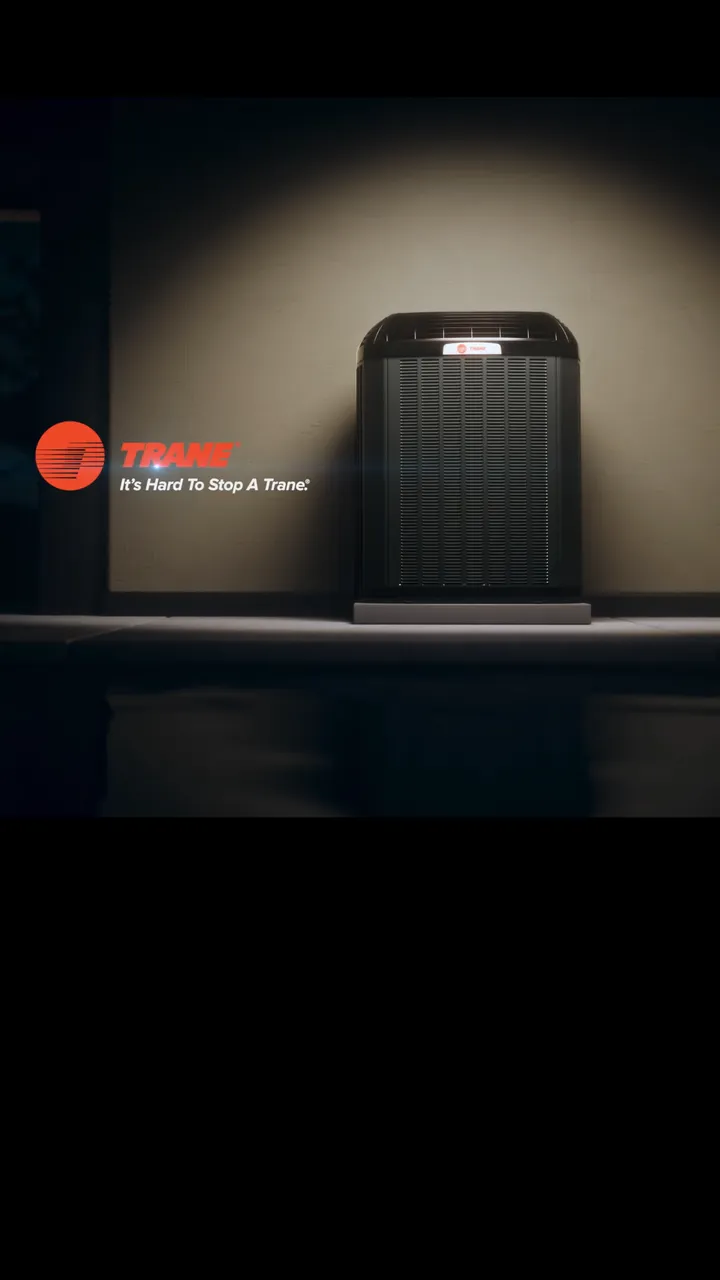
Heat lamps, snow and rain on one outdoor unit: that’s Trane’s own film. We’re a Trane Comfort Specialist, on Trane’s own dealer locator, and when you pick a Trane, our crew puts it in.
Films: Trane’s own.
No heat tonight: keeping the house and the pipes safe while you wait
Once the nights drop below freezing, no heat stops being only uncomfortable. Here’s how to get through the hours until the furnace or heat pump runs again without starting a second problem.
Space heaters, used the way the fire service says. The U.S. Fire Administration keeps it to a short list: anything that can burn, like bedding, clothing and curtains, at least 3 feet away; a heater that shuts itself off if it tips over; off when you go to bed or leave the room; and plugged straight into a wall outlet, never an extension cord or power strip.
Never the oven, the stove or a grill. The American Red Cross says never to heat a home with a cooking oven or stove, and to run generators, grills and camp stoves only outdoors and away from windows. What they give off is carbon monoxide, which is why the Fire Administration wants a CO alarm outside each sleeping area and on every level of the house.
Keep the heat you have. Close the doors to rooms nobody’s using, pull blinds and curtains after dark, and bring everyone into one or two rooms. If the house keeps dropping and someone in it is very young, elderly or unwell, go somewhere warm for the night.
The pipes. The Red Cross says to open the kitchen and bathroom cabinet doors so warmer air reaches the plumbing, and when it’s very cold out, to let cold water drip from the faucets served by exposed pipes, because water moving even at a trickle helps keep a pipe from freezing. If you open a faucet and only a trickle comes out, suspect a frozen pipe: keep that faucet open and warm the pipe with a hair dryer, a heating pad or towels soaked in hot water, never an open flame. A pipe that has already burst is a plumbing emergency, and our plumbers run 24/7 emergency service too: emergency plumbing.
The full cold-night list, symptom by symptom, is in the heat is out: what to check. If the furnace runs but the air coming out is cold, start with HVAC blowing cold air in winter.
When it’s the air conditioning that quits
Same checks, with two cooling twists. If the copper lines or the indoor coil are iced over, set the thermostat to Off and the fan to On, and let it thaw completely before you try again; running it frozen is hard on the compressor. And if the outdoor unit hums but its fan won’t spin, that’s usually a capacitor, $240 to $370 from us. Don’t poke the fan with a stick to start it.
In a heat wave, the person comes before the system: someone very young, elderly or unwell in a hot house needs somewhere cool first. Our guide to an AC that quits in a heat wave has the first hour step by step, the temperatures that matter and Fairfax County’s cooling centers. This time of year, a heat pump that won’t cool is worth fixing before the first freeze, because it’s your heat in January too.

What to tell us when you call
Five things help us send the right technician with the right parts:
- What it’s doing. No heat, no cooling, water, a smell, a noise, or a breaker that won’t stay on.
- What the thermostat says. Its mode, the setting, the room temperature, and any AUX, EM or error message.
- What you’ve already tried. A breaker reset once, a new filter, water in the drain pan.
- What you have. A gas or propane furnace, a heat pump, central AC, a ductless system or a hot water boiler, and its age if you know it. A phone photo of the unit’s label helps. We don’t service oil heat; that’s a call for your fuel company.
- Who’s home, and how we get in. A baby, someone elderly or unwell, an attic or crawlspace unit, a gate code, a dog.
When can someone come? Often same-day, and we will tell you honestly when we can get there. If it can’t wait, call rather than booking online. For anything that can, book online and pick the time.
What an emergency HVAC visit costs
The diagnostic is $99, flat, heat or cooling, and Comfort+ members get it included. A technician finds the fault and prices the repair in writing before anything is opened up or ordered, and you can say no. Calling at night or on a weekend, ask what the visit costs before anyone heads out. The usual culprits on a no-heat or no-cooling call, at our prices for a standard home system:
| Repair | What you noticed | Our price |
|---|---|---|
| Flame sensor cleaned, gas furnace | Lights, runs a few seconds, shuts off | $95 to $180 |
| Igniter replaced, gas furnace | Clicks or hums, burners never light | $240 to $410 |
| Condensate drain cleared, trap and switch added | Water in the pan, or a system that shut itself off | $175 to $420 |
| Run capacitor replaced | A hum, and the motor never gets going | $240 to $370 |
| Contactor replaced, outdoor unit | Thermostat calling, outdoor unit silent | $290 to $425 |
| Defrost board replaced, heat pump | The outdoor coil turns to ice and stays that way | $450 to $1,150 |
| Control board replaced, furnace or air handler | Nothing responds at all | $550 to $1,180 |
| Blower motor replaced | It’s running, but little or no air at the vents | $670 to $2,400 |
Capacitors, contactors, igniters and flame sensors usually ride on the truck, so those tend to get fixed on the first visit. Every repair, symptom by symptom, is in HVAC repair and heating repair, and what a service call costs across the board, tune-ups and plans included, is in HVAC service cost.
Sometimes the night ends with a system that isn’t worth fixing: a cracked heat exchanger, or a compressor out of warranty on an old unit. A new gas furnace from us runs $4,285 to $14,040 installed. From about $71 a month at 0% APR for 60 months, the whole price financed, on approved credit.
A heat pump system runs $8,499 to $21,650. From about $142 a month at 0% APR for 60 months, the whole price financed, on approved credit. The HVAC estimator prices your own house in about a minute, so you’re deciding with a number instead of a guess, and HVAC replacement has the rest. Whatever deals we’re running are on our offers page, and if another company’s quote says replace, get our free second opinion first.

Heading off the next emergency
A lot of cold-night breakdowns are a part that was already on its way out and picked the night the system worked hardest. The flame sensor that’s coated now, the capacitor testing weak, the drain line starting to slime over: each one shows up on a fall visit, months before it fails. Ours is the $67 Heating Check, one furnace or heat pump, through December 31. Comfort+ is $199 a year or $20 a month, month to month, and its four visits a year include a heating visit every fall and a cooling visit every spring, with 15% off any service and the diagnostic included. What a full service visit should cover, item by item, is in the HVAC service checklist.
Emergency HVAC service questions, answered
What counts as an HVAC emergency?
A gas smell, a carbon monoxide alarm, water pouring out of the system or through a ceiling, a burning or electrical smell, a breaker that trips again after one reset, or no heat in freezing weather (or no cooling in a heat wave) with someone very young, elderly or unwell at home. A system that runs but struggles, makes a new noise or leaves one room behind can usually wait for a daytime visit.
Who provides emergency HVAC repair in Northern Virginia?
SwiftPro does, with 24/7 emergency service for heating and cooling across Fairfax, Loudoun, Prince William, Arlington and Fauquier counties, from Chantilly and Ashburn. Call (703) 997-9757. Often same-day, and we will tell you honestly when we can get there. The diagnostic is $99.
How much does emergency HVAC service cost?
From us, the diagnostic is $99, included for Comfort+ members, and the repair is priced in writing before work starts. The usual no-heat and no-cooling fixes run from a flame sensor cleaned at $95 to $180 to a blower motor at $670 to $2,400. At night or on a weekend, ask what the visit costs when you call.
Is no heat an emergency?
It is when it’s below freezing outside and the house is dropping, or someone very young, elderly or unwell is home: call now. If the house is holding and everyone’s fine, run the five checks and book a daytime visit if they don’t fix it.
What should I do if my furnace stops working at night?
Check the thermostat’s mode and batteries, the breaker and the switch beside the furnace, the filter and the drain pan. If it still won’t run, call (703) 997-9757. Meanwhile, keep everyone in one or two rooms, use a space heater only the safe way, and open the cabinet doors under sinks on outside walls.
Should I turn on emergency heat?
Only when the heat pump’s outdoor unit has quit or is iced solid and won’t defrost. EM HEAT shuts the heat pump off and runs the backup heat by itself, which keeps the house warm but costs more to run. Aux heat vs. emergency heat has the details.
How do I keep my pipes from freezing with no heat?
Open the kitchen and bathroom cabinet doors so warmer air reaches the pipes, and let cold water drip from faucets on exposed pipes; the Red Cross says even a trickle helps. If a faucet only trickles when you open it, a pipe may already be frozen: keep it open and warm the pipe with a hair dryer or heating pad, never an open flame.
Is it safe to use a space heater while I wait?
Used the U.S. Fire Administration’s way, yes: 3 feet from anything that can burn, a model that shuts off if it tips over, off when you leave the room or go to bed, and plugged straight into a wall outlet, never an extension cord or power strip. Never heat the house with an oven or stove.
Should I turn off my HVAC if water is leaking?
Yes. Set the thermostat to Off so the system stops making water, catch what you can, and call. If the system already shut itself off with water in the pan, a float switch did that on purpose, and the drain needs clearing.
Emergency HVAC service in Northern Virginia: call (703) 997-9757
Call (703) 997-9757, day or night. For anything that can wait, book online, or send the form at the top of this page and the office calls or texts you back. Everything a heating or cooling visit covers, with prices, is on HVAC service, and the repair pages are furnace and heat pump repair and AC repair. Plumbing too: our 24/7 emergency service covers heating, cooling and plumbing.

SwiftPro Heating, Cooling & Plumbing repairs gas and propane furnaces, heat pumps, air conditioners, ductless mini-splits and hot water boilers across Northern Virginia, from Chantilly and Ashburn, with a dedicated HVAC team and a separate plumbing team. Trane Comfort Specialist, Rheem Pro Partner, Carrier experts and Mitsubishi Electric Diamond Contractor. Family owned, BBB Accredited with an A rating, 24/7 emergency service, Virginia Class A contractor license 2705192276, and rated 5.0 stars across 1,132 reviews on Google, Angi, Yelp, the BBB and Facebook. Read the reviews.


