Written October 2026 from our own price book, with ENERGY STAR, Trane, Goodman, EPA, Washington Gas and Fairfax County Fire and Rescue read at the source the same week.
Most HVAC repair calls start the same way: something is wrong, and you can’t tell which part. Before you pay anyone to find out, spend five minutes on the checks below: the thermostat’s mode and batteries, the breaker and the switch by the furnace, the filter, whether the outdoor unit is iced over, and the drain’s float switch. If those check out, a technician finds the fault on a $99 diagnostic visit anywhere in Northern Virginia, and you get the repair priced in writing before any work starts. Book it where it fits: furnace and heat pump repair when the heat is the problem, AC repair when it’s the cooling, and heat pump repair if one outdoor unit heats and cools the house.
Smell gas, or a carbon monoxide alarm is going off? Skip the checks and get everyone out of the house first (the steps are further down). Water coming through a ceiling, a burning electrical smell, or a breaker that trips again after one reset: leave the system off and call (703) 997-9757. We run 24/7 emergency service.
HVAC repair starts with five checks you can do yourself
In this order, heat or AC. None of them needs a tool or a ladder.
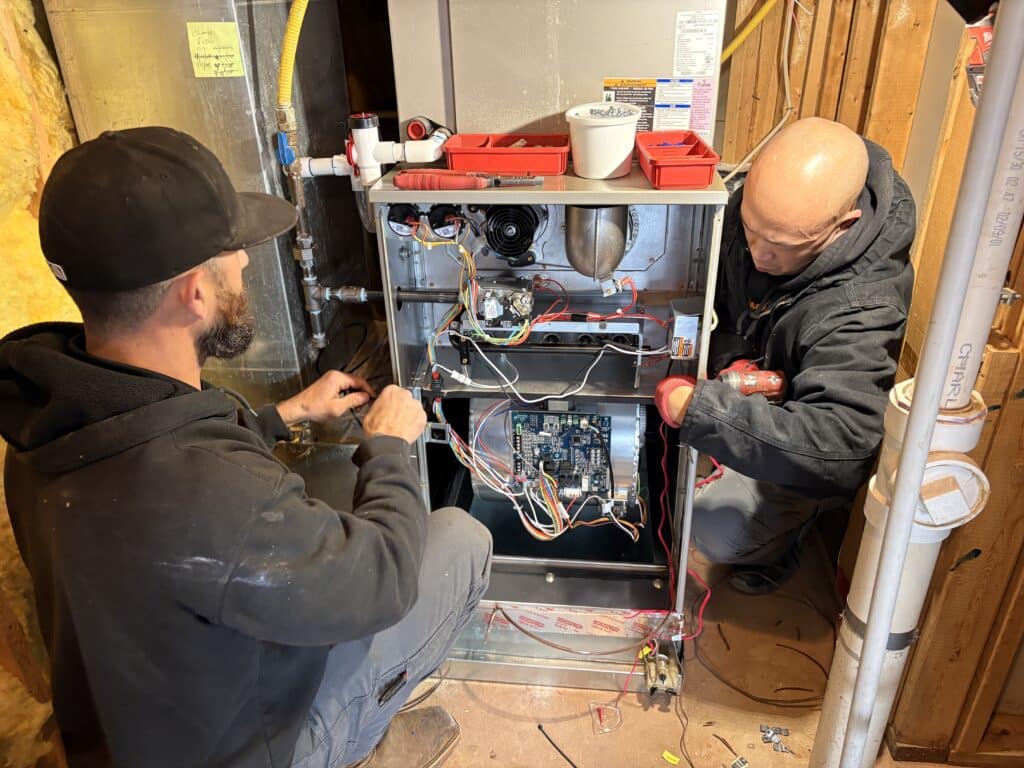
- The thermostat. Heat or Cool, not Off, the fan on Auto, and the setting a few degrees past the room. A blank screen usually means dead batteries. Trane adds the one that catches people out: somebody got cold and changed the settings without saying so. Then give it five minutes, because a gas furnace runs its inducer fan first and holds the blower until the burners warm up. More in thermostat not working.
- The breakers and the furnace switch. Most systems have two breakers, one for the indoor unit and one for the outdoor unit. Next to a furnace there’s a shutoff that, in Trane’s words, “may look like a light switch,” and it gets bumped. Outside, the gray box on the wall by the outdoor unit is the disconnect. Trane’s advice on a tripped breaker is not to flip it at all. Ours is one reset, once. If it trips again, leave it off and call.
- The filter. Hold it up to a light. If none comes through, put in a new one. ENERGY STAR says to look at it every month, and warns that “a dirty filter can increase energy costs and damage your equipment, leading to early failure.” A choked filter is how an AC coil freezes and how a furnace overheats and shuts its burners off. Which one to buy: our filter guide.
- The outdoor unit. In summer, ice on the copper lines or the coil means an airflow or refrigerant problem: set the thermostat to Off, the fan to On, and let it thaw completely before you try again. In winter, a heat pump that frosts over and then sends up a cloud of steam is defrosting, which Trane calls “a totally normal process.” Ice that stays and keeps growing is a repair.
- The drain and its float switch. An AC wrings water out of the air all summer, and a high-efficiency furnace makes water all winter. It leaves through a small PVC line at the indoor unit. Many systems have a safety switch there that, per Trane, “will automatically shut down the indoor unit if the water level inside the drain pan begins to rise.” Water in the pan and a system that shut itself off? That’s the drain, and clearing it sits near the bottom of the price list.
The system we put in first
Built to take a beating. Put in by our crew.
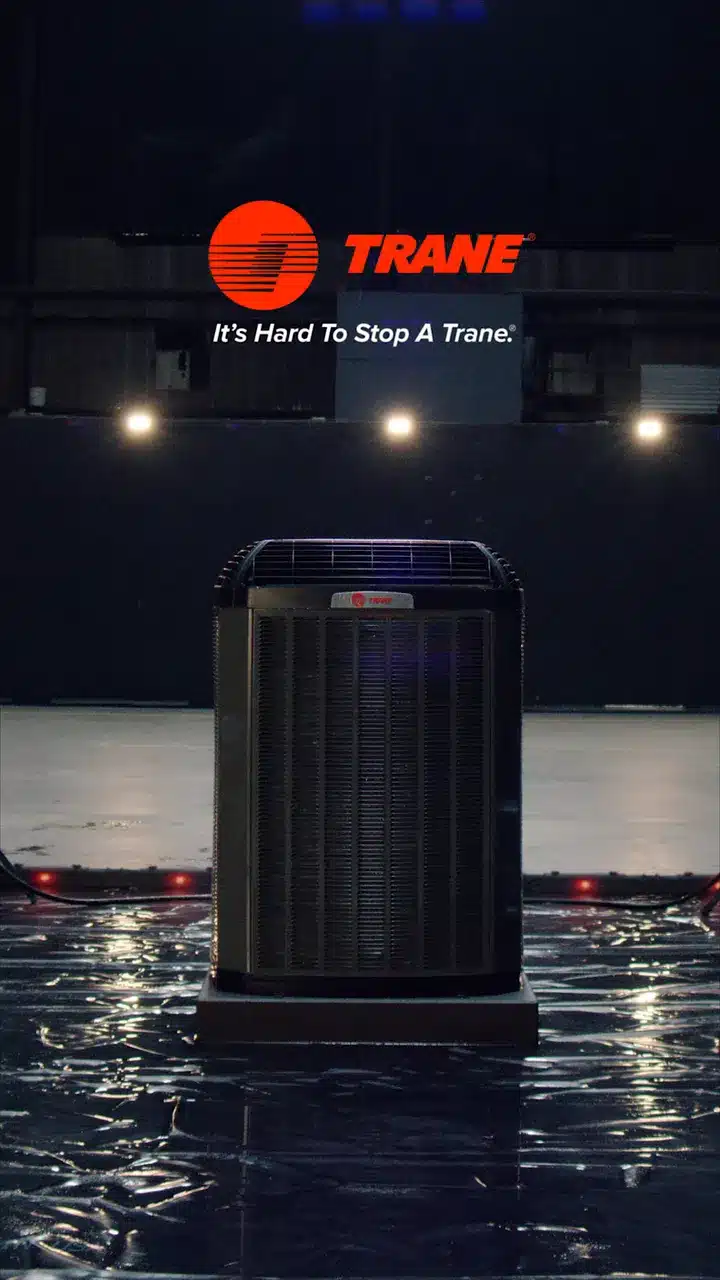
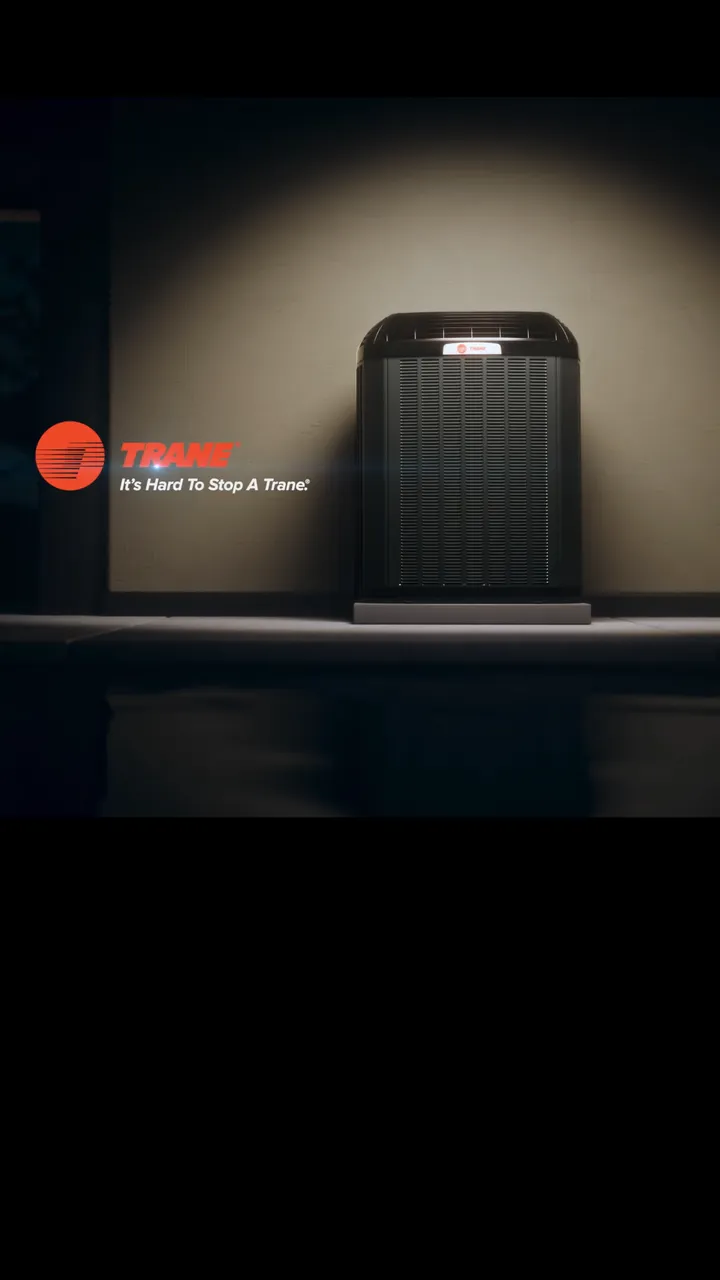
Heat lamps, snow and rain on one outdoor unit: that’s Trane’s own film. We’re a Trane Comfort Specialist, on Trane’s own dealer locator, and when you pick a Trane, our crew puts it in.
Films: Trane’s own.
Heat, cooling or both? Where the problem usually lives
Most houses here have two halves. Inside, a furnace or an air handler moves the air, with the filter, the blower, the cooling coil and the drain. Outside sits an air conditioner or a heat pump, and Trane says the two “look virtually the same.” The thermostat tells you which: an Em Heat or Aux Heat setting means a heat pump, and that outdoor unit is your heat in January too. The ducts tie it together; a crushed or disconnected run is why one room is miserable while the rest of the house is fine.
Checks didn’t fix it? Here’s what each symptom usually turns out to be, in either season, and where it’s written up in full.
| What it’s doing | What it usually is | The full answer |
|---|---|---|
| Nothing at all: no fan, no sound | Power (batteries, a breaker, the furnace switch or its door switch), then the control board | The heat is out: what to check |
| Indoor fan runs, outdoor unit sits silent | The outdoor unit’s capacitor or contactor, or its disconnect | AC repair |
| Cooling on, air not cold | A refrigerant leak, a frozen or dirty coil, or the compressor | What AC repairs cost |
| Heat on, air blowing cold | Burners that never lit, or a heat pump in defrost | HVAC blowing cold air in winter |
| Furnace lights, runs a few seconds, shuts off | A dirty flame sensor, most of the time | Heating repair |
| Outdoor unit buried in ice | Summer: airflow or refrigerant. Winter: frost that clears is defrost; ice that stays is the defrost board, a sensor or low refrigerant | Heat pump: normal or broken |
| Water around the indoor unit, or the system shut itself off | The condensate drain, its trap or the float switch | The drain that shuts your furnace off |
| AUX or EM on the thermostat | AUX on a cold morning, or during defrost, is the backup heat helping. AUX all day isn’t | Aux heat vs. emergency heat |
| Runs and runs, never reaches the setting | The filter, a dirty coil, low refrigerant, or weather past what the system was sized for | Set to 69, stuck at 66 |
What breaks most, and what each repair costs
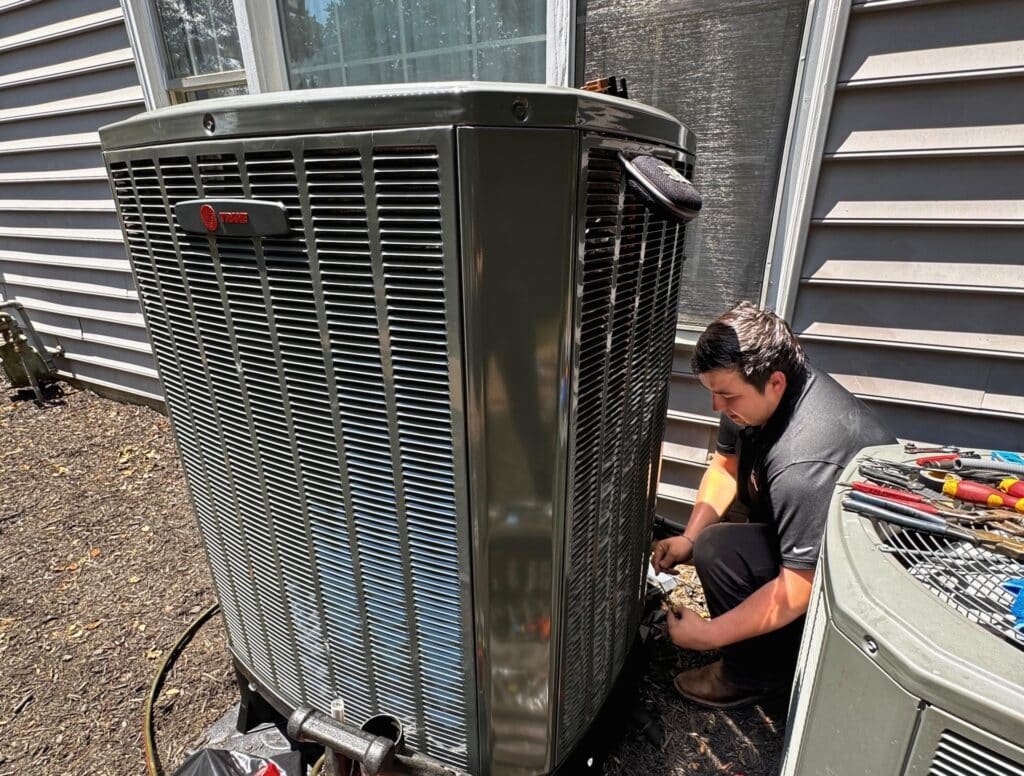
Most of what we fix, heat or AC, runs $95 to $1,500, from a flame sensor cleaned on a furnace to a condenser fan motor on an AC. These are the repairs we run most, at our own prices for the repair on a standard home system. Your exact price comes in writing before anyone starts.
| Repair | What you notice | Our price |
|---|---|---|
| Flame sensor cleaned, gas furnace | Lights, runs a few seconds, shuts off | $95 to $180 |
| Condensate drain cleared, trap and switch added, indoor unit | Water in the pan, or a system that shut itself off | $175 to $420 |
| Run capacitor replaced, outdoor unit or furnace blower | A hum, and the motor never gets going | $240 to $370 |
| Contactor replaced, outdoor unit | Thermostat calling, outdoor unit silent | $290 to $425 |
| Thermostat replaced | Never calls, calls at odd times, or runs backup heat when it shouldn’t | $300 to $640 |
| Defrost board replaced, heat pump | The outdoor coil turns to ice and stays that way | $450 to $1,150 |
| Control board replaced, furnace or air handler | Nothing responds, or it runs out of order | $550 to $1,180 |
| Blower motor replaced, furnace or air handler | It’s running, but little or no air at the vents | $670 to $2,400 |
Capacitors, contactors, igniters and flame sensors usually ride on the truck, so those tend to get fixed on the first visit. The blower motor’s range is wide because a standard motor and a variable-speed one are different jobs. Every row on each side, with what each part does, is on AC repair and furnace and heat pump repair, and the heat pump list on heat pump repair runs $240 to $2,400. The furnace side, symptom by symptom: what furnace repairs cost.
What an HVAC repair visit looks like, and what it costs
The diagnostic is $99, flat, heat or AC. A technician looks at the whole system, not just the part making the noise: the electrical side and motor amps, refrigerant pressures, temperatures in and out, and on a furnace the flame and the safeties. Then you get the repair price in writing before anything is opened up or ordered. Approve it or don’t. If you don’t, the diagnosis is still yours.
Every other kind of visit, from a tune-up to the fall Heating Check, is priced in one place in HVAC service cost, visit by visit.
Booking one? Our HVAC service page has every kind of visit priced side by side: a repair, a tune-up or the fall heating check.
When can someone come? Typically the same day or the next day, and we’ll tell you honestly when we can get there. We run 24/7 emergency service, so if the house is cold or hot right now, call rather than booking online: you go on the dispatch board instead of into the next open slot. For anything that can wait, book online and pick the time.
Comfort+ members get the diagnostic included and take 15% off any service. Half of each repair bill is banked toward replacing that system, up to $1,500, and each credit lasts 24 months. So a control board this winter isn’t money lost if the furnace gets replaced next year. How Comfort+ works.
Emergency HVAC repair: what can’t wait, and what to do first
A gas smell. Natural gas smells like sulfur or rotten eggs. Washington Gas says to leave the building immediately, then call 911 and its Emergency Leak Line, 844-WASHGAS (927-4427), option 1. Don’t switch lights or appliances on or off on the way out, and don’t call from inside: Washington Gas counts phones among the things that can spark. On propane, call your propane company from outside instead.
A carbon monoxide alarm. Fairfax County Fire and Rescue says everyone out of the house at once, 911 from a neighbor’s house, and don’t open doors and windows to air it out, because the crews take readings around the house to find the source. Once they’ve cleared it, we’ll find out why it went off. More in what to do when a carbon monoxide alarm goes off.
Call us now, day or night, for water coming through a ceiling, a burning electrical smell, a breaker that won’t stay on, or no heat below freezing with someone very young, elderly or sick in the house. A system limping along on a mild day can usually wait for a daytime slot. The first hour in a summer breakdown, step by step: when the AC dies in a heat wave.
Every kind of breakdown sorted into call tonight and what can wait, with what to do while you wait, is in emergency HVAC service.
HVAC repair vs. replace: where we draw the line
If a system can be repaired sensibly, we’d rather repair it, and most calls end that way. The line where that changes is Goodman’s, and it’s a fair one: “If a major piece of AC equipment fails or the repair cost is close to 1/2 the price a new air conditioner, it may be better to replace the system.” Our own rule of thumb, out loud: a furnace past fifteen years with a repair over a third of the price of a new one is usually better replaced, and a cracked heat exchanger ends the conversation. A heat pump works winter and summer, so its line comes sooner.
Two repairs usually start that conversation. A refrigerant leak found, repaired and recharged runs $1,850 to $2,700. From about $31 a month at 0% APR for 60 months, the whole price financed, on approved credit. A compressor out of warranty runs $2,200 to $5,100. From about $37 a month at 0% APR for 60 months, the whole price financed, on approved credit. If the system still runs on R-22, a real leak is usually where we’d put a new system’s price beside the repair: EPA says no new R-22 has been made or imported in the United States since January 1, 2020, and what’s left is used refrigerant, cleaned up.
When it is time, here’s what a new system costs from us, installed:
| New system | Installed | Monthly, from |
|---|---|---|
| A gas furnace, keeping your AC | $4,285 to $14,040 | $71/mo at 0% APR for 60 months |
| An air conditioner, keeping your furnace | $5,942 to $14,450 | $99/mo at 0% APR for 60 months |
| A heat pump system | $8,499 to $21,650 | $142/mo at 0% APR for 60 months |
| Furnace and AC together | $8,898 to $23,000 | $148/mo at 0% APR for 60 months |
Monthly figures: 60mo @ 0% APR on each starting price, the whole price financed, on approved credit. Longer plans lower the payment and cost more in total. The lender sets the final terms.
Where you land in each range is size and efficiency. The HVAC estimator prices your own house in about a minute, and HVAC replacement has a page for each system. The best deal we have on a replacement right now: Free furnace with a new AC and its matching coil. The terms are on its own page, and everything else we’re running is on our offers page. Holding another company’s quote that says replace? Get our free second opinion first.
The HVAC maintenance that heads off most of these repairs
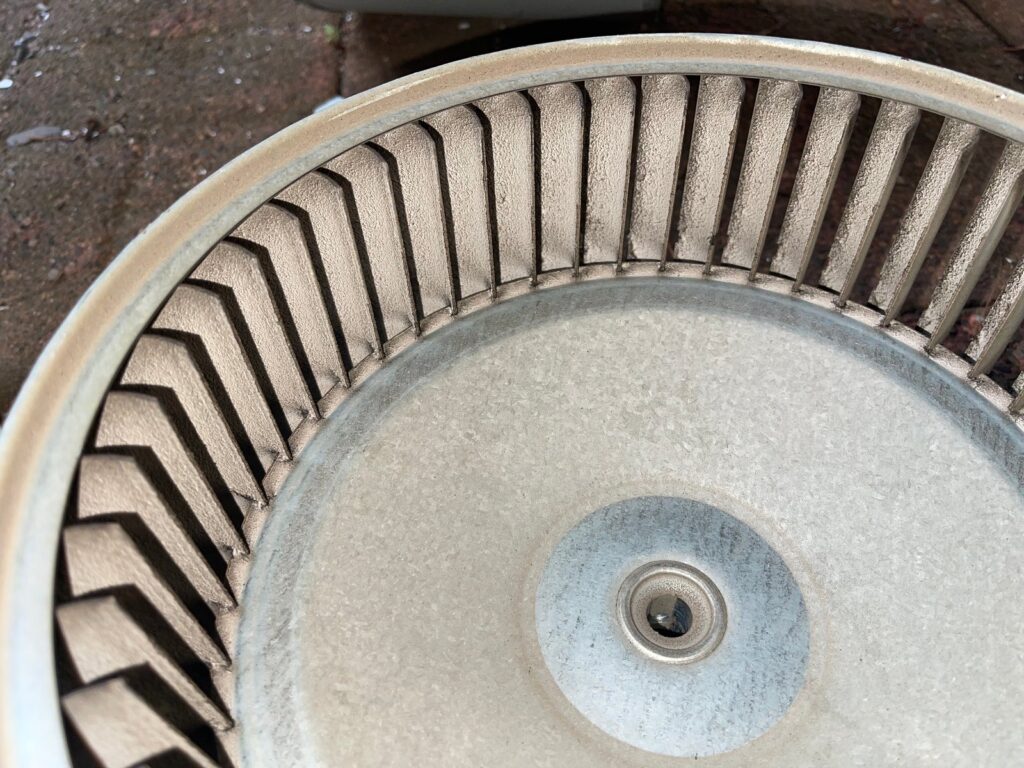
ENERGY STAR makes the case in one line: “Maintain your equipment to prevent future problems and unwanted costs.” Its schedule is ours too: the cooling checked in the spring, the heating in the fall. Look back at the repair table and a lot of it shows up early on a visit: a flame sensor with a film on it, a capacitor testing weak before the hottest week of the year, a drain line starting to clog, a filter packed solid. ENERGY STAR names the drain specifically: “A plugged drain can cause water damage in the house and affect indoor humidity levels.”
No visit stops everything. Control boards and compressors fail on their own schedule. What maintenance does well is find the part on its way out while you still get to pick the day it’s fixed.
What it costs with us. For the fall, the $67 Heating Check covers one furnace or heat pump, through December 31. A seasonal tune-up on one system, the AC before summer or the furnace before winter, is $99, on our maintenance page; heat pumps, boilers and ductless mini-splits are the same price. Rather have it handled? The best deal we have for the year is the membership: $199 a year for dryer vent cleaning, a water heater flush, heating and cooling maintenance, and 15% off any service. That’s Comfort+, also $20 a month, month to month, and its four visits every year are a heating maintenance visit in the fall, a cooling maintenance visit in the spring, a dryer vent cleaning, and a water heater flush with a sewer camera inspection. Whatever else we’re running is on our offers page.
Your part between visits: the filter every month, leaves kept off the outdoor unit, an eye on the drain line. The whole year, visit by visit, is in HVAC maintenance, and each visit up close is in what an AC tune-up includes and what a furnace tune-up includes and costs.
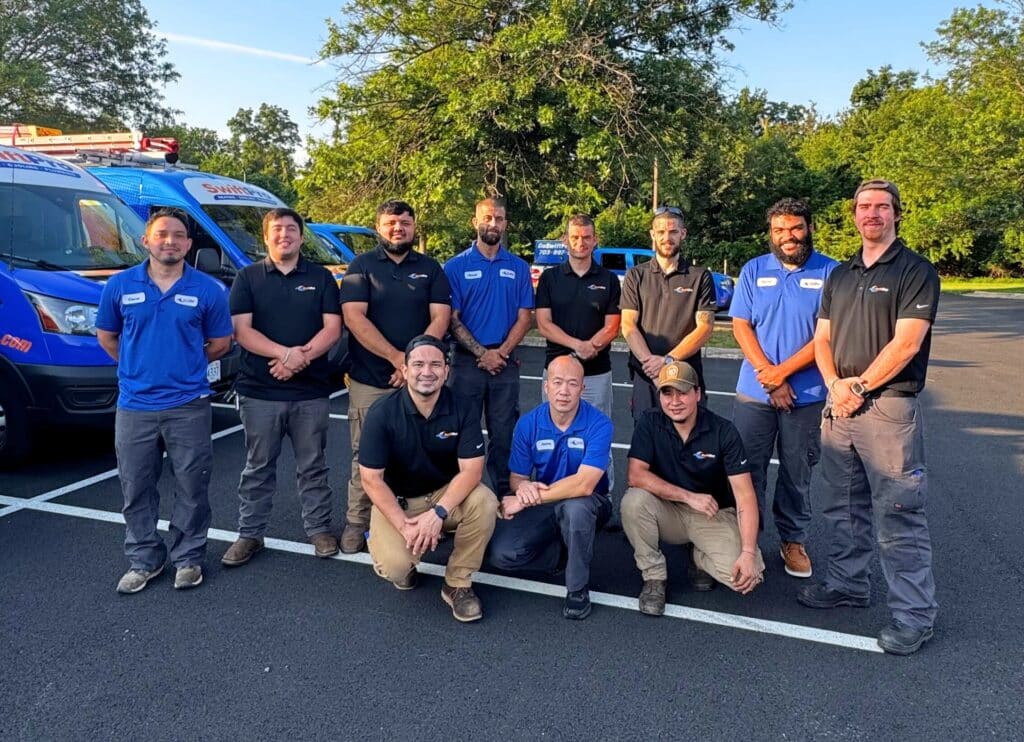
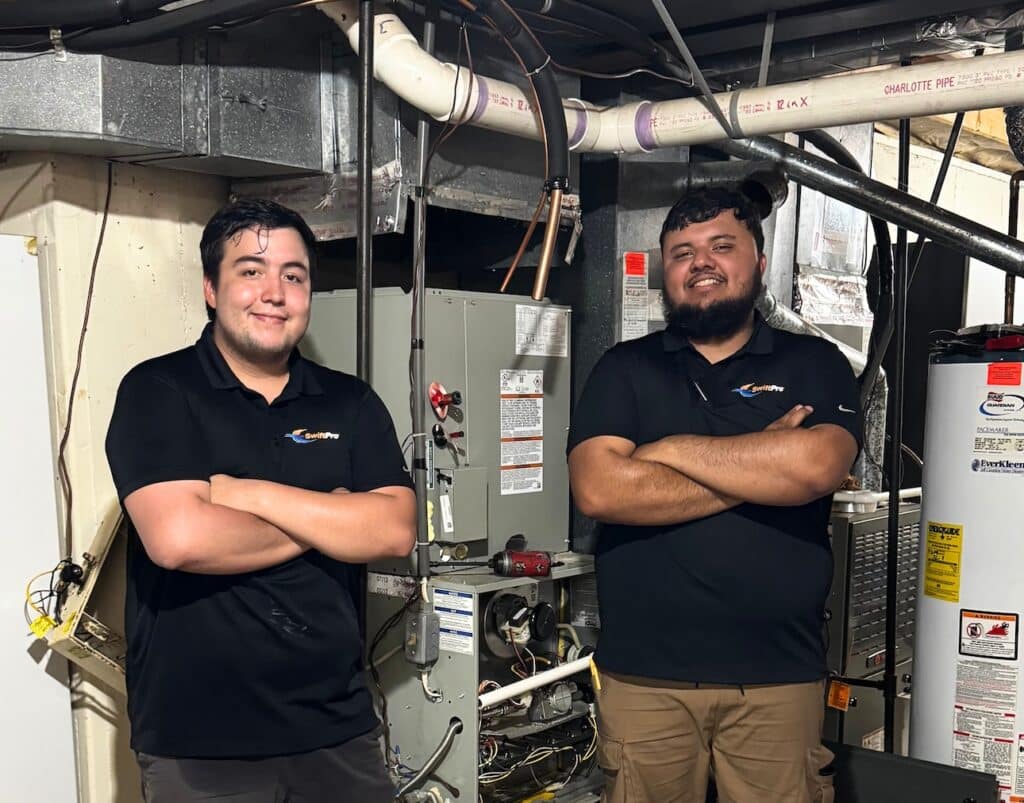
What we repair, and who’s coming to your house
Gas and propane furnaces, heat pumps, central air conditioners, ductless mini-splits (one indoor head can quit while the rest keep running) and hot water boilers on gas or propane. Not oil, and not steam boilers. We’re a Trane Comfort Specialist, a Rheem Pro Partner, Carrier experts and a Mitsubishi Electric Diamond Contractor, and we repair Lennox, Goodman, Amana, Daikin, York, Bryant, Ruud, Payne, Coleman, Luxaire and the rest, including systems somebody else put in. If you’re still deciding who to call, here’s how to check an HVAC contractor before anyone touches the system. Not sure what heats your house? How to tell what’s in your basement.
HVAC repair questions, answered straight
How much does HVAC repair cost?
From us, most repairs run $95 to $1,500, after a $99 diagnostic: a run capacitor is $240 to $370, a flame sensor cleaned $95 to $180, a control board $550 to $1,180. The big ones are a refrigerant leak, $1,850 to $2,700, and a compressor out of warranty, $2,200 to $5,100. From about $37 a month at 0% APR for 60 months, the whole price financed, on approved credit. You get the exact price in writing before any work starts.
Should I repair or replace my HVAC system?
Repair, for most parts on a system of almost any age. Put a new system’s price beside the repair when the repair is close to half of it (Goodman’s line), when a furnace past fifteen years needs a repair over a third of a new one, when a compressor fails out of warranty, or when an R-22 system has a real leak. We’ll price both and tell you which we’d pick.
Why is my HVAC not turning on?
Run the five checks: thermostat mode and batteries, the breakers and the switch by the furnace, the filter, and water in the drain pan, since a tripped float switch shuts everything off. If they all pass, it’s a part: often the capacitor or contactor outside, or the control board inside.
Do you do emergency HVAC repair?
Yes, with 24/7 emergency service across Northern Virginia. Typically the same day or the next day, and we’ll tell you honestly when we can get there. If the house is too cold or too hot to wait, call (703) 997-9757 rather than booking online. A gas smell or a carbon monoxide alarm is a 911 call first.
What does the HVAC diagnostic include?
The whole system, not just the noisy part: the electrical side, motor amps, refrigerant pressures, temperatures, and on a furnace the flame and the safeties. It ends with the fault named and the repair priced in writing. The $99 covers the visit, and you can say no to the repair. Comfort+ members get it included.
Where do you do HVAC repair?
Across Northern Virginia, from our offices in Chantilly and Ashburn: Fairfax, Loudoun, Prince William, Arlington and Fauquier counties, including Reston, Herndon, Centreville, Manassas, Sterling, Leesburg, Alexandria and Vienna.
How often should HVAC be serviced?
Twice a year for a heat pump, or for a furnace with central AC: the heating in the fall, the cooling in the spring, which is ENERGY STAR’s schedule. Look at the filter every month in between. The whole calendar is in HVAC maintenance.
Is an HVAC maintenance plan worth it?
If you’d book the visits anyway, usually yes. Comfort+ is $199 a year for both HVAC maintenance visits, a dryer vent cleaning and a water heater flush, with the diagnostic included and half of each repair bill banked toward replacing that system. Replacing the system this year? Put the money toward the new one.
Can I fix my HVAC myself?
The five checks, yes: the thermostat, the breakers, the filter, a frozen coil thawed with the system off, and a look at the drain. Past that, anything with a panel off, gauges on or the power cut at the disconnect is a job for a technician.
Book an HVAC repair in Northern Virginia
Call (703) 997-9757, book online, or send the form at the top of this page and the office calls or texts you back. The service pages, with every price: furnace and heat pump repair, AC repair and heat pump repair.
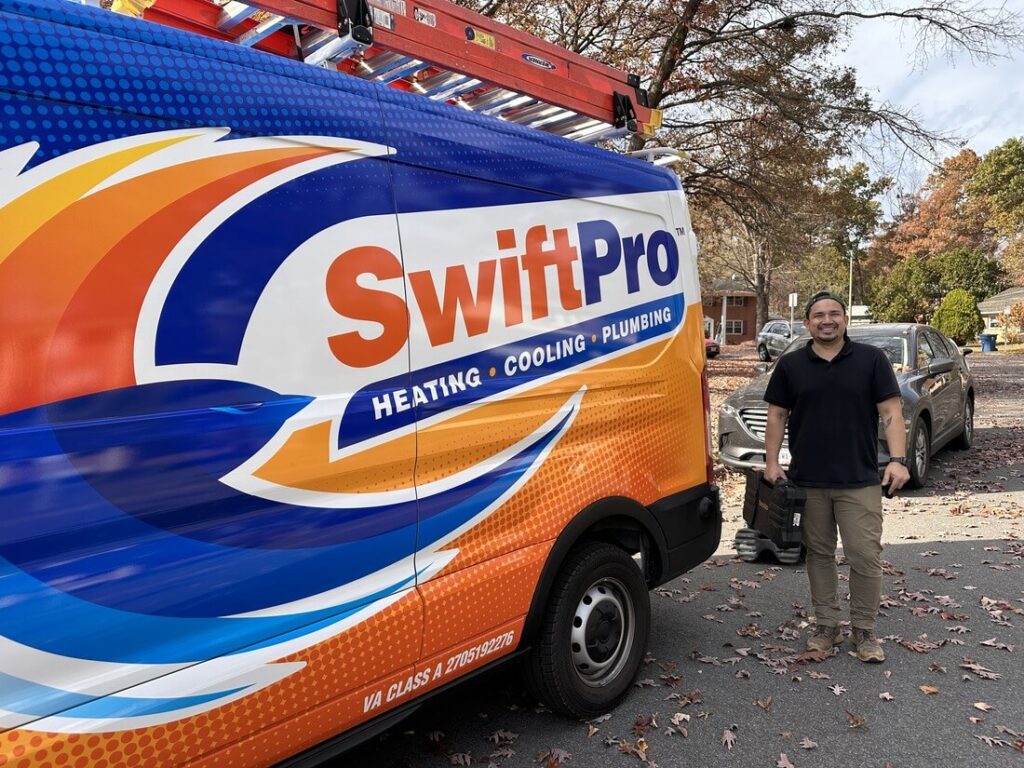
SwiftPro Heating, Cooling & Plumbing repairs furnaces, heat pumps, air conditioners, ductless mini-splits and hot water boilers across Northern Virginia, from Chantilly and Ashburn, with a dedicated HVAC team and a separate plumbing team. Trane Comfort Specialist, Rheem Pro Partner, Carrier experts and Mitsubishi Electric Diamond Contractor. Family owned, BBB Accredited with an A rating, 24/7 emergency service, Virginia Class A contractor license 2705192276, and rated 5.0 stars across 1,132 reviews on Google, Angi, Yelp, the BBB and Facebook. Read the reviews.