


Written October 2026 from our own plumbing calls and price book, every outside fact read at its source the same week.
Most sewer smells in a house come from a drain that has lost its water seal, a toilet seal that has let go, or a vent that can’t breathe, and where and when you smell it tells you which. Start with the drains nobody uses: pour a quart of water into each floor drain, guest sink, tub and shower. If the smell has cleared an hour later, that was it. If it keeps coming back, it’s a job for a plumber: a visit from us anywhere in Northern Virginia is $49, and the repair is priced in writing before any work starts. Everything our plumbers do is on our plumbing services page, or call (703) 997-9757.
Rotten eggs near the stove, furnace, water heater or gas meter, rather than at a drain, can be natural gas. Don’t go looking for it. Get everyone out, then call 911 and your gas company from outside.

Sewer smell in house: find it by where and when you smell it
Fairfax County‘s first step is the right one: look for the source in the bathrooms, the kitchen and the basement before you call anyone. The room, and the moment the smell shows up, narrow it to one or two causes.
| Where you smell it, and when | Most likely cause | Five-minute test, then who fixes it |
|---|---|---|
| Basement floor drain. Worse in winter | Dry trap | A quart of water, then a spoon of mineral oil. Gone an hour later? That was it. Yours to fix |
| A guest bath nobody uses | Dry traps, or a toilet bowl that has dropped | Run every tap 30 seconds, flush once. Yours to fix |
| Toilet base. Worse after a flush | Failed wax ring, or a toilet that rocks | Push the bowl side to side with your knees. Any give? Call a plumber |
| One bathroom sink | Gunk in the overflow or on the stopper | Sniff the overflow hole under the rim. Scrub it with a bottle brush. Yours to fix |
| Kitchen sink. When the dishwasher drains | Drain hose with no high loop | Under the sink, the hose should loop up high. Clip it up. Yours to fix |
| Laundry. When the washer drains | Hose too deep in the standpipe, or no trap | Pull the hose up a few inches and run a rinse. Yours to fix |
| Upstairs, or all over. Drains gurgle | Blocked or cracked vent stack | From the yard, look at the pipe through the roof. Stay off the roof. Call a plumber |
| Supply vents. When the furnace or AC fan runs | AC drain line with a dry trap, glued into a drain | Find where the line ends. Pour a cup of water into its trap. Call a plumber |
| Basement bath with a pump basin | Ejector basin lid or vent not sealing | Loose or missing lid bolts, gaps around the pipes? Call a plumber |
| Sump pit | Stagnant water, or a drain piped in that shouldn’t be | Look in: clear water, or gray water with lint? Call a plumber |
| Near a capped pipe stub on the main | Cleanout cap off or cracked | Is the plug there, and tight? Yours to fix |
| Every hot tap, never the cold | Water heater anode rod | Smell a glass of cold, then a glass of hot. Call a plumber |
| Near the stove, furnace, water heater or meter | Possibly natural gas | No test. Everyone out, then 911 and the gas company from outside. Leave first |
| Lowest floor, after heavy rain | Main line backing up, or a cracked pipe in wet ground | Does the lowest drain gurgle or fill while nothing is running? Call a plumber |
| Older house, no single spot | Cracked cast iron drain in a wall or floor | Rust stains or a damp line on a basement ceiling or wall? Call a plumber |
In our own sewer smell calls, the toilet is the most common answer, usually a wax ring that has let go. Basement pits come next, then sink traps, cracked drain and sewer lines, and water heaters. Alexandria sends us the most of these calls, then Arlington and Fairfax, and plenty come from landlords whose tenants noticed the smell, or from sellers whose agent did.
Sewer smell in basement: the floor drain, the pits and the cleanout
The floor drain. Every drain has a trap, a dip in the pipe that holds water, and that water is all that stands between your basement and the sewer. The Virginia Residential Code wants at least 2 inches of it (section P3201.2). A floor drain only gets water when something spills, so the seal evaporates, faster in dry winter air. Fairfax County says to add water regularly to seldom used drains. We add one step: pour the water in, then a tablespoon or two of mineral oil, which floats on top and slows the evaporation. Some newer houses have a trap primer, a small line that tops the trap up from the water supply.
The ejector basin. A basement bathroom or laundry below the sewer line drains into a basin, and a pump lifts it up to the main. The code calls for that basin to have a gastight removable cover and a vent (section P3007.3.2). A cracked lid, a missing bolt, a dried-out gasket or a gap around a pipe, and the basin breathes into the basement. If the smell is strongest at the lid, our sewage ejector pump page covers the fix, from a new gasket to a new pump.

The sump pit. A sump holds groundwater, not sewage, so a sewer smell from one means stagnant water in a pit whose pump rarely runs, a laundry or floor drain piped into it, or a basin that is really an ejector. Clear water with a little silt is groundwater; gray water with lint or soap scum means a drain is going where it shouldn’t. The pump side is on sump pump repair.
The cleanout. Somewhere on the main drain, low on a basement wall or just outside, there’s a capped stub of pipe where a plumber feeds a drain machine in. A cap left off after the last drain cleaning is an open pipe to the sewer.
Sewer smell in bathroom: the toilet seal, the guest bath and the shower
The toilet. A toilet sits on a wax ring that seals it to the drain in the floor. When the toilet rocks, even a little, the seal breaks, and sewer air escapes at the base with every flush. It’s the most common answer in our smell calls, and a toilet that started smelling right after it was installed usually needs the same fix. Push the bowl side to side with your knees. If it moves, or the floor at the base is stained or soft, the toilet comes up and goes back down on a new ring. Snugging the bolts won’t reseal a squashed ring, and cranking on them can crack the porcelain. Toilet repair from us runs $250 to $900; toilet repair has the rest.
The guest bath. The traps under a sink, tub and shower nobody uses dry out like the basement floor drain, and a toilet whose fill valve has stopped refilling the bowl smells the same way. Run each tap for thirty seconds and flush. Going away? A little mineral oil in the sink and tub drains first.
The shower. A smell at the shower drain is usually hair and soap slime above the trap, not sewer gas. Pull the strainer and clean what you can reach. If the drain is slow too, the clog is further down, and drain cleaning from us is $200 to $800 a fixture.
Sewer smell from sink: the overflow, the dishwasher hose and the trap
A bathroom sink has an overflow hole under the rim, and the channel behind it collects soap, toothpaste and hair that sour in the dark. Put your nose right at the hole. If that’s the smell, it isn’t sewer gas: scrub the channel with a bottle brush and run hot water through it. If it still smells after that, the trap underneath may be corroded through or missing its dip, and replacing a trap is a small job for us.
A kitchen sink that smells when the dishwasher runs usually comes down to the dishwasher’s drain hose. The code wants it to rise to the underside of the counter before it joins the sink drain or the disposal (section P2717.2), so dirty sink water can’t run back into the dishwasher. If yours droops along the cabinet floor, clip it up. Some sinks also have an air admittance valve underneath, a small cap that lets air into the drain and closes to keep sewer air in; when one sticks open, it gets replaced.
The washer drains into a standpipe that needs its own trap, and its hose should hang a few inches into the pipe, not deep inside it. While you’re back there, look at the supply hoses too: they lead our list of five plumbing parts that flood houses.
Gurgling drains and a smell upstairs: the vent stack
Every drain connects to a vent, a pipe that rises through the roof and lets air in so water can run out without sucking the traps dry. The code ends it at least 6 inches above the roof (section P3103.1.1). Fairfax County’s advice: if every trap is full of water and there’s still an odor, look at the vent, because vents plugged by leaves or birds’ nests can push sewer gas back into the house. When the vent can’t breathe, the drains pull air through the traps instead. The tub gurgles when the toilet flushes, and the bowl water sits low. A vent cracked inside a wall does the same, minus the gurgle.
You’ll read that frost closes vents in winter. That’s a colder country’s problem: the code only asks for frost protection where the winter design temperature is 0°F or below, and Prince William County sets ours at 17°F. Here it’s leaves, nests and the odd ball off the gutter. Look from the yard and stay off the roof: clearing a vent means a drain machine up there and a cable down the stack, and our plumbers do it.
A smell when the heat or the AC fan runs: the condensate drain
This one fools people, because it smells like plumbing but comes out of the supply vents. An air conditioner or heat pump wrings water out of the air at the indoor coil, and a small pipe carries it to a drain. Trane’s installer’s guide for its air handlers says why that pipe needs a trap holding at least 2 inches of water: the blower creates negative pressure at the drain while it runs. It also says not to connect the line to a closed drain. Glued straight into a sewer pipe, with its trap dried out over the months the AC makes no water, the line lets the blower pull sewer air in and send it around the house. A smell that arrives with the first heating days of fall, from the vents rather than a drain, points here.
Find where the condensate line ends. Into a floor drain or standpipe with open air between them is fine. Glued into a drain pipe, pour a cup of water into the trap at the unit and see whether the smell stops. That line is the heating and cooling side, and our HVAC service covers it. A high-efficiency gas furnace drains water too: the drain that shuts your furnace off.
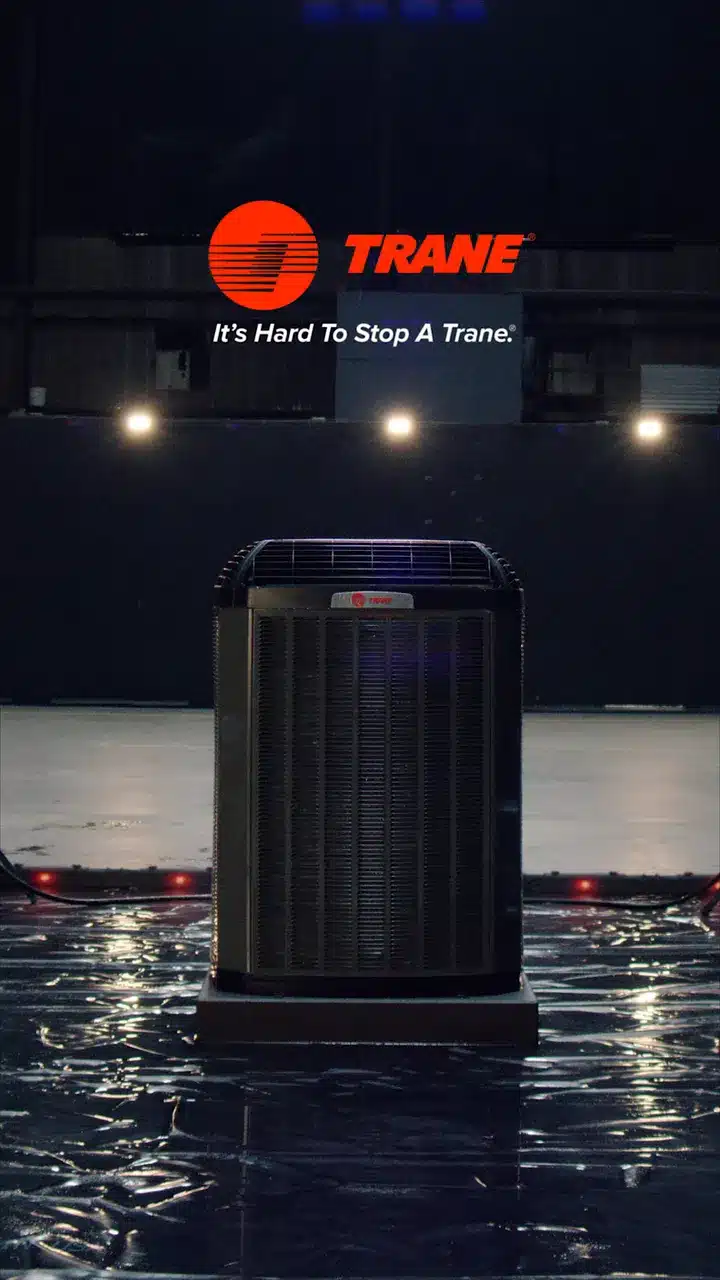
The system we put in first
Built to take a beating. Put in by our crew.
Heat lamps, snow and rain on one outdoor unit: that’s Trane’s own film. We’re a Trane Comfort Specialist, on Trane’s own dealer locator, and when you pick a Trane, our crew puts it in.
Films: Trane’s own.

Older houses: cracked cast iron you can’t see
In older Alexandria, Arlington, Fairfax and Falls Church houses, the drains inside the walls and under the basement floor are often cast iron. It rusts from the inside and thins along the bottom of the horizontal runs, until a crack lets air out long before it lets water out. That smell comes and goes with the weather, and it’s never strongest at one drain. Look for a rust stain or a damp line on a basement ceiling or wall, or a drain that keeps slowing after it’s cleared. More in plumbing in Arlington.
This is where we stop guessing. For a smell with no clear source, we run a smoke test: a machine fills the drain system with smoke, and it comes out wherever a pipe is cracked, a seal has failed or a fitting is loose. If the trouble looks like the line to the street, a camera goes in, $89 when we’re already there or $500 to $1,700 on its own. When a camera is worth paying for is in sewer camera inspection: when it is worth it, and we run one in Alexandria, Arlington, Falls Church and across Northern Virginia.
Rotten eggs: sewer gas, natural gas, or the water heater
The rotten egg smell in sewer gas is hydrogen sulfide. The CDC’s ATSDR says it’s often called sewer gas, and people can smell it at 0.0005 to 0.3 parts per million. OSHA lists nausea, watery eyes and headaches with prolonged exposure at 2 to 5 parts per million. So your nose finds it first: fix it this week, no need to panic, and if anyone gets headaches or feels sick when it’s strong, open the windows and call.
Natural gas smells on purpose: Washington Gas adds an odorant called mercaptan so a leak smells like sulfur or rotten eggs. Near the stove, furnace, water heater, a gas dryer or the meter rather than a drain, treat it as gas. Washington Gas says to leave, leaving doors and windows open if you can, without switching anything on or off, lighting a flame or using a phone, then call 911 and its Emergency Leak Line, 844-WASHGAS (927-4427), option 1, from somewhere safe. It responds 24/7. Gas line repairs afterward are on our gas plumber page.
The water heater. Rotten eggs from every hot tap and never the cold isn’t the drains. North Dakota State University’s water quality team traces it to sulfates in the water reacting with the magnesium anode rod in the tank, and points to a different anode as the fix. Smell a glass of cold and a glass of hot. Hot only, it’s the tank, and swapping the rod is a plumber’s job; both, it’s the water itself. See water heater repair.
Sewer smell in house after rain: what the weather is telling you
Rain changes three things. Soaked ground pushes into any crack in a drain or sewer line. The sewer fills, and a main line that’s already partly blocked backs up into the lowest drain. And on a heavy, still, damp day, air leaving the roof vent doesn’t lift away; it can drift down past a window. The code keeps an open vent 10 feet sideways from an openable window unless it sits at least 3 feet above it (section P3103.5), but older houses and later additions don’t always meet that.
The test is the lowest drain in the house. If it gurgles or fills while nobody upstairs is running water, that’s the main line. Fairfax County says sewage backing up when you aren’t using any fixtures may mean trouble in the county’s main, and sends an inspector when you call its 24-hour line, 703-323-1211 (other towns and counties have their own). If the county’s line is clear, the private lateral from the house to the main is the owner’s to maintain: main sewer line cleaning from us runs $550 to $1,650. Our five-minute test for one drain versus the whole house is in clogged drain or main line.
What finding and fixing a sewer smell costs
A plumber finds the source and prices the fix in writing before any work starts, and you can say no. From our price book:
| What it is | Our price |
|---|---|
| Plumbing visit: a plumber finds the source | $49, or $250 after hours |
| Toilet repair, a new wax ring or a new fill valve included | $250 to $900 |
| Drain cleaning, one fixture | $200 to $800 |
| Main sewer line cleaning | $550 to $1,650 |
| Sewer camera inspection, added to a visit | $89 |
| Sewer camera inspection on its own | $500 to $1,700 |
| Smoke test, vent repair, ejector basin resealed | Priced in writing at your house |
If it were our house: water and a spoon of mineral oil in every drain nobody uses, the knee test on every toilet, a look at the dishwasher hose and the cleanout cap, then a call. And for a smell with no obvious source, we’d ask for a smoke test before a camera: a camera sees inside the pipe it can reach, and smoke shows where air gets out, behind a wall included.
When can someone come? Often same-day, and we will tell you honestly when we can get there. A smell that can wait, book online. Current plumbing deals are on our offers page, every drain and sewer price is on drain cleaning and sewer repair, and if another company says dig up the yard, get our free second opinion and read up on trenchless sewer repair first.
Sewer smell questions, answered
Why does my house smell like sewer?
Sewer air is getting past a seal that should hold it back: a dried-out trap, a toilet’s wax ring, a blocked vent, an ejector basin lid, an open cleanout or a cracked pipe. Start in the bathrooms, the kitchen and the basement, and pour water down drains you don’t use often.
Is sewer gas dangerous?
The smell is hydrogen sulfide. The CDC’s ATSDR says people smell it at 0.0005 to 0.3 parts per million, below the 2 to 5 where OSHA lists nausea and headaches with prolonged exposure. Fix it this week, and if anyone feels sick, air the house out and call.
How do I find where a sewer smell is coming from?
Go room by room, nose close to each drain, toilet base, sink overflow, pit and cleanout, and notice when it’s worst: after a flush, when the dishwasher drains, when the heat runs, after rain. If you can’t pin it down, a plumber’s smoke test will.
Why does my toilet smell like sewer?
At the base, the wax ring has failed, often because the toilet rocks. In the bowl, the water may be too low to seal, from a fill valve that stopped refilling it or a blocked vent. Toilet repair from us runs $250 to $900.
Who fixes a sewer smell, a plumber or the county?
Inside the house, and in the lateral to the public sewer, it’s yours and a plumber’s: Fairfax County says the private lateral is the owner’s to maintain. If sewage backs up when nobody is using water, or you smell sewage outside, call your sewer authority first; in Fairfax County, 703-323-1211.
Does homeowners insurance cover a sewer backup?
Not always. Fairfax County suggests checking your policy, since sewage backup coverage may be optional and can generally be added, and advises it for homes with fixtures below grade, like a basement bathroom.
How much does it cost to fix a sewer smell?
From us, a plumbing visit is $49 ($250 after hours), and the fix is priced in writing before work starts: toilet repair runs $250 to $900, drain cleaning $200 to $800 a fixture.
Why does my water smell like rotten eggs only when it’s hot?
Sulfates in the water reacting with the magnesium anode rod in the water heater, per North Dakota State University’s water quality team. A different anode rod is the usual fix.
Sewer smell in Northern Virginia: call (703) 997-9757
Call (703) 997-9757, day or night, book online, or send the form at the top of this page and the office calls or texts you back. Everything our plumbers do, with prices, is on plumbing services, and if anything is backing up, our 24/7 emergency plumbing page has what to do while you wait.

SwiftPro Heating, Cooling & Plumbing has its own plumbing team, separate from its HVAC team, working out of Chantilly and Ashburn across Northern Virginia: drains and sewer lines, toilets, ejector and sump pumps, water heaters and gas lines. Family owned, BBB Accredited with an A rating, 24/7 emergency service, Virginia Class A contractor license 2705192276, and rated 5.0 stars across 1,132 reviews on Google, Angi, Yelp, the BBB and Facebook. Read the reviews.

