


Written October 2026, with our price book, the Census Bureau’s heating fuel counts by county and the federal efficiency rules read the same week.
The best heating and air conditioning system for a Northern Virginia house is the one the house is already built for. Gas and ducts: a gas furnace with central AC, or dual fuel if you want a heat pump doing the mild-weather heating. Ducts but no gas: a heat pump. No ducts: ductless mini splits. Hot water radiators or baseboard: keep a boiler for heat and add ductless for cooling. A new furnace and AC together runs $8,898 to $23,000 installed. From about $148 a month at 0% APR for 60 months, the whole price financed, on approved credit. Every system is priced on our HVAC replacement page.
This page is about the kind of system, not the name on the box. Once you know the kind, the brand question is its own post: the best heating and air conditioning brands. And if yours quit tonight, call (703) 997-9757. A dead system in January gets decided with a technician standing in front of it, not off a web page.

The best heating and air conditioning system for each kind of house
Two questions sort it out. Is there natural gas at the street, or a propane tank in the yard? And are there ducts? Northern Virginia splits close to down the middle on the first one. In the Census Bureau’s 2020 to 2024 survey, utility gas heats 54 percent of homes in Fairfax County, 59 percent in Loudoun and 54 percent in Prince William, while electricity heats about half the homes in Arlington and Alexandria (Census table B25040). Find your house in the left column:
| Your house | The system that fits | Installed | Monthly, from |
|---|---|---|---|
| Gas and ducts, furnace and AC both old | Gas furnace and central AC together | $8,898 to $23,000 | $148/mo at 0% APR for 60 months |
| Gas and ducts, AC dying, furnace still good | A new AC on the furnace you keep (or a heat pump in its place, for dual fuel) | $5,942 to $14,450 for the AC | $99/mo at 0% APR for 60 months |
| Gas and ducts, furnace dying, AC still good | Gas furnace alone | $4,285 to $14,040 | $71/mo at 0% APR for 60 months |
| Ducts, no gas | Heat pump and air handler | $8,499 to $21,650 | $142/mo at 0% APR for 60 months |
| No ducts, one room or an addition | Ductless mini split, one zone | $7,000 to $10,000 | $117/mo at 0% APR for 60 months |
| No ducts, the whole house | Ductless, two to six zones | $11,000 to $30,000 | $183/mo at 0% APR for 60 months |
| Hot water radiators or baseboard | Gas boiler for heat, ductless for cooling | $9,900 to $16,500 for the boiler | $165/mo at 0% APR for 60 months |
| Gas and ducts, and you want the heat pump carrying mild days | Dual fuel: a heat pump outside, a gas furnace inside | Priced at your house | |
| Condo on the building’s water loop | Water source heat pump | Priced at your house | |
| A lot with room for a ground loop | Geothermal | Priced job by job | |
Monthly figures: 60mo @ 0% APR on each starting price, the whole price financed, on approved credit. Longer plans lower the payment and cost more in total. The lender sets the final terms.
Three rows have no range because the house sets the price. Dual fuel is a heat pump plus whatever the furnace side needs, which might be nothing or might be a new furnace. A building water loop and a ground loop are different at every address. Everything else is the same price book our estimator runs on.
One more thing before the details: the system type matters more than the brand. A well-sized heat pump from any of the big names will beat a top-of-the-line furnace in a house with no gas line or propane tank, because that furnace can’t go in at all. Pick the kind first. The brand, the size and the quote come after, and they’re at the bottom of this page.
Gas and ducts: a furnace and central AC is still the default
If your house has a gas meter and ductwork, a gas furnace with a central air conditioner is the system it was most likely built around, and replacing like for like is the simplest job there is. The furnace heats the air, the AC’s coil sits on top of it, and the same blower pushes both through the ducts you already have. If only one of the two is dying, you can replace just that one: a furnace alone runs $4,285 to $14,040 installed. From about $71 a month at 0% APR for 60 months, the whole price financed, on approved credit.
Propane works the same way. A propane furnace is a gas furnace set up for LP, and it’s common out past the gas lines: the Census counts propane heat in about 8 percent of Loudoun homes and 17 percent of Fauquier’s.
On efficiency, federal rules set the floor. A gas furnace sold today must be at least 80 percent AFUE, and furnaces made on or after December 18, 2028 must reach 95 percent. Central air in Virginia must be at least 14.3 SEER2 below 45,000 Btu per hour and 13.8 SEER2 above it (the federal efficiency standards). A 95 percent furnace is a condensing furnace: it vents through PVC pipe, usually out a side wall, instead of up the chimney.

Washington Gas pays $500 toward a new furnace rated 95.1 to 96.9 percent AFUE and $700 at 97 percent and up, for Virginia customers, through a contractor in its network. We’re in that network for furnaces. The paperwork has to be in no later than 30 days after the install, and homes on Columbia Gas (parts of Chantilly and Herndon) don’t qualify. The terms are on the Washington Gas page.
Not sure how big the new one should be? A furnace is sized by a load calculation on your house, not by the label on the old one. Our post on what size furnace you need walks through it, and the furnace replacement page has the details on the install.
Free Furnace With a New AC
Put in a new AC with its matching coil and a basic single-stage gas furnace goes in with it, installed together. See the free furnace
Want your own number before anyone comes out? The HVAC estimator prices your house in a few questions.
Dual fuel: the one we lean toward when the AC goes first
Here’s our opinion, and it’s the one place on this page we’ll push. If you have gas and ducts, and the air conditioner dies while the furnace still has years in it, take a hard look at a heat pump in place of that AC. It cools exactly like an air conditioner all summer. Then in fall and spring, and on the milder days of winter, it heats the house too, and the gas furnace only lights on the cold nights. ENERGY STAR says a heat pump can go in as a drop-in replacement when either the central air or the furnace needs replacing, and that this creates a dual-fuel system for a modest extra cost over an AC system (ENERGY STAR on air source heat pumps).
The thermostat decides who runs. Below a temperature you set, the furnace takes over; above it, the heat pump carries the load. Whether that pencils out on your bills depends on your gas and electric rates, and our heat pump vs gas furnace cost post runs those numbers with local rates. How the two pieces are set up, and where the switchover usually lands, is in our dual fuel post.
If you’d rather keep it simple, a straight AC on the furnace you have runs $5,942 to $14,450 installed. From about $99 a month at 0% APR for 60 months, the whole price financed, on approved credit. Nothing wrong with that choice. The difference between the two is covered in heat pump vs air conditioner, and the price of each is on our heat pump vs furnace page.
Ducts but no gas: a heat pump, and yes, it handles our winters
Plenty of Northern Virginia houses never had gas. Electricity heats 42 percent of homes in Fairfax County, 40 percent in Prince William and more than half in Arlington and Stafford, per the same Census table. In a house with ducts and no gas line, a heat pump with an indoor air handler is the system to put in. It heats and cools from one outdoor unit, and the air handler inside replaces the furnace.
The usual worry is whether it keeps up in January. The Department of Energy puts every county around here in the mixed-humid climate, IECC zone 4A (DOE climate region guide): hot, sticky summers and winters that are cold but not Minnesota. ENERGY STAR tests cold-climate heat pumps down to 5 degrees and says they keep working below that, paired with a backup heat source (ENERGY STAR). Here that backup is electric heat strips in the air handler, the thing your thermostat calls aux heat; aux heat vs emergency heat explains it, and our heat pump in a Virginia winter post covers what to expect on the coldest nights.
A heat pump and air handler run $8,499 to $21,650 installed. From about $142 a month at 0% APR for 60 months, the whole price financed, on approved credit. Federal rules require at least 14.3 SEER2 and 7.5 HSPF2 on a new split heat pump. The federal tax credit ended for heat pumps put in after December 31, 2025 (IRS notice), so leave it out of your math.

Replacing an old heat pump with a new one is the most straightforward job of all. The heat pump replacement page has the details, and our rebates page has what’s current.
The system we put in first
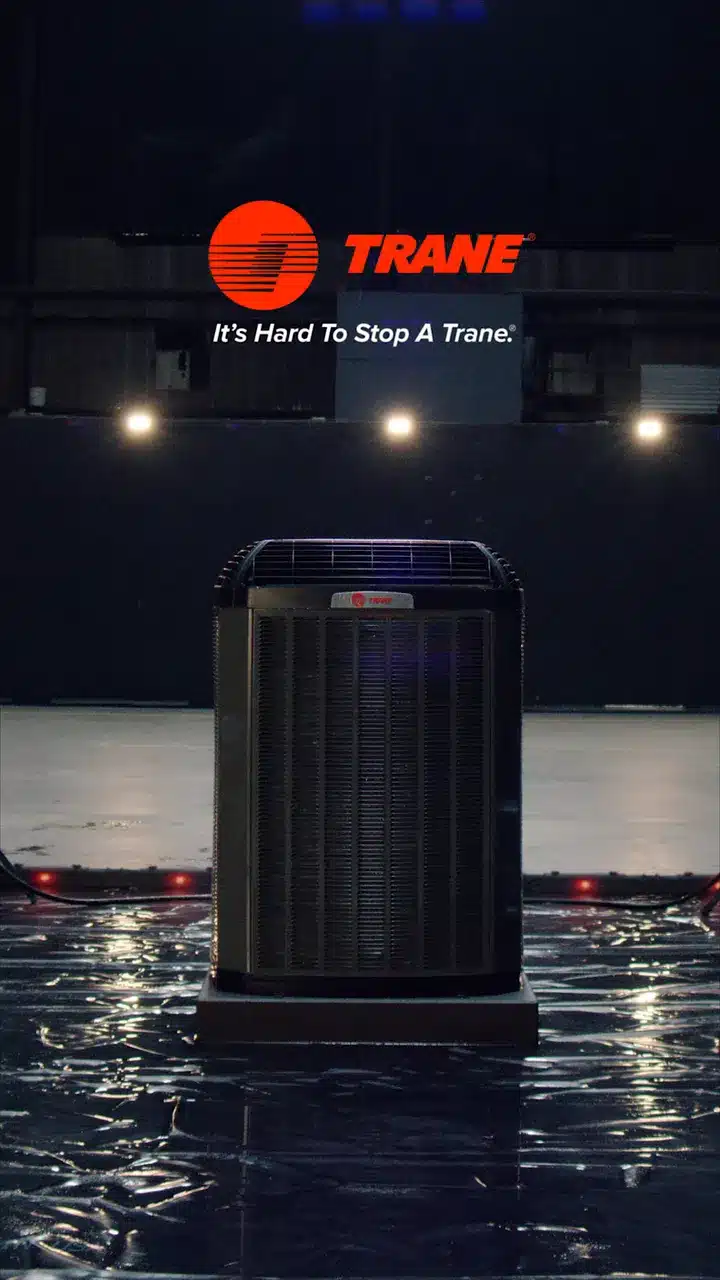
Built to take a beating. Put in by our crew.
Heat lamps, snow and rain on one outdoor unit: that’s Trane’s own film. We’re a Trane Comfort Specialist, on Trane’s own dealer locator, and when you pick a Trane, our crew puts it in.
Films: Trane’s own.

No ducts: ductless mini splits
ENERGY STAR puts it plainly: ductless systems are designed for homes, or sections of homes, that don’t have ductwork, and if your home does have ducts, a ducted heat pump may be the right system instead (ENERGY STAR on ductless). That’s our rule too. A mini split is a heat pump with a small head on the wall in each room it serves, linked to an outdoor unit by a line set through a small hole in the wall.
It fits a sunroom, an addition, a finished attic, a garage you’ve turned into a gym, or one room the ducts never reach well. One zone runs $7,000 to $10,000 installed. From about $117 a month at 0% APR for 60 months, the whole price financed, on approved credit.
For a whole house with no ducts, two to six zones run $11,000 to $30,000 installed. From about $183 a month at 0% APR for 60 months, the whole price financed, on approved credit. If it’s one cold room in a house that does have ducts, read zoning vs ductless for one cold room before you buy anything.

What drives the price, room by room, is in our ductless mini split cost post, and the ductless mini split page shows what we install.
Older homes with radiators or baseboard: keep the boiler, add cooling
Some older houses heat with a hot water boiler: radiators or baseboard along the walls and no ducts at all. That heat is quiet and even. Replacing the boiler with a new gas boiler keeps it. A hot water boiler replacement runs $9,900 to $16,500 installed. From about $165 a month at 0% APR for 60 months, the whole price financed, on approved credit.
The catch is cooling. A boiler doesn’t do it, and with no ducts, the cooling answer is ductless: a few wall heads in the rooms you use most, or a full set.
If your house still heats with oil, we don’t work on oil equipment. The usual move off it is a heat pump, or a gas boiler or furnace if the street has a gas line.

An older house that does have ducts gets the same answer as a newer one, once someone checks that the ducts are big enough for cooling. Boiler details are on the boilers page, and what moves the price is in our boiler replacement cost post.
Townhouses and condos
A townhouse is just a house with shared walls, so the same two questions apply. Most have ducts, and the answer is a furnace and AC if there’s gas or a heat pump if there isn’t. The one thing to check first is where the outdoor unit can go: a roof, a small patio or a spot your HOA has rules about.
Condos are where it gets specific. Some condo buildings run a water loop through the building, and each unit has a water source heat pump in a closet that trades heat with that loop instead of with outdoor air. If yours is one of those, the right replacement is another water source heat pump, sized to fit the closet and the loop (how water source heat pumps work). Some older garden condos have a through-the-wall packaged unit instead, covered in our Magic-Pak post. The condo HVAC page covers the building questions, from access to the board.
Is geothermal the best heating and cooling system?
On efficiency, it’s near the top. ENERGY STAR calls geothermal heat pumps among the most efficient and comfortable heating and cooling technologies available, since they use the earth’s natural heat, and it also says they can be more expensive to purchase up front (ENERGY STAR on geothermal). Inside the house, a geothermal system looks a lot like any heat pump with an air handler. The difference is outside: instead of an outdoor unit, the system trades heat through a loop of pipe buried in the yard or run down into wells.
That loop is why it’s priced job by job, and it’s most of the price. It needs a lot with room to dig or drill, and access for the equipment to get there. On a typical Northern Virginia lot, the honest comparison is a geothermal system against a good air source heat pump or dual fuel, both of which are in the table above with a real range.
Then the brand, the size and the quote
With the kind of system settled, the rest follows. For brands, our heating and AC brands post and the brands page show what we put in and why; best HVAC brands goes deeper on the names. For size, what size AC unit you need and the furnace post above both come down to a load calculation, not the old unit’s label.
For the quote, how to read an HVAC replacement quote shows what should be on the page. If you already have a quote from someone else and want a second set of eyes, that’s what our second opinion is for. And if you want to see what the whole install looks like, from the old unit out to the new one running, read our heating installation post.
Questions about picking a heating and AC system
What is the best heating and air conditioning system for a home?
The one your house is built for. With gas and ducts, a gas furnace and central AC, or dual fuel with a heat pump in place of the AC. With ducts and no gas, a heat pump and air handler. With no ducts, ductless mini splits. With a hot water boiler, a new boiler for heat and ductless for cooling.
What is the best heating and cooling system for an older home?
It depends on what’s already there. An older house with ducts gets a furnace and AC or a heat pump, once the ducts are checked for size. An older house with radiators or baseboard keeps a hot water boiler for heat and adds ductless mini splits for cooling, since there are no ducts to carry central air.
Is a heat pump or a gas furnace better in Northern Virginia?
Both work here; the house decides. With no gas line, a heat pump is the answer, and cold-climate models keep heating well below freezing with electric backup heat. With gas, a furnace is the simple choice, and dual fuel lets a heat pump handle the mild days. The cost comparison is here.
What is the best heating and air conditioning unit for a townhouse or condo?
A townhouse follows the same rules as any house: furnace and AC with gas, heat pump without it, as long as there’s a spot for the outdoor unit. A condo on a building water loop takes a water source heat pump in the closet, and a few older condos use a through-the-wall packaged unit.
Is dual fuel worth it?
For a gas house whose AC is dying while the furnace is fine, it’s the option we lean toward. ENERGY STAR describes it as a modest extra cost over an AC. The heat pump heats on mild days and the furnace takes the cold nights. Whether it lowers your total heating cost depends on your gas and electric rates, so run the numbers before deciding.
Is geothermal the best heating and cooling system?
It’s among the most efficient, per ENERGY STAR, and it costs more up front because of the ground loop. It’s priced job by job and needs a lot with room to dig or drill. On most lots around here, compare it against an air source heat pump or dual fuel.
What efficiency rating should a new system have?
Federal rules set the floor in Virginia: 14.3 SEER2 for central air under 45,000 Btu per hour, 14.3 SEER2 and 7.5 HSPF2 for a split heat pump, and 80 percent AFUE for a gas furnace, rising to 95 percent for furnaces made from December 18, 2028. Washington Gas pays toward a furnace at 95.1 percent AFUE and up.
Should I pick the brand or the system first?
The system. The kind of system decides whether it even fits your house; the brand decides details like warranty, parts and how the controls feel. Pick gas, heat pump, dual fuel, ductless or boiler first, then compare brands within that kind.
Get the right system priced for your house
The HVAC estimator asks a few questions about your house and shows an installed range for it. Every system’s price sits on our HVAC replacement page, with financing and current offers a click away.
Or have someone look at the house and tell you which kind fits. Call (703) 997-9757 or book online.

SwiftPro Heating, Cooling & Plumbing installs gas and propane furnaces, central air, heat pumps, dual fuel systems, ductless mini splits and hot water boilers across Northern Virginia, from Chantilly and Ashburn. We’re a Trane Comfort Specialist, a Rheem Pro Partner, Carrier experts and a Mitsubishi Electric Diamond Contractor. Family owned, BBB Accredited with an A rating, 24/7 emergency service, Virginia Class A contractor license 2705192276, and rated 5.0 stars across 1,130 reviews on Google, Angi, Yelp, the BBB and Facebook. Read the reviews.


