Written October 2026. The prices are our own price book; Washington Gas, Fairfax County Fire and Rescue, Trane, Carrier and Goodman were read at the source the same week.
Most heating repairs we run cost $95 to $1,180, from cleaning a flame sensor to replacing a control board. Before you call anyone, take five minutes for the checks below: a thermostat on the wrong setting, a furnace switch somebody bumped, a packed filter or a backed-up drain can each stop the heat, and none of them needs a technician. The one exception: if you smell gas or a carbon monoxide alarm is going off, skip the checks and get everyone out of the house first.
If the checks don’t bring the heat back, that’s a repair visit: a $99 diagnostic, and the repair priced in writing before anybody starts it. Book furnace and heat pump repair or call (703) 997-9757. Heat pumps have their own page, heat pump repair, and so do hot water boilers. We run 24/7 emergency service for the nights and weekends the heat picks to quit.
Running, but blowing cold air? That one has its own answer, for a furnace and for a heat pump: why your HVAC is blowing cold air in winter.
Gas smell or a carbon monoxide alarm? Get out first
If it smells like rotten eggs, treat it as a gas leak. Washington Gas adds that smell to natural gas so you’ll notice it, and its safety page says what to do: leave the building immediately, then from a safe place call 911 and then the Washington Gas Emergency Leak Line, 844-WASHGAS (927-4427), option 1. Don’t switch lights or appliances on or off, and don’t call from inside: Washington Gas counts phones among the things that can spark. If another company supplies your gas, or you’re on propane, call that company from outside instead.
If a carbon monoxide alarm goes off, do what Fairfax County Fire and Rescue says: everyone out of the house at once, call 911 from a neighbor’s house, and don’t stop to open windows, because the crews measure the air room by room to find where it’s coming from. Carbon monoxide is odorless and colorless, so feeling fine proves nothing. Once the house is cleared, call us and we’ll find out why. More: what to do when a carbon monoxide alarm goes off, and how to know a cracked heat exchanger diagnosis is real.
Heating repair starts with five checks you can do yourself
In this order. The first two take seconds.
- The thermostat. Set to Heat, not Cool or Off, a few degrees above the room. A blank or faint screen usually means dead batteries. Then turn it up three degrees and give it five minutes: a gas furnace starts its inducer fan first and holds the blower until the burners have warmed up, so a quiet first minute is normal. More in thermostat not working.
- The furnace switch and the breaker. Near the furnace there’s a switch that looks exactly like a light switch, and it’s easy to bump off. Then the breaker (a heat pump usually has two, outdoor unit and air handler). A breaker that trips again right after you reset it is a repair: leave it off.
- The filter. Hold it up to a light. If you can’t see through it, replace it. A packed filter starves the furnace of air, it runs hot, and a safety switch called the limit shuts the burners off while the fan keeps blowing. Goodman’s service manual names too little air as a cause of “limit tripping,” and running hot over and over is hard on the heat exchanger. Which one to buy: furnace filters and MERV.
- The condensate drain. A high-efficiency furnace (white plastic vent pipes, not a metal flue) makes water, and a small tube carries it to a floor drain or a little pump. When the tube clogs or freezes, or the pump quits, a safety switch stops the heat so the water doesn’t end up on the floor. Water at the base of the furnace is the clue. The drain that shuts your furnace off walks through it.
- The furnace door. The lower panel presses a switch that, in Goodman’s words, “interrupts unit voltage when the blower door is opened.” Had the panel off for the filter? Push it back on until it sits flat. Many furnaces also have a little window in that door with a status light that blinks a code. Write the pattern down before you call.
On a heat pump, two things look like trouble and aren’t. In cold, damp weather the outdoor coil frosts over, and the heat pump clears it by running in reverse for a few minutes. Trane calls it “a totally normal process that may cause a cloud of steam to rise from the outdoor unit.” The outdoor fan stops meanwhile, and backup heat strips, which Trane says most homes have, keep the heat coming. What isn’t normal, in Trane’s words: defrost cycles that “last longer and longer with frost and ice starting to cover the unit.”
The second is the thermostat. AUX on the screen is backup heat helping on a cold morning: “normal operation in cold weather,” says Carrier. EM, emergency heat, is a manual setting that “shuts off the heat pump entirely and uses only the backup heating source,” in Carrier’s words, meant for a heat pump that has broken down. Backup heat costs more to run, so if you’ve switched to EM to get through the night, book the repair rather than living on it. The long version: aux heat vs. emergency heat.
No heat, or not enough heat? Where each symptom points
Checks didn’t fix it? Here’s what each symptom usually turns out to be, and where it’s written up in full.
| What it’s doing | What it usually is | The full answer |
|---|---|---|
| Nothing at all: no sound, no fan | Power, the door switch, or the control board | The heat is out: what to check tonight |
| Lights, runs a few seconds, shuts off, tries again | A dirty flame sensor, most of the time | Furnace flame sensor problems |
| The fan runs but the air is cold | Burners that never lit, or a heat pump in defrost | HVAC blowing cold air in winter |
| On and off every few minutes | The filter, the flame sensor, or a furnace too big for the house | Furnace short cycling |
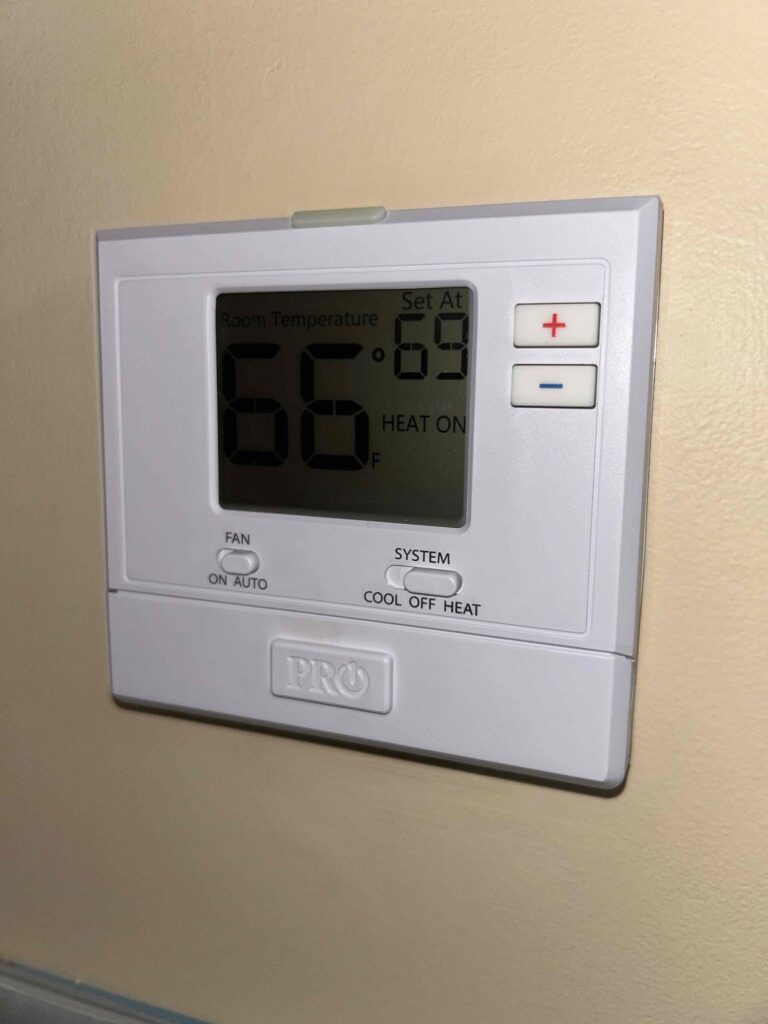
| Set to 69, stuck at 66 | Low airflow, or a cold snap past what it was sized for | The thermostat says 66 and it’s set to 69 |
| A boom or a squeal | A boom as it lights is delayed ignition (call); a squeal with the fan is the blower | Furnace making noise |
| A burning smell | Dust burning off on the first cold day is normal; hot electrical isn’t | Furnace burning smell |
| Water around the furnace | The condensate drain, its trap or its pump | The drain that shuts your furnace off |
| The heat pump outside is a block of ice | Defrost not working: the board, a sensor, or low refrigerant | Heat pump repair: normal or broken |
One more: a heating bill that doubled while the house stayed warm. Sometimes that’s the weather, sometimes backup heat strips doing a heat pump’s job. Your heating bill doubled: weather, or a problem?
What breaks in a gas furnace, and what each fix costs
A gas furnace starts in a set order, and each step has a part that can stop it. In Goodman’s service manual the sequence runs like this: the control checks that the limit switch is closed, the inducer motor “must run and pull in” the pressure switch, the igniter heats, the gas valve opens and the burners light, and the flame sensor has to prove a flame or the control shuts the gas off, retries, then locks out. The blower comes on last. Propane furnaces work the same way, and we repair those too.
| Part | What you notice | Our price |
|---|---|---|
| Limit switch | Burners shut off partway through while the fan keeps blowing. Check the filter first | Quoted after we look |
| Inducer motor | A hum, whine or rattle as it starts, then no flame | Quoted after we look |
| Pressure switch | The inducer runs and nothing lights. Often a blocked vent or drain is behind it, not the switch | Quoted after we look |
| Igniter | No glow, no flame, a few tries, then it gives up | $240 to $410 replaced |
| Flame sensor | Lights, runs a few seconds, shuts off | $95 to $180 cleaned, $240 to $410 replaced |
| Condensate drain, trap and switch | Water at the base, or a high-efficiency furnace that quits | $175 to $420 |
| Run capacitor | The blower hums but won’t spin | $240 to $370 |
| Control board | Nothing responds, or it does things out of order | $550 to $1,180 |
| Blower motor | Burners light, then little or no air at the vents | $670 to $2,400 |
| Thermostat | Never calls for heat, or calls at odd times | $300 to $640 |
| Gas valve or heat exchanger | The igniter glows and the gas never lights; or a crack found on inspection | Quoted after we look |
“Quoted after we look” means exactly that: those parts aren’t in our price book, so they get priced at the furnace, not guessed at here. The blower motor range is wide because a standard motor and a variable-speed one are different jobs. A cracked heat exchanger usually ends the furnace, not the repair, so see the crack yourself before you believe it. Symptom by symptom: what furnace repairs cost in Northern Virginia.
Heat pump repair: the parts that fail, and what they cost
A heat pump is two halves: the outdoor unit that moves the heat, and the air handler inside with the blower and, in most houses, electric backup heat strips. The service page is heat pump repair, and the normal-or-broken guide is heat pump repair in Northern Virginia.
| Part | What you notice | Our price |
|---|---|---|
| Run capacitor | The outdoor unit hums, and the fan or compressor won’t start | $240 to $370 |
| Contactor | The outdoor unit sits silent while the thermostat calls, and AUX does all the work | $290 to $425 |
| Defrost board | The outdoor coil turns into a block of ice and stays that way | $450 to $1,150 |
| Reversing valve | Cool air for an hour, not a few minutes | Quoted after we look |
| Refrigerant | Long run times, weak heat, ice on the coil | $190 to $740 added, one to three pounds |
| Control board | Nothing comes on, or it won’t change modes | $550 to $1,180 |
| Blower motor | No air from the vents | $670 to $2,400 |
| Thermostat | AUX or EM on when it shouldn’t be | $300 to $640 |
About that refrigerant row: if a heat pump is low, it leaked, because refrigerant doesn’t get used up. A top-off buys a season, and on a heat pump the leak comes back as no heat in January. Finding the leak, fixing it and recharging runs $1,850 to $2,700 from our price book. From about $31 a month at 0% APR for 60 months, the whole price financed, on approved credit. If the heat pump still runs on R-22, the leak is usually where the repair conversation ends: no new R-22 has been made or imported in the United States since January 1, 2020, and what’s left is recovered and cleaned refrigerant.

Hot water boiler repair: the pump, the valves, the tank
A hot water boiler heats water, and a circulator pump pushes it through the radiators or baseboard and back. Boiler firing, radiators cold: the water isn’t moving, usually a stuck circulator, a zone valve that won’t open, or air in the loop. Pressure climbing and the relief valve dripping: usually a waterlogged expansion tank or a fill valve that won’t shut off. Never cap or plug a relief valve.
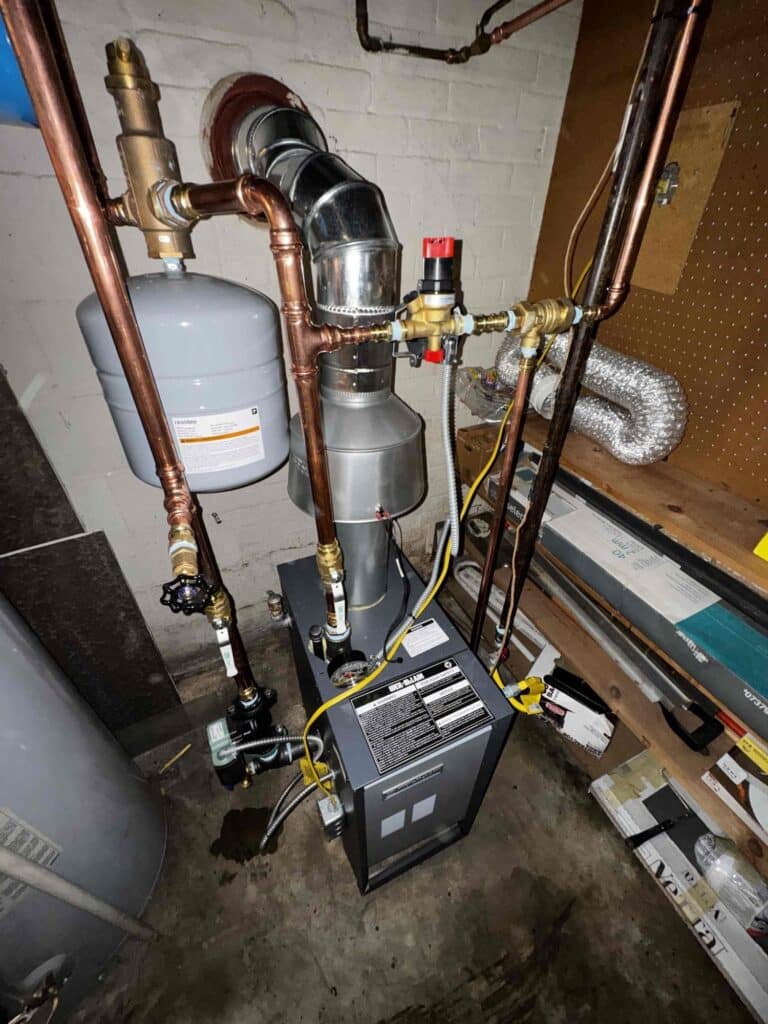
Boiler parts aren’t in our price book, so a boiler repair starts with the $99 diagnostic and the price is written down at the boiler. We work on hot water boilers, gas or propane. Not steam boilers, and not oil. More on the boilers page, the yearly visit in boiler service before winter, and emergency boiler repair in Alexandria.
What a heating repair visit costs, and the repair credit
The diagnostic is $99, flat. A technician finds the actual fault, writes down the price of the repair, and you approve it or don’t. Flame sensors, igniters, capacitors, contactors and thermostats ride on the van; anything else gets ordered and booked.
If you’re a Comfort+ member, the diagnostic is included, you take 15% off any service, and half of each repair bill is banked toward replacing that system, up to $1,500, each credit good for 24 months. Pay for a control board this winter, replace the furnace next year, and half that repair bill is already working toward the new one. Comfort+ is $199 a year or $20 a month, with four visits a year: heating maintenance in the fall, cooling maintenance in the spring, a dryer vent cleaning, and a water heater flush with a sewer camera inspection. How Comfort+ works.
Working, just never looked at? Through December 31, the $67 Heating Check covers a furnace or a heat pump before the cold settles in. Whatever else we’re running is on our offers page.
Repair or replace: where we draw the line
Most of the parts above are worth fixing on a furnace of almost any age. Our rule of thumb, out loud: a furnace past fifteen years with a repair over a third of the price of a new one is usually better replaced, and a cracked heat exchanger ends the conversation. A heat pump works winter and summer, so its line comes sooner: a dead compressor out of warranty, or a leak on R-22, is where we’d put a new system’s price next to the repair and let you pick. Someone else’s quote says replace? Get our free second opinion first.
When it is time, a new gas furnace runs $4,285 to $14,040 installed, by size and efficiency. From about $71 a month at 0% APR for 60 months, the whole price financed, on approved credit. A heat pump system runs $8,499 to $21,650. From about $142 a month at 0% APR for 60 months, the whole price financed, on approved credit. Both are on HVAC replacement, with a page each for a furnace and a heat pump, and the HVAC estimator prices your own house. Which system fits your house, and what each install involves: heating installation, system by system.
On Washington Gas, a new furnace earns a rebate: $500 at 95.1 to 96.9 percent AFUE and $700 at 97 percent and up, for Virginia customers, filed by a contractor in its network. We’re in that network for furnaces. And how long a furnace should last: how long does a furnace last.
Heating repair in your town
We’ve written up heating repair town by town: the houses, the systems in them and what tends to break. Pick yours: Aldie, Alexandria, Annandale, Arlington, Ashburn, Bristow, Burke, Centreville, Chantilly, Clifton, Fairfax, Fairfax Station, Falls Church, Gainesville, Great Falls, Haymarket, Herndon, Leesburg, Lorton, Manassas, Marshall, McLean, Oakton, Reston, Springfield, Stafford, Sterling, Vienna, Warrenton and Woodbridge.
Heating repair questions, answered straight
How much does heating repair cost?
From us, most heating repairs run $95 to $1,180: a flame sensor cleaned $95 to $180, an igniter $240 to $410, a control board $550 to $1,180, after a $99 diagnostic. The big ones are a blower motor, $670 to $2,400, and a heat pump refrigerant leak, $1,850 to $2,700. From about $31 a month at 0% APR for 60 months, the whole price financed, on approved credit.
Why is my heat not working?
Check the thermostat (Heat mode, fresh batteries), the switch by the furnace, the breaker, the filter and, on a high-efficiency furnace, the condensate drain. Any one of them stops the heat. If they all check out, it’s a part: on a furnace usually the flame sensor or the igniter, on a heat pump often the capacitor or contactor outside.
Is no heat an emergency?
It can be. Below freezing, or with someone very young, elderly or sick in the house, treat it as one and call (703) 997-9757: we run 24/7 emergency service. Fifty degrees out and the house holding at 64, a daytime appointment is fine. A gas smell or a carbon monoxide alarm is a 911 call first.
How do I reset my furnace?
Turn the switch by the furnace off, wait a minute, turn it back on. That clears a lockout and the furnace tries again. If it locks out a second time, leave it off and call: a furnace that keeps locking out is telling you something a reset won’t fix.
Should I use emergency heat if my heat pump stops working?
Yes, if the heat pump has actually failed and it’s cold out. EM shuts the heat pump off and runs only the backup heat, which costs more to run, so book the repair too. Don’t switch just because AUX shows on the screen: that’s the backup helping, and it’s normal on a cold morning.
Is it worth repairing an old furnace?
Usually, for a cheap part on a sound furnace. Past fifteen years, with a repair over a third of the price of a new one, replacing usually wins. We’ll price both and tell you which we’d pick.
Do you repair oil furnaces?
No. We work on gas and propane furnaces, heat pumps and hot water boilers, and we don’t work on oil at all. If you’re thinking about moving off oil, a heat pump or a propane furnace is ours to price.
Do you work on every brand?
Yes. We’re a Trane Comfort Specialist, a Rheem Pro Partner and Carrier experts, and we repair Lennox, Goodman, Amana, Daikin, York, Bryant, Ruud, Payne, Coleman, Luxaire and the rest. The badge on the cabinet doesn’t change whether we’ll fix it.
Do you repair boilers?
Hot water boilers, yes, on gas or propane: circulators, zone valves, expansion tanks, relief valves and the controls. Not steam boilers, and not oil. A boiler repair starts with the $99 diagnostic and gets priced at the boiler.
Book a heating repair in Northern Virginia
Call (703) 997-9757, book online, or send the form at the top of this page and the office calls or texts you back. For a gas furnace or a heat pump the service page is furnace and heat pump repair; for a boiler, hot water boilers.
SwiftPro Heating, Cooling & Plumbing repairs gas and propane furnaces, heat pumps and hot water boilers across Northern Virginia, out of Chantilly and Ashburn, with a dedicated HVAC team and a separate plumbing team. We’re a Trane Comfort Specialist, a Rheem Pro Partner and Carrier experts. Family owned, BBB Accredited with an A rating, 24/7 emergency service, Virginia Class A contractor license 2705192276, and rated 5.0 stars across 1,131 reviews on Google, Angi, Yelp, the BBB and Facebook. Read the reviews.