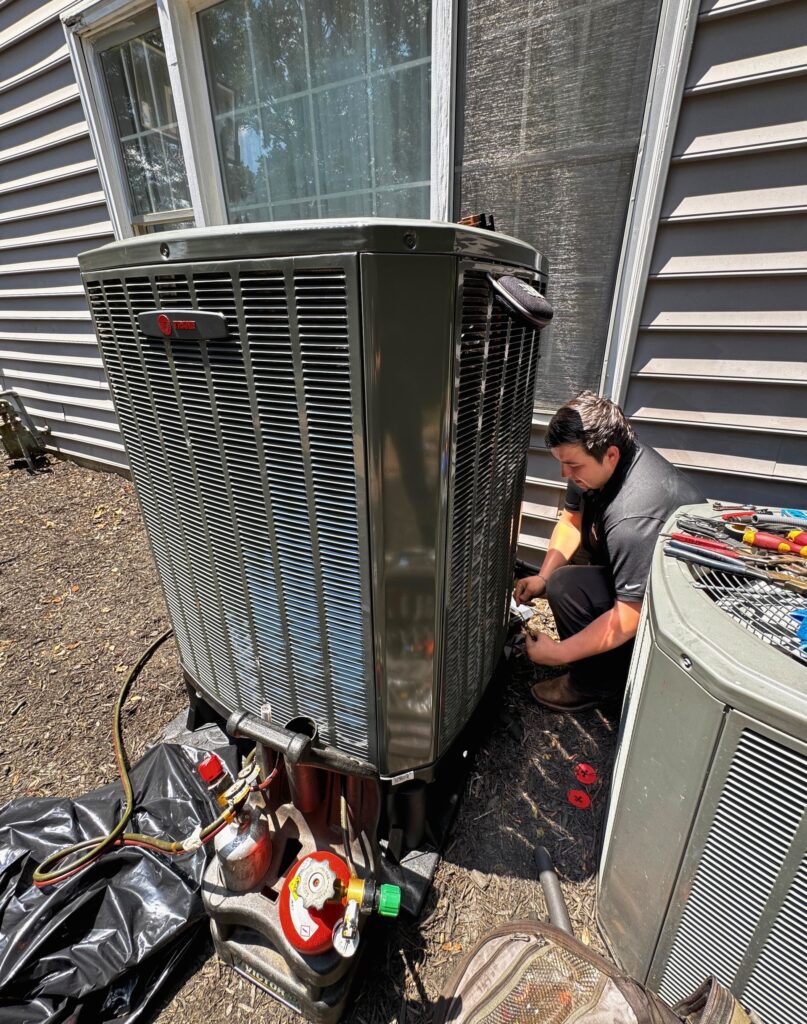
Fairfax Station is almost entirely detached houses, and 49 percent of its homes went up in the 1980s alone, eight in ten between 1980 and 1999, the median owner’s in 1988. A builder’s air conditioner from then has very likely been replaced already, and sometimes only halfway: some got a new condenser outside while the old coil stayed on the furnace. That matters now. A new A2L condenser has to be paired with a coil made for it, so if your coil is older than the outdoor unit, this replacement swaps both.
Size runs big here. In 22039, 92 percent of homes have four bedrooms or more, against 40 percent across Fairfax County, and a house like that often cools the bedrooms on a second system, its air handler in the attic. Each one is its own air conditioner, and you can replace the one that failed without touching the other. The attic one is the harder job: the hatch, the pull-down stairs, the platform and the drain pan all shape it, so get it priced by somebody who climbed up to look.
Gas heats about six in ten owner homes, most heavily in the subdivisions of South Run and Crosspointe, where the coil sits on a gas furnace in the basement and an AC-only swap is the usual job. Propane heats more homes out on the big lots than across the ZIP, and a propane furnace takes a new air conditioner the same way. About a third of owners heat with electricity, more of them on the big lots than in the subdivisions, and in those houses the outdoor unit is usually a heat pump, a different job at $8,499 to $21,650 for the system.
West of Ox Road the county plans for one house per five to ten acres, and the ZIP takes in the woods of Burke Lake Park and Fountainhead Regional Park. On a lot like that the condenser usually has room, so the question at replacement is where it should sit: out of the mower’s line of fire, clear of the drip line under the trees, a couple of feet off shrubs planted in the 1980s. If a standby generator backs up the house, it was sized for the old compressor, and the new one’s draw gets checked against it.