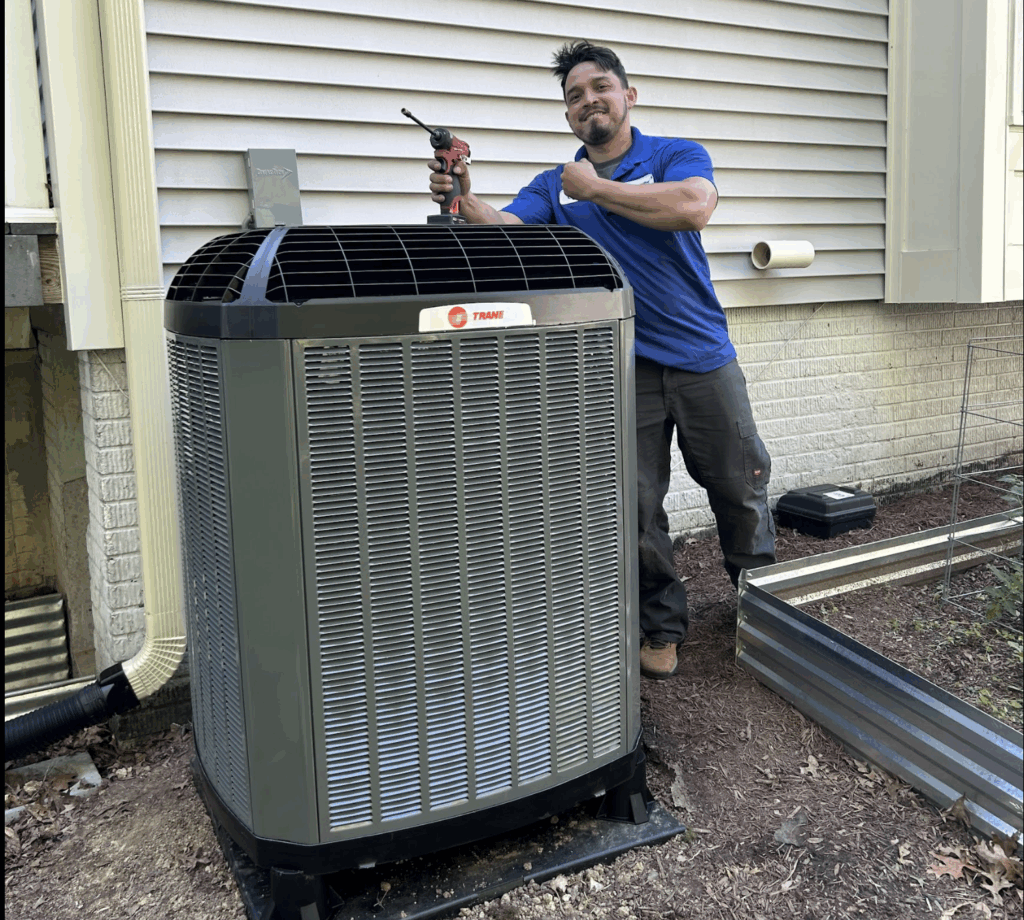
What heats the house decides which job you have. Of the 1,066 owner homes in ZIP 22728, the Census counts 622 heating with electricity, 354 with propane and 12 on a utility gas line. In the electric houses the yard unit is usually a heat pump, replaced for $8,499 to $21,650 installed. The Midland air conditioner replaced by itself sits in one of the 354 propane houses: a tank-gas furnace, a cooling coil on top, a condenser outside. If that furnace has winters left, it stays.
The railroad laid out the village in 1873, and its I-houses went without cooling until ducts came decades later. Beyond the old depot streets the housing is mostly younger: the ZIP counts 406 homes from the 1980s and 1990s and 315 from 2000 on. The builder’s condenser on a Midland house from the first years after 2000 has had close to twenty summers, and a unit that age often still runs on R-22, out of production since 2020.
NOAA’s normals for Warrenton 3 SE, six miles north-northwest at about 500 feet to the village’s 327, put the July high near 85 with about 21 days a year at 90 or hotter, and on June 29, 2012, the Weather Service logged heat indices of 110 to 114 across Southern Fauquier. Size the new unit for afternoons like that on your own house, not on the old label: an open Midland lot with no shade on the roof changes the number.
Then pick the spot. The weather station at Warrenton-Fauquier Airport, inside the Midland service district, measured a 74 mph gust on August 13, 2021. Marsh Run carries floodplain on the village’s southwest side, and the August 10, 2022 flash flood closed VA-610 in Midland. Set the new condenser on a level pad or stand above any water you’ve seen stand, clear of the big limbs.