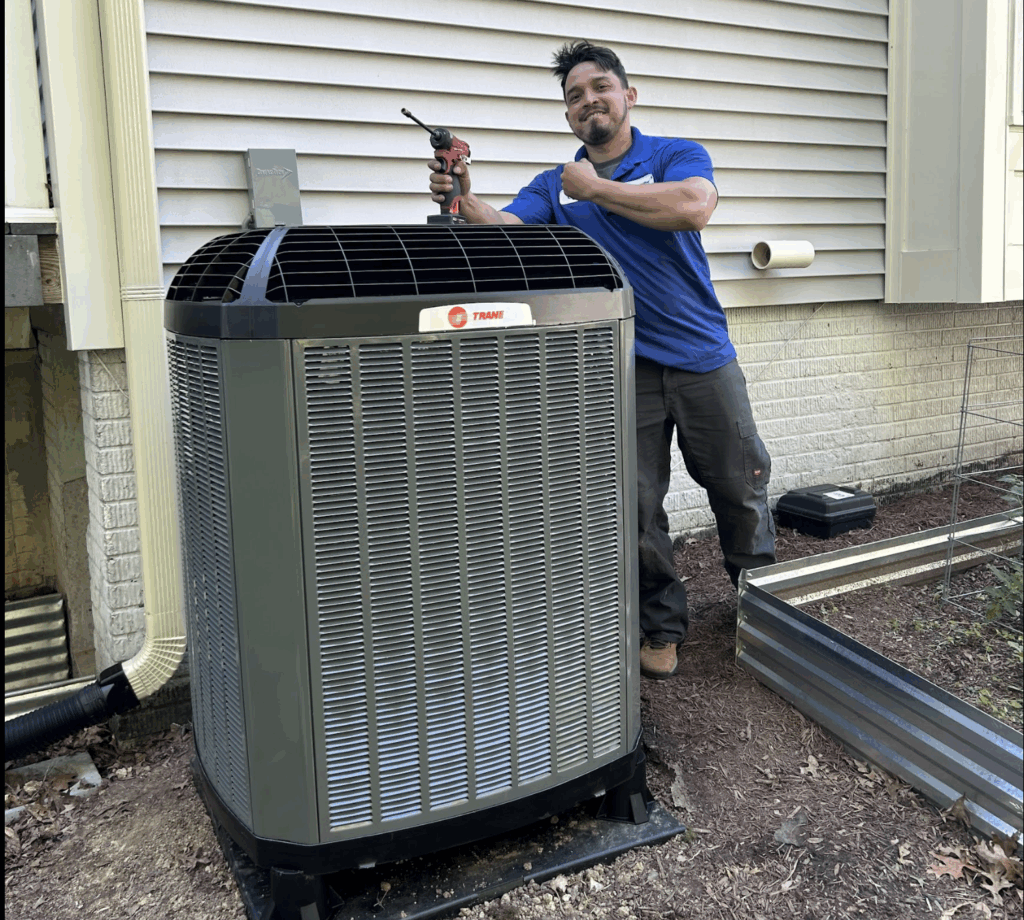
Start by checking whether this is your page. The Census counts 935 of the 1,274 owner homes in the Bealeton Census place heating with electricity, about three in four, and in houses of this age that mostly means a heat pump, whose outdoor unit heats as well as cools. Replacing one of those is a heat pump job, $8,499 to $21,650 for the system. An air conditioner replaced by itself belongs to the other houses: 188 owner homes on propane and 102 on utility gas, each with a furnace inside and a cooling-only condenser in the yard. If that furnace has years left, it keeps them.
Past the service district the mix shifts toward fuel. Across all of ZIP 22712, which reaches well beyond the Census place, propane heats 568 of the 2,469 owner homes and utility gas 120, so a propane furnace with a plain AC over it is more common on the bigger lots out of town than in the subdivisions. Wherever the house sits, the condenser on a propane or gas furnace often went in the same year as the furnace. The labels on the two settle whether one can stay while the other goes, so read both before you call.
Bealeton’s houses came in waves, and each wave left its own kind of air conditioner. The Census place counts 495 homes from the 1980s and 305 from the 1990s, and those are on their second condenser at least. Another 423 went up from 2000 through 2009, the Station Drive years, and a builder’s unit from then most likely holds R-22, whose production ended in 2020. The 338 from the 2010s mostly got the refrigerant that replaced it, still serviceable, so a leak on one of those is usually worth fixing. A new unit today runs on one of the A2L refrigerants.
Not every Bealeton AC sits in a side yard. About one home in five in the Census place is in an apartment or condo building, many of them buildings of ten to nineteen units, and another 141 are attached houses. A condo’s condenser can share a pad, a roof or a fenced yard with the neighbors’ units, and the association may have a say in what goes there, so ask before a quote is final. Detached houses have their own issue: the County’s plan describes an old lakebed with soils that hold water, and a pad on that ground can settle at a corner, so the new unit goes on a level base.