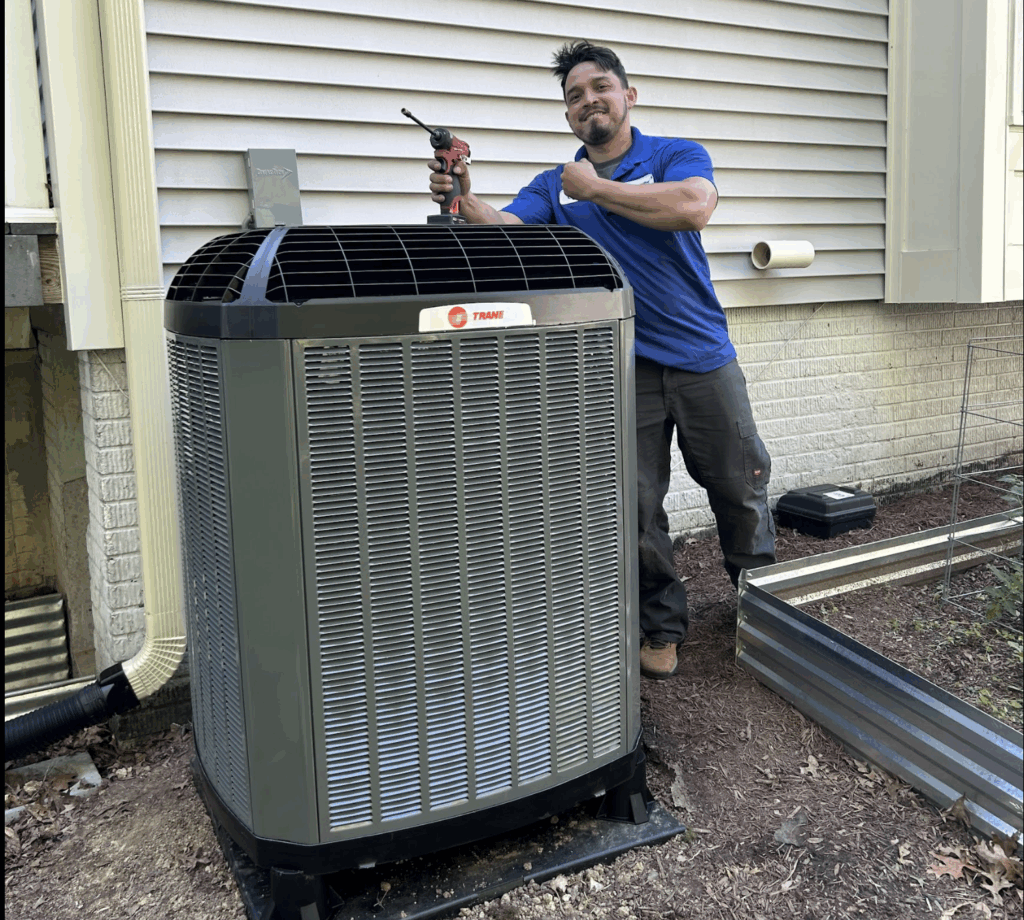
Springfield’s typical owner home went up in 1968, and North Springfield’s typical one in 1957, before central air was standard. Plenty of these houses got their cooling years after they were built: a condenser out back, a coil set on top of the basement furnace, and copper lines threaded along the basement ceiling and out through the foundation. That first add-on unit is long gone, and the one out there now is often the second or third. What hasn’t changed is the ductwork, drawn to carry heat, often with registers low in the floor.
In Kings Park, North Springfield and Ravensworth the great majority of owners heat with gas, so a worn out condenser there is an AC-only job: the furnace stays, and the outdoor unit and the coil on top of the furnace change. That’s the pattern for most of town, where gas heats 58.1 percent of owner homes. A unit set before 2010 most likely runs on R-22, and since its production ended in 2020, a leak on one gets refilled from whatever recovered stock is left. Put that recharge quote beside the price of a new AC before you choose.
The copper is the part to ask about. In a house that got central air late, the line set may cross a basement ceiling that’s since been finished. A new AC can reuse it if it’s the right size and sound, or it may need new copper, and running that above finished drywall is real work, so ask which the quote assumes. Sizing matters as much. Many of these houses have new windows, more attic insulation or a finished basement since the last unit went in, so the new one gets sized from the house as it is now, not bumped up a size from the old label.
West Springfield, mostly 1960s and 70s, puts close to four in ten of its homes in townhouses, with condensers standing in a row behind the units, so the new one has to fit the old one’s slot. Around Newington the outdoor unit is more often a heat pump: 57 percent of Newington owners heat with electricity, and Newington Forest leans further that way, which makes it a heat pump replacement at $8,499 to $21,650. In Springfield proper about a third of homes are rented, so the owner approves the swap. Fairfax County files it as mechanical work, plus the A2L certification.