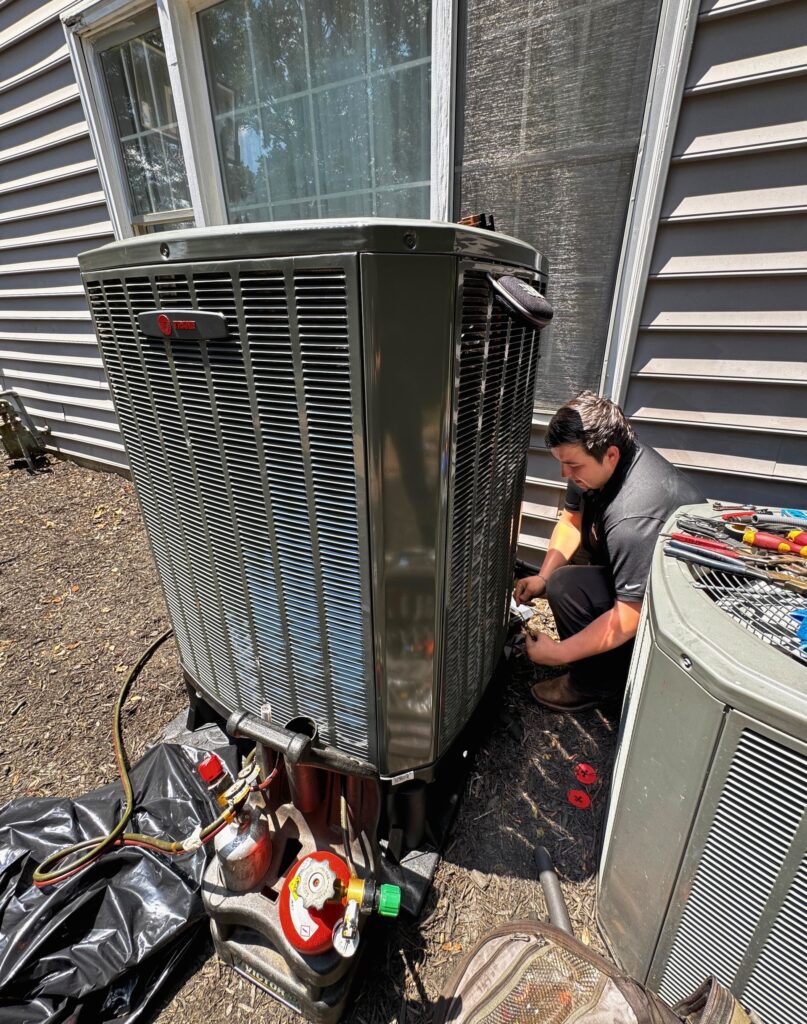
ZIP 20137 holds 660 owner homes, all detached by the Census count, and the middle one went up in 1979. Just over half predate 1980 and about one in six predate 1960, while only about one in seven dates from 2000 on. So the condenser in a Broad Run yard is rarely the house’s first. On the federal planning figure of about 18 years a unit, a 1979 house is likely on its third, and one from before 1960 got central air long after it was built, with ductwork fitted around rooms never laid out for it. That history decides what a new unit can do there.
The AC-only job here sits on a propane furnace. Close to three owner homes in ten burn propane and the Census finds none on utility gas, and in a propane house the outdoor unit only cools while its coil rides on the furnace and borrows the furnace blower. Replace that cooling side and the furnace stays. Just over half heat with electricity, often through a heat pump, which is a $8,499 to $21,650 system job rather than this one. About one in seven heats with oil. Oil burners are outside our work, so in an oil house we’d price a move to propane or a heat pump instead of an AC on its own.
One ZIP, two counties. By the 2020 Census blocks about 120 of 20137’s 690 housing units sit on the Prince William side and the rest in Fauquier. Prince William County lists work that alters a home’s heating and cooling as permit work, yet it names a condensing unit swapped for the same type in the same spot as an ordinary repair. Fauquier County says much the same about an electric appliance replaced like for like, and wants a permit once the unit moves. So the first question on a Broad Run quote is whether the new condenser goes exactly where the old one sat.
Summer here is humid more than it is hot. The Warrenton 3 SE record, the closest long one, puts a July night near 66 and about three weeks a year at 90 or above, and on July 20 and 21, 2019 Northern Fauquier ran dew points near 70 with air in the mid 90s to low 100s. On air that wet, an AC sized too big chills the room fast and shuts off before it has wrung the water out, so the house ends up cold and clammy. In an older house with an addition or a finished basement, the right size comes from measuring the rooms, not from the old unit’s label.