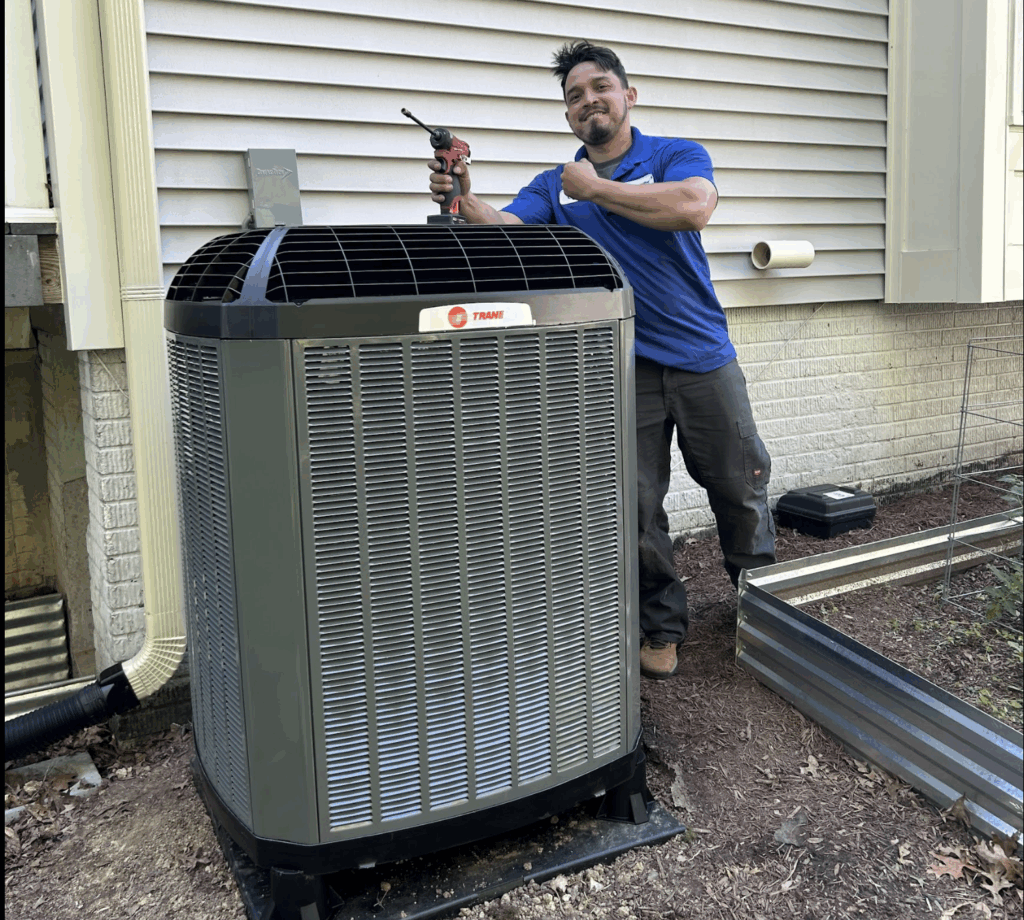
Start with what heats the house. Nearly half the owner homes in 20143 run on electricity, mostly through heat pumps that cool as well, and those get swapped as heat pumps. About one in three heat with propane. There a furnace heats and a separate condenser cools, so a worn condenser gets replaced alone, along with the coil sitting on that propane furnace.
Catharpin was built in four rounds. About one home in five dates from before 1960, roughly as many from the 1960s and 70s, another fifth from 1980 through 1999, and nearly four in ten since 2000. A house from the first round got its central air added along the way and is likely on its second or third condenser. A 2000s house may still run the builder’s unit, and if it predates 2010 it’s probably charged with R-22.
Outdoor units here take real weather. Hail up to ping pong ball size fell near Catharpin on August 18, 2011, and the June 2020 storm that blew down numerous large trees near Sudley Springs and Catharpin carried winds estimated near 69 mph. Hail flattens the thin fins on a condenser coil, and a unit breathing through bent fins runs longer for less cooling. On a young unit that’s worth straightening; on an old one it usually tips the math toward a new condenser.
Dulles, the nearest full weather record, logs 32.7 days a year at 90 or hotter, Manassas closer to 40.5, and July’s average low there is 66.8 degrees, so a condenser gets little rest overnight. In a house from the 1986 median or earlier, an addition or a finished basement has often changed the house since the old unit was picked, so the tech measures the rooms rather than trusting its label. The answer can come out smaller.