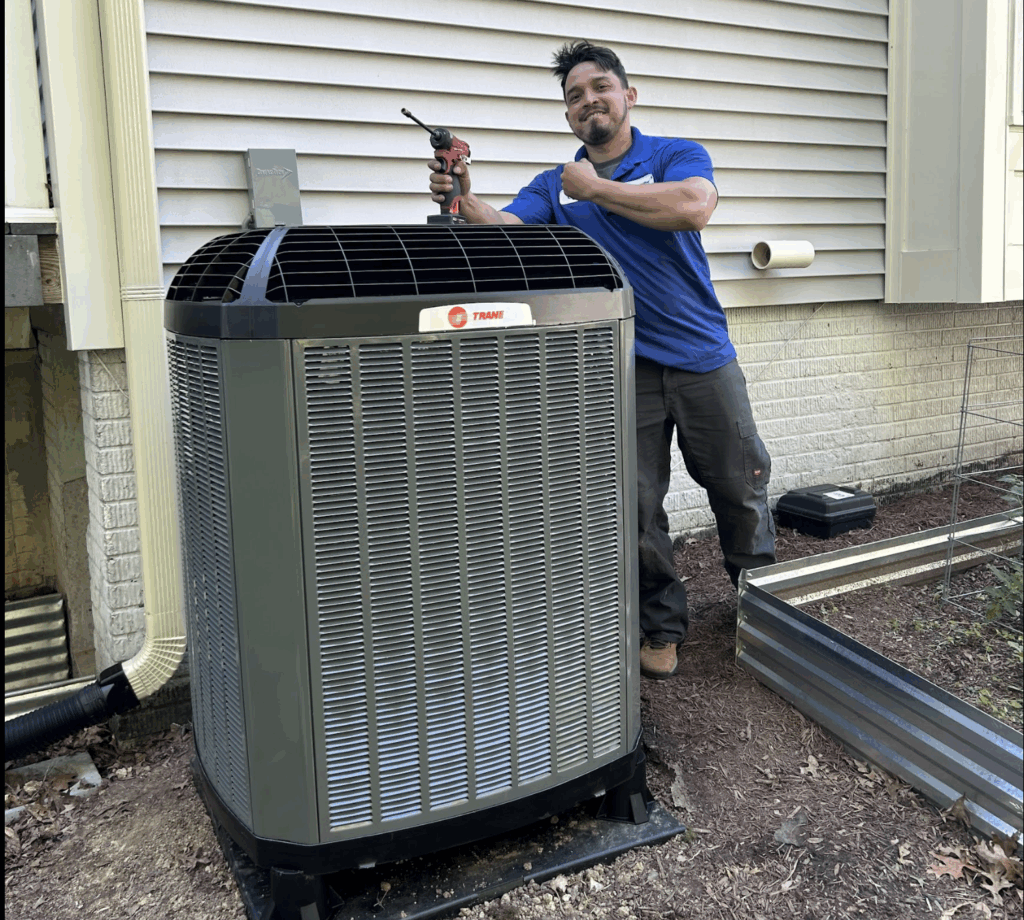
Gas heats about seven in ten owner homes in Annandale, so the usual job here is the cooling half alone: a new condenser on the pad out back and a new coil on top of the furnace that stays. In a rambler that furnace stands in the basement; in a split-level it’s on the lowest floor, often behind a door off the family room. The coil gets replaced with the condenser because a new A2L unit is built to work with its own matched coil, not one from the R-22 years. Fairfax County counts the swap as mechanical permit work.
The median owner home here went up in 1967, and about eight in ten were built before 1980. An air conditioner lasts somewhere around fifteen to eighteen years, so a house that age is likely on its third or fourth, and a condenser put in before 2010 most likely holds R-22. What usually hasn’t changed is the sheet-metal trunk under the basement ceiling. A new AC can only push as much air as those ducts will carry, so the tech checks the returns and the static pressure before settling on a size.
Ductless mini-splits are a bigger part of our Annandale work than anywhere else we work regularly. In a 1960s house the rooms added later, a family room off the back or a lower level finished decades on, are often the ones the original ducts never reached, and a wall head cools them instead. Replacing the central AC leaves those heads alone. Tell us which rooms run on the mini split, so the new condenser is sized for the part of the house the ducts actually serve.
The rest of Annandale lives closer together. Garden-style condo and apartment buildings cluster around the business district where Little River Turnpike meets Columbia Pike, northwest of Backlick Road and I-495, and east of Heritage Drive, and about a fifth of homes are in buildings like that. The townhouse rows on the north side of Braddock Road, east of Wakefield Chapel Road, keep their condensers in small back yards, so the new unit has to fit the old pad. About three in ten homes here are rented, and there the call is the landlord’s.