Start with which government your house answers to, because Falls Church mail reaches well past the City limits: Merrifield, Seven Corners and Bailey’s Crossroads are Fairfax County. Inside the City, an air conditioner in a single-family house can be replaced without a permit, and for a townhouse or a condo unit, the counter at City Hall, 300 Park Avenue, is the place to ask. On the county side the same swap is mechanical permit work, and because new condensers run on the A2L refrigerants, Fairfax County wants its refrigeration certification filed alongside.
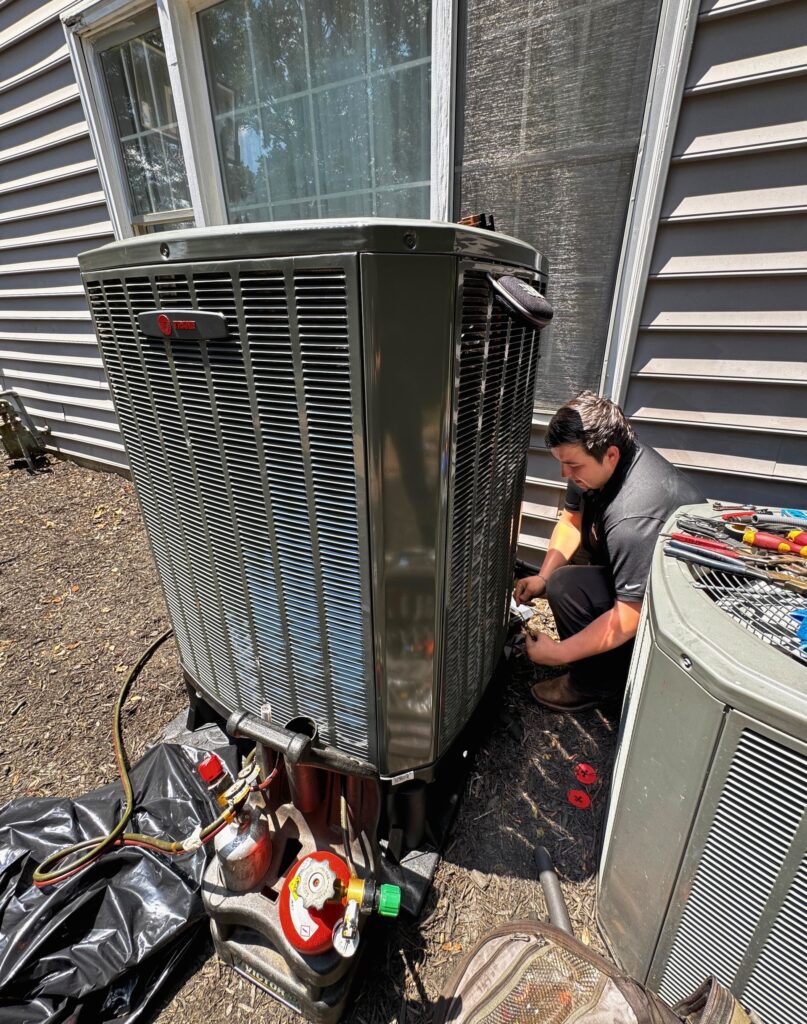
The oldest Falls Church houses sit on the county side: the typical owner home went up in 1957 in West Falls Church, 1958 in Lake Barcroft and 1961 in Pimmit Hills, and gas heats about seven in ten City homes and more on those streets. In those houses the coil rides on a basement furnace, the copper lines leave through the foundation wall, and the condenser sits on a pad beside the house. A house that age has gone through several air conditioners, often on ducts first laid out for heat, so the new one gets sized to what those ducts can move.
Falls Church is one of the two places, with McLean, where boilers are a regular part of our heating work. A radiator house never had ducts for its heat, so where it has central air, the air handler usually lives in the attic, with short runs to ceiling vents and a drain pan over the bedroom plaster. The job there is two pieces, the condenser in the yard and the cooling coil inside that attic air handler, and the boiler in the basement isn’t touched. Getting the old coil down and the new one up through the hatch is most of the work, so the attic gets a look before the price.
The City also has a younger layer. About 28 percent of its homes went up since 2000, and about 23 percent in Pimmit Hills, so a house finished in the early 2000s may still run the builder’s air conditioner, past twenty now and most likely on R-22. Inside the City, condo and apartment buildings hold close to half the homes, and tenants live in close to half. In a building the outdoor unit may share a roof or a pad, and the association decides where its replacement goes; in a rental, the owner makes the call.