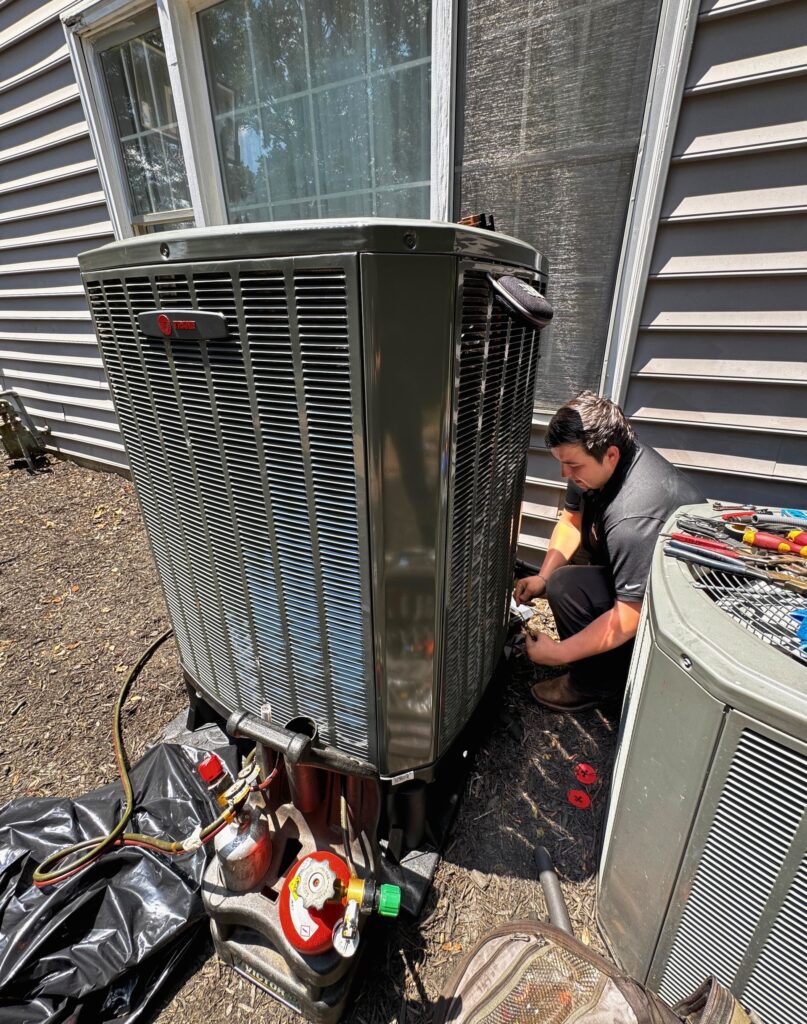
The closest Census picture of Orlean is the block group centered on the village. Electricity is the main heat in 306 of its 543 occupied homes, and on a ducted farm lot that tends to mean a heat pump, which cools as well. Ninety-five heat with tank propane. In one of those, the air conditioner is two pieces hung on the furnace’s blower: an evaporator coil in the basement cabinet and the condenser out by the fence line. While the furnace has years in it, only the cooling half changes.
The block group counts 140 homes from the 1970s and 169 from the 1990s, all of them detached, and the County’s village plan says much of the upland soil here suits a basement. A 1970s house has likely gone through two or three air conditioners on its original ductwork; a 1990s one is on its second or due. Before paying for a leak repair, read the label: an R-22 machine runs on a refrigerant whose production ended in 2020.
The Warrenton 3 SE station, about 12 miles east-southeast and roughly a hundred feet below the village’s 611, averages about 21 days a year at 90 or hotter. Along Leeds Manor Road the National Register survey lists standing-seam metal roofs all through the historic district, and the rooms under them run hottest. Size the new condenser from a load calculation on your house, upstairs included, not from the old tonnage.
The condenser lives beside pasture and under old trees. Hayfield chaff mats its fins, so set the new pad where haying blows past it. On June 22, 2022, gusts estimated at 80 to 90 mph reached Orlean and brought down thousands of trees, and on June 12, 2026 another fell at Cabin Branch Road and Cliff Mills Road. If the old pad sits under a big limb, moving it is Fauquier County permit work, and the quote prices it both ways.