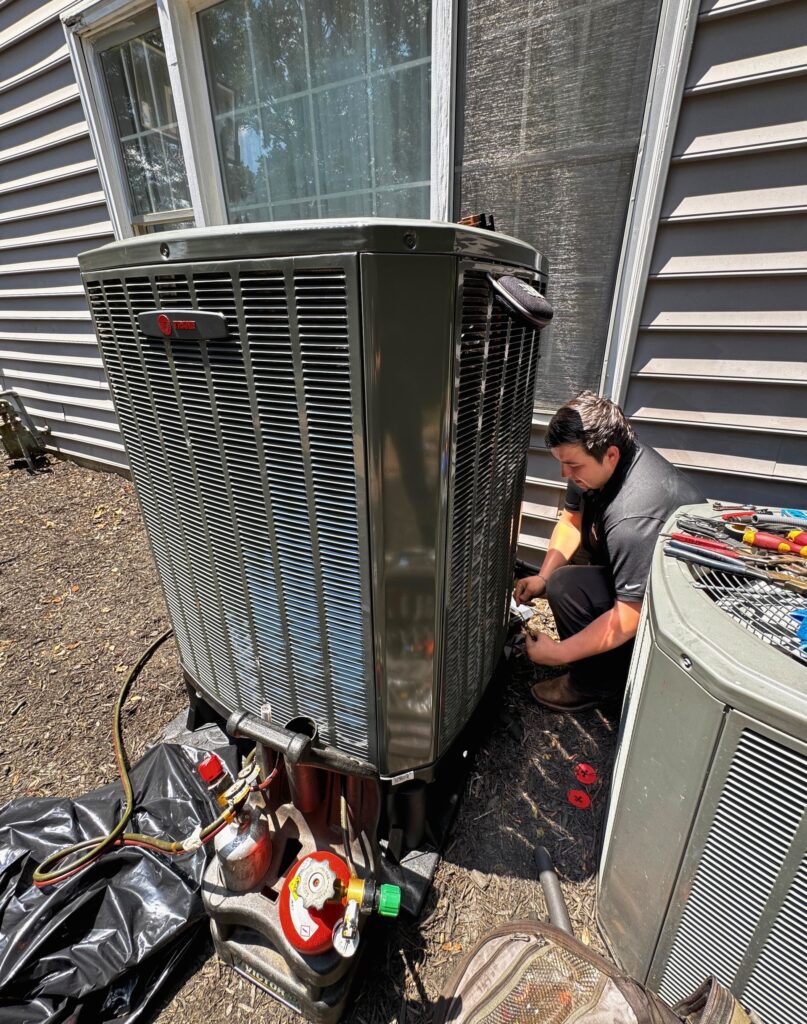
Philomont’s Census figures come from ZIP 20132, the Purcellville ZIP area the village sits in, and there propane and electricity are a dead heat: about 42 percent of owner homes each. Natural gas adds about 6 percent. The propane and gas houses, close to half, have a furnace with a separate air conditioner on it, and that’s the pairing where a worn condenser and its coil can be replaced on their own. The electric houses mostly heat with a heat pump, so a failing outdoor unit there gets replaced as a heat pump system, $8,499 to $21,650, not as an AC.
The ZIP’s median owner home dates to 2000, and close to half its homes went up since then, so plenty of the air conditioners out here are builder originals or their first replacements. An original from a 2000 house has run more than two decades, past the roughly 18 years federal planners count on for central air in Virginia, and it most likely holds R-22, which stopped being produced in 2020. Houses that got a newer condenser after 2010 are in better shape: its refrigerant is still made for service, and a leak or a dead fan motor on it is normally worth fixing.
The village sits between two streams, a Butcher’s Branch tributary to the north and a Beaverdam Creek tributary to the south, and the water does come up: flooding closed Snickersville Turnpike near Hibbs Bridge Road, about a mile south-southeast, on September 28, 2018 and again that December. An outdoor unit on a low pad in a wet corner of the lot is worth raising when it’s replaced. And a condenser that has sat in standing water should stay off until its wiring and controls have been checked, whatever its age.
About 85 percent of homes in the ZIP area are detached houses on their own lots, so the condenser usually has room; the question is what hangs over it. Trees came down on wires at Snickersville Turnpike and JEB Stuart Road in June 2016, and multiple trees fell across roads south of the village on July 16, 2024. When the old unit comes out, its spot gets a look: clear of overhanging limbs, a few feet off the house wall, and close enough to keep the copper run to the furnace short. A longer run works too, sized for the new unit.