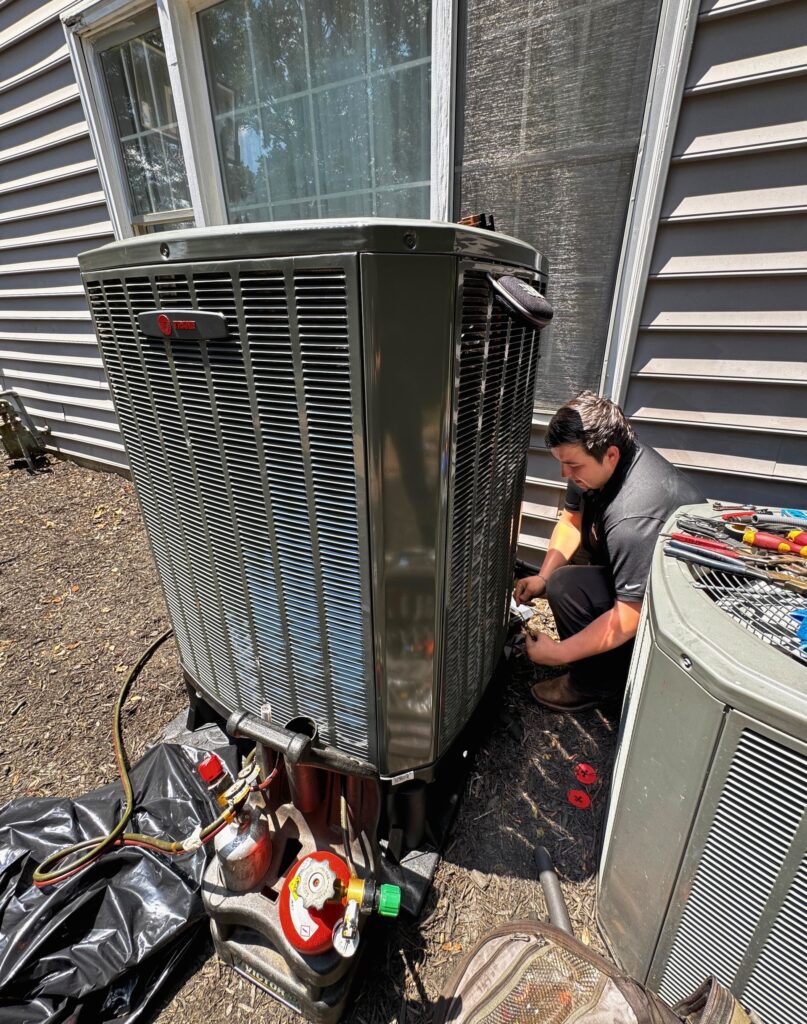
Inside the town limits, electricity heats about 49 owner homes in 100, and in houses from the 1980s on that’s mostly a heat pump, whose replacement is a heat pump system at $8,499 to $21,650. An air conditioner on its own fits the rest of the town: propane in about 34.5 percent of owner homes and natural gas in about 5, the lowest gas share of any town in the Census figures behind these pages. In those houses the cooling is a condenser out back and a coil riding on the furnace, and when the condenser goes, the furnace can stay.
Past the limits, on the county side of 20132, the balance tips the other way: propane heats about 48 percent of owner homes and utility gas about 7, so more than half of those houses have a furnace for a new AC to sit on. About 96 in 100 are detached, many on three-to-five-acre lots, which leaves room to set the new condenser where it suits the house instead of where the builder found space. Distance has a cost, though: the farther the condenser sits from the furnace, the longer the copper, and the line set has to be sized for the new unit.
The town’s median owner home dates to 2001, and its biggest building decade, 2000 to 2009, holds nearly four homes in ten. A builder condenser on one of those has 17 to 26 summers behind it, if it hasn’t been swapped yet, and one set before 2010 is likely an R-22 unit, a refrigerant out of production since 2020. A Purcellville house from the 1980s or 90s, about a third of the town, is probably on its second air conditioner already, and whether that one went in before or after 2010 decides which refrigerant you’re dealing with.
Near Main and 21st Streets the houses go back further: Victorians from after the railroad came, bungalows and foursquares, brick and stone Cape Cods from the 1940s and 50s. Central air came to all of them later. In a Cape Cod the upstairs air handler often sits behind a knee wall, so a new coil has to fit through that little door, and the drain line out of it gets rerouted or checked while the wall is open. Outside, the Board of Architectural Review looks at projects in the Historic Corridor Overlay, but not single-family homes.