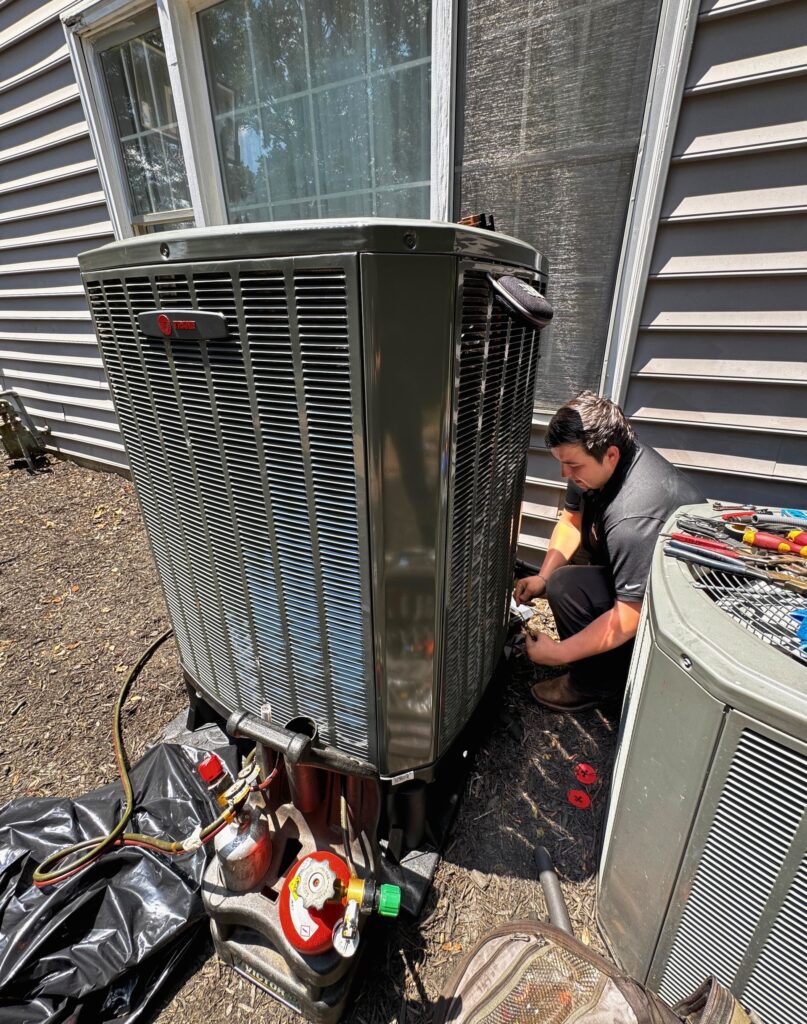
Round Hill grew fast. The Town’s utility plan describes very rapid growth from the mid 1990s through 2005, and the Census dates 604 homes in 20141 to the 1990s and 871 to the 2000s, which puts the median owner home at 2004. Condensers from that boom have twenty to thirty summers on them now, past the roughly 18 that federal planners use for central air in Virginia. The boom’s earlier units mostly run R-22, and with no fresh R-22 made since 2020, a leak in one of them tends to settle the question in favor of a new AC.
Which page you need depends on the tank in the yard. Of the ZIP’s 2,362 owner homes, 953 heat with propane, and those houses have a furnace inside with the cooling attached to it: a coil on top, a condenser out back. When the condenser is the worn part, it and a matched coil get replaced and the propane furnace keeps heating. The 1,257 all-electric homes are the other story, a heat pump and an air handler, and their replacement is a heat pump system, $8,499 to $21,650. Piped gas reaches only 46 owner homes.
Inside the town limits, most houses went up before the end of the 1920s, the Town’s plan says, so their cooling came decades later, often as an air handler in the attic with ducts dropped to the rooms below. Replacing the AC in a house like that can mean the condenser outside and the attic unit together, not a coil on a furnace. Round Hill doesn’t run a town historic district the way Leesburg, Middleburg and Purcellville do, so where the new condenser goes is mostly a question of room, noise and the neighbors’ windows.
Storms are the other way a condenser here gets retired early. Winds near 61 knots uprooted big trees along New Cut Road, Bell Road and Main Street on June 16, 2016, and quarter-size hail fell in town on July 25, 2023. Hail like that crushes the thin aluminum fins across the coil’s face, and a twenty-year-old unit with a hammered coil is rarely worth reviving. Water is the third risk: torrential rain closed Main Street at Greenwood Drive in July 2017, and a unit that has sat in floodwater stays off until it’s checked.