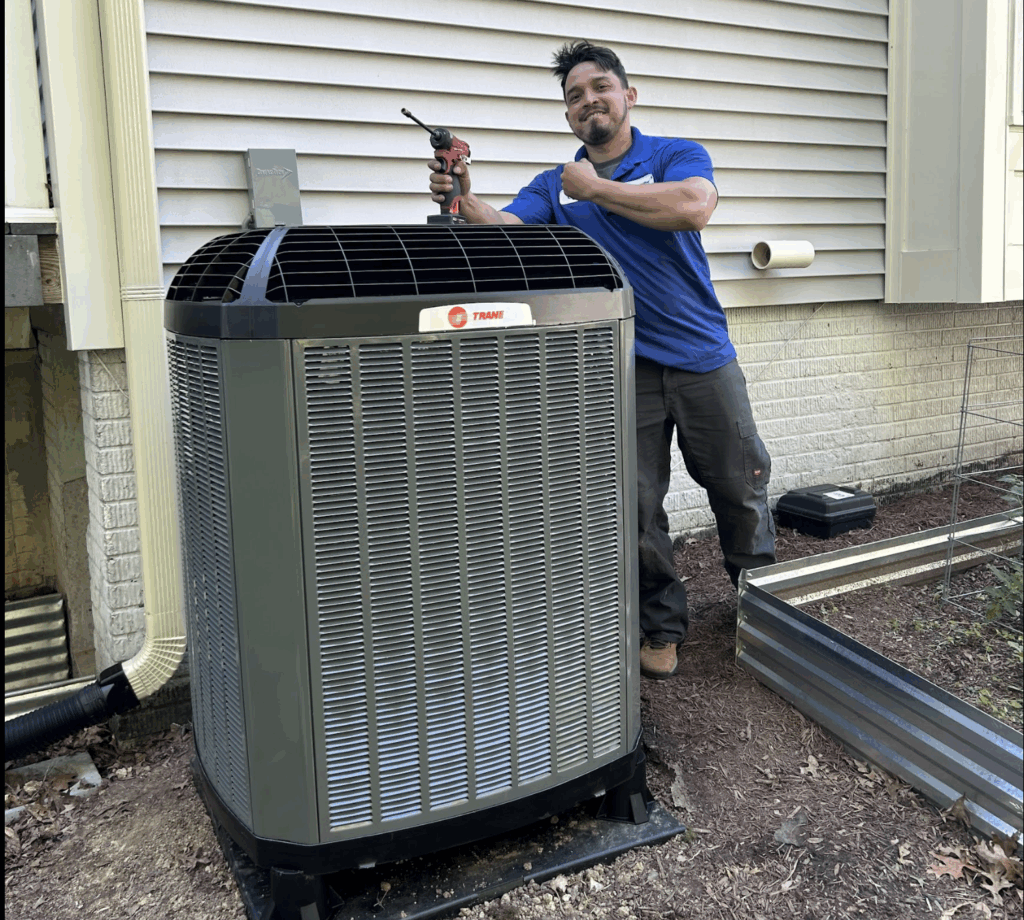
Propane heats 47 percent of owner homes in ZIP 20129, electricity 35 and oil 18, and the Census finds no natural gas at all. The propane houses are the ones this page fits: a furnace burning from a tank on the lot, with a coil on top and a condenser outside doing the cooling. When the condenser wears out, it and its coil get replaced and the furnace stays. The electric houses mostly run heat pumps, one outdoor unit doing both seasons, and swapping one of those is priced as a heat pump system, $8,499 to $21,650.
The village began as a summer escape: families came for the spring water and to get away from the city’s humid summers. Central air does that job now, and the Purcellville station still logs a July average high of 86.4 and about 30 days a year at 90 or above, roughly 1,050 cooling degree days in all. That’s enough to wear a condenser out, but not enough to justify one bigger than the house needs. Sized to the house, it runs long enough on a muggy afternoon to pull the damp out along with the heat.
Then there’s age. The median owner home here was built in 1997, so an original condenser would be nearly three decades old, far past the roughly 18 years federal planners give one in Virginia, and most of these houses are likely on a second unit by now. Which second unit matters: a unit set before 2010 is probably on R-22, out of production since 2020, while a later one uses a refrigerant that can still be serviced. A new AC runs on an A2L refrigerant with its own matched coil, so the old coil on the furnace comes out with it.
Trees are the local hazard. On July 15, 2024, winds estimated near 75 mph brought down dozens of large trees, wires and a few poles at Clarkes Gap Road and Hurley Lane, and on June 19, 2017, storm winds snapped big poplars 10 to 20 feet up along Tim Tact Court. A new condenser usually goes on the old pad, unless there’s a reason to move it, and a big tree overhead is a reason. Moving it means longer copper and a new pad, and the quote should price that plainly.