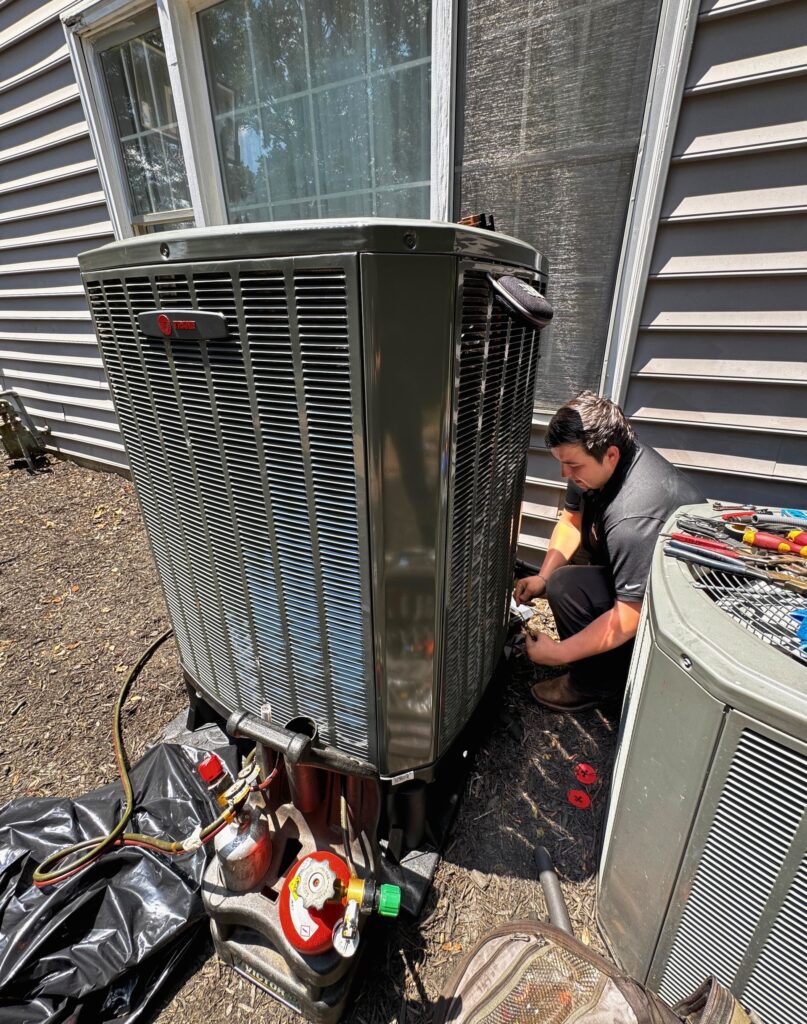
The Census sample for ZIP 20184 is small, 67 owner homes with a wide margin, but it found none on utility gas and none on oil: about two in three heat with electricity and the rest with propane. Electric heat here usually means a heat pump, replaced as its own system, $8,499 to $21,650 installed. The air conditioner replaced by itself belongs to the propane third: a furnace fed from a yard tank, a coil on top of it, a condenser outside.
The 2021 National Register update for the Upperville Historic District dates 40 of its 136 main buildings to before 1861. Its four Minimal Traditional houses from about 1945 to 1955 and its thirteen ranches went up with ductwork from the start, so they’re the likeliest to have a furnace with a coil on it, by now on a second or third condenser. In the older brick and stone houses, cooling came later, often through an attic air handler or ductless heads.
Summer runs hotter here than the mountains in view suggest. The Purcellville co-op station, about 14 miles northeast at 510 feet to the village’s 557, averages 86 on a July afternoon and about 30 days a year at 90 or above. Mount Weather, on the ridge five miles north, averages 82 and carries about a fifth less cooling load. Size the new unit for the valley’s numbers on your own house.
Virginia’s historic resources department describes the village as shaded along its whole length by masses of trees, and storms keep testing them: hundreds of trees and wires down between Middleburg and Upperville on June 22, 2022, dozens more on August 7, 2023. Golf-ball hail fell near Upperville in August 2011 and again on August 10, 2021. Set the new condenser out from under the heaviest limbs and off the low ground along Panther Skin Creek and Tanyard Branch, where FEMA maps flood hazard areas.