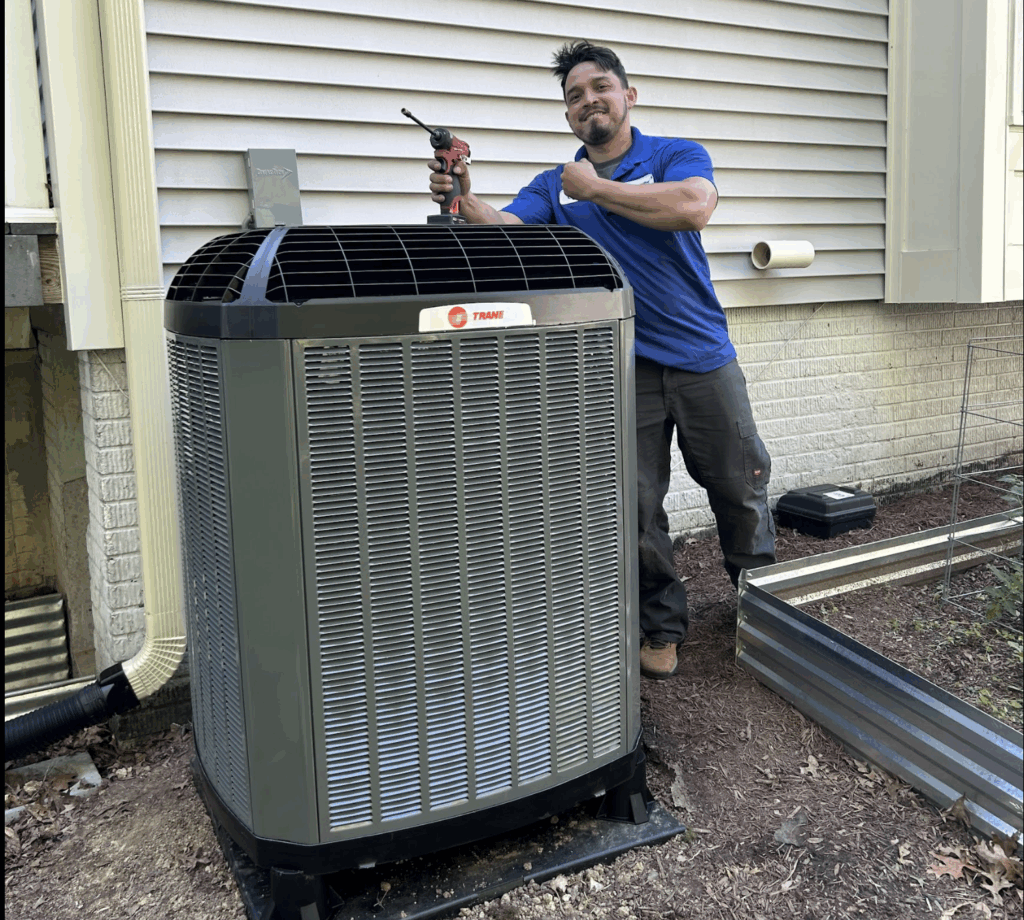
Burke splits almost down the middle on heat. Just over half the owner homes heat with electricity, which here mostly means a heat pump doing the cooling too, and a heat pump house replaces a heat pump, not an air conditioner. This page is for the other half: a gas furnace inside and a plain condenser out back. More of those sit in the Burke Census place around Lake Braddock and Burke Lake Road, where about six in ten owners burn gas, than in Burke Centre. The label on the outdoor unit tells you which kind you have.
Age decides the rest. The typical owner home went up in 1979, half of them before 1980 and nearly all the others by 1999, so very few Burke houses still cool with the builder’s AC. What’s out back is a replacement, and its own date is what counts. If yours has stood on that pad through fifteen-plus Burke summers, odds are it’s charged with R-22, and production of R-22 ended in 2020. A younger one runs on the refrigerant that replaced it, which can still be serviced, so it’s usually worth repairing until a big part fails.
Inside Burke Centre, the Conservancy has a say about the outdoor half. Its Architectural Standards let you replace a like air conditioner in the same location with no application at all. Moving it, adding a second unit or switching to ductless takes an approved application first, and units belong in the rear yard unless the original stood in a side yard. A ground unit the street or a parking lot can see gets screened. A new condenser can come in a different size than the old one, so ask whether yours fits the same pad before it’s ordered.
Close to four in ten Burke homes are townhouses, and on a row the condensers stand in small rear yards a few steps apart. The Conservancy asks for a new unit’s decibel rating when one is moved or added, and on a row that number is worth comparing anyway. If the old AC dies in July and the right replacement doesn’t match it, the Standards allow an Emergency Permit from the Executive Director, with the full application due within 30 calendar days. Each of the 65 clusters can add rules of its own.