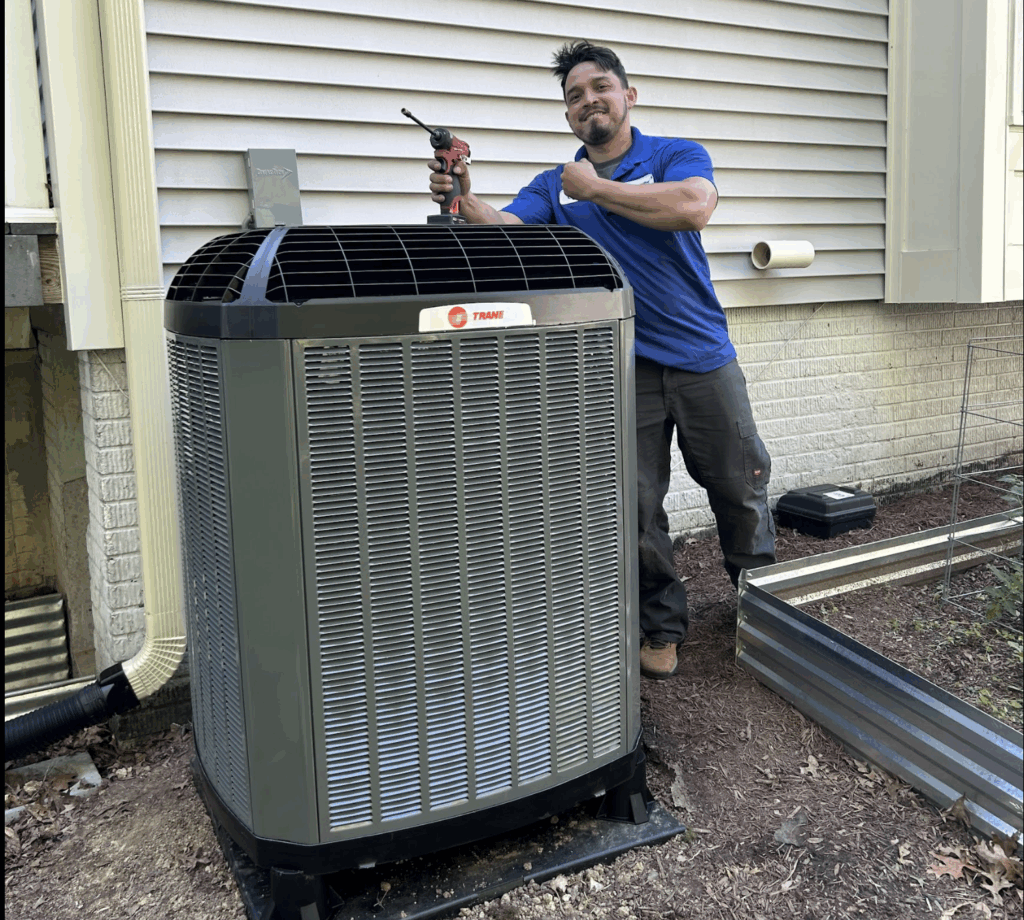
Mail to Casanova goes to 20139, a ZIP of post office boxes with no mapped area, so the Census numbers here come from 20119, the Catlett ZIP area around the village. A little over half the owner homes there heat with electricity, close to three in ten with propane, and none with utility gas. The propane houses are where an air conditioner gets replaced on its own: the tank-fed furnace stays, while the condenser and the coil it feeds are swapped. About one in eight lists wood or another fuel as its main heat, and where a wood-heated house cools with a central AC over a backup furnace, the same swap applies.
The village began as Three Mile Station, three miles out along the Warrenton Branch railroad, and the frame I-houses of its historic district date from roughly 1880 to 1910. They were built for stoves and fireplaces, so central air in one came as a later addition, with ducts threaded through an attic or closets decades after the walls went up. On replacement day that history sets the limit: the new AC has to match the air those runs can carry, which can be less than a modern unit expects. The farm-road houses beyond the village are mostly younger, near the 1990 median for 20119, with their ducts built in.
Casanova’s weather record sits close by. NOAA’s Warrenton 3 SE station is about three miles west-northwest of the village, so its normals likely track your own yard: a July afternoon of 84.9 degrees, about 21 days a year at 90 or hotter, and July nights near 66. It read 95 on July 22, 2011, then 99 on July 23. That’s a moderate cooling load with a few hard spells, and it’s why a new unit sized room by room can come out smaller than the one it replaces. An oversized unit in that climate chills the air in short bursts and leaves the damp behind.
Where the lot sits matters more than the ZIP. FEMA maps the ground around the Casanova crossroads as Zone X, minimal flood hazard, but it marks a Zone A floodplain along Turkey Run at Meetze Road, and roads nearby go under: Rogues Road closed in November 2020, and a foot of water crossed Balls Mill Road near Moopack Lane in July 2025. On a low lot, the new condenser goes on a stand. Wind reaches the high lots too. On August 13, 2021, gusts estimated at 60 knots brought down numerous trees at Casanova Road and Meetze Road, and a condenser replaced under the same limbs is waiting for the next storm.