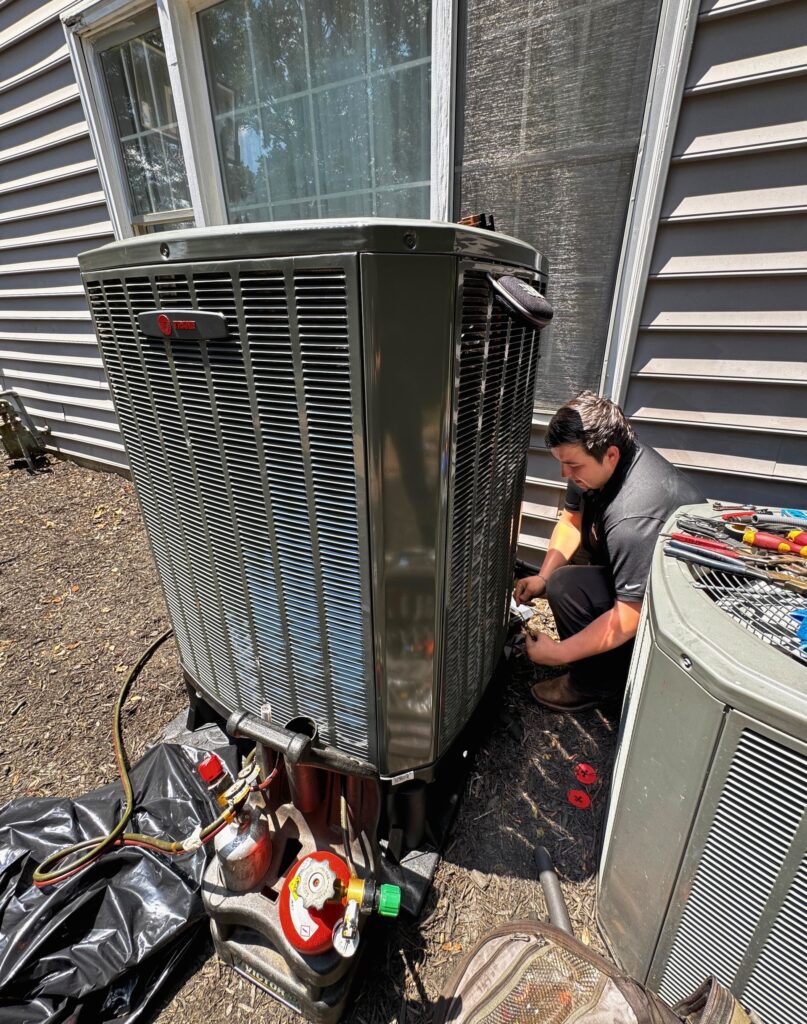
Gas heats close to eight in ten owner homes across 20105, and in Stone Ridge it’s nearer 86 percent. In a gas house the air conditioner is two pieces hung off the furnace: the condenser on its pad outside and a coil on top of the furnace cabinet, borrowing its blower. When the condenser is the piece that quits, the furnace stays, and a new outdoor unit goes in with a coil built to match it. In a ZIP this heavy on gas, that’s the swap most houses need.
Then there’s age. The median owner home in 20105 went up in 2013, so a typical original air conditioner here has a dozen or so summers on it, well short of the roughly 18 years the Energy Department figures on for central air in this climate. Systems that young run on R-410A, which can still be serviced, so a leak or a tired fan motor is usually worth fixing. On a house from the 2010s, the $99 diagnostic comes first, the repair written down beside the replacement range.
Stone Ridge is where the originals run out first. Its median owner home dates to 2009, and the switch from R-22 to R-410A came at the start of 2010, so a condenser that came with one of the earlier Stone Ridge houses may still hold R-22. That refrigerant went out of production in 2020, which turns a leak into a decision. The furnace under that coil is the same age, though, so on a 2009 original it’s worth pricing the pair, $8,898 to $23,000, beside an AC alone, and picking with both numbers in front of you.
Stone Ridge is mostly townhouses, 56 percent of its homes, each condenser on a small pad behind the unit with the neighbor’s a few feet off. The association’s design standards keep a same-spot swap simple: an existing approved air conditioner can be replaced with no application. A new pad, an added unit or a move needs an approved application before the install. In the old village along Route 50, the county’s historic district reviews most exterior changes before work starts, so a condenser headed for a new spot there gets asked about first.